
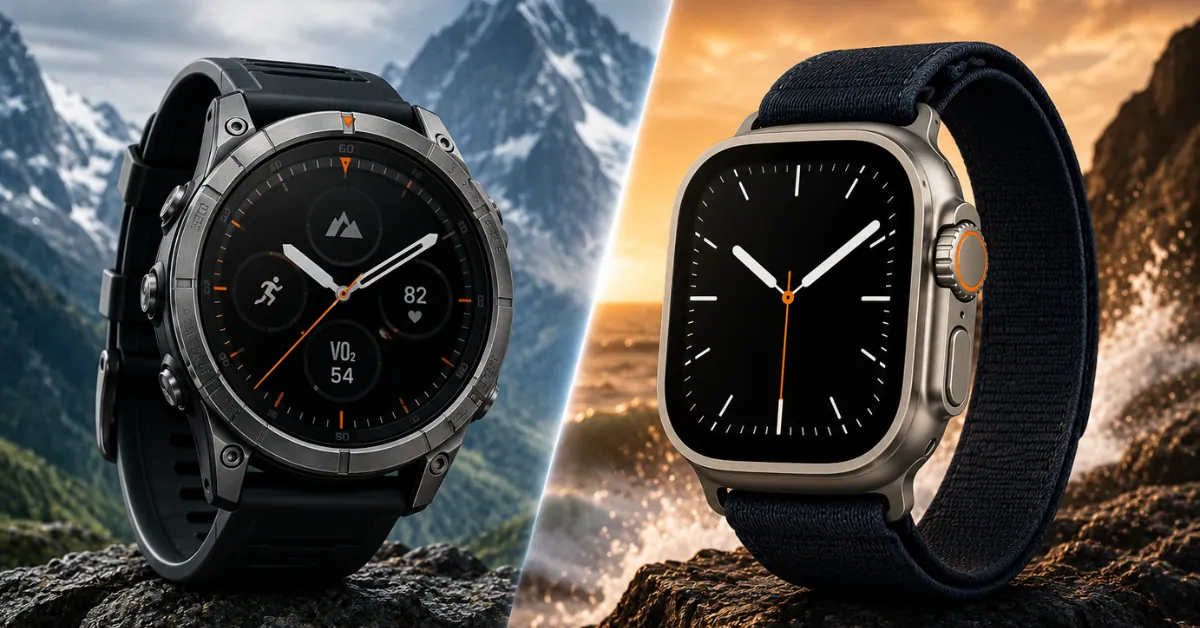
Short answer: Both watches are now fully official. The Fenix 9 launched August 25, 2026, at $999.99, with multi-week battery life confirmed. The Apple Watch Ultra 4 launched September 9, 2026, at $799, keeping its familiar titanium design rather than the “major redesign” some pre-launch reports predicted — and with battery life up to 84 hours in Low Power Mode, a real jump over the Ultra 3. If you have an iPhone and want satellite messaging and the best connected smartwatch experience — the Ultra 4 delivers that at $799, though Touch ID did not make it into this generation. If you need multi-week battery life, full offline topo maps, and the deepest training analytics platform available — the Fenix 9 is the clear choice.
Two watches. Two completely different philosophies. Both now fully specced and shipping.
The Garmin Fenix 9 is built on 30 years of outdoor GPS expertise — the kind of watch you take on a 100-mile ultramarathon through the Rockies knowing it’ll still have battery left when you cross the finish line three days later. The Apple Watch Ultra 4 is built around making your iPhone work on your wrist — tight ecosystem integration, independent cellular, and health sensors Apple has been quietly perfecting for a decade.
Here’s the thing both brands won’t tell you: most people who buy either of these watches don’t actually need them. They’re both overkill for gym workouts and weekend jogs.
But if you do need them — if you’re training seriously, racing long, or spending real time in real backcountry — the differences between these two watches are genuinely significant. Let me break them down.
Garmin officially launched the Fenix 9 and Fenix 9 Pro on August 25, 2026. Apple officially launched the Ultra 4 on September 9, 2026. This comparison is now fully confirmed on both sides — no more estimates, no more “expected” language.
Quick Overview
| Garmin Fenix 9 | Apple Watch Ultra 4 | |
|---|---|---|
| Status | Launched August 25, 2026 | Launched September 9, 2026 |
| Price | $999.99–$1,199 (before optional inReach add-on) | $799 |
| Compatibility | Android + iPhone | iPhone only |
| Ships | Orders opened August 28, 2026 | September 18, 2026 |


Both watches are now confirmed, shipping products. Every spec below is official — no leaks, no estimates.
Full Specs Comparison
| Spec | Garmin Fenix 9 | Apple Watch Ultra 4 |
|---|---|---|
| Price | $999.99 (43/47mm base) · $1,099.99 (51mm base) · $1,099–$1,199 (Pro tier) · +$100 for satellite (Pro only) | $799, all configurations |
| Launch Date | Officially launched August 25, 2026; orders opened August 28 | Officially launched September 9, 2026; ships September 18 |
| Case Material | Titanium bezel + sapphire lens, standard even on base model | Titanium — same core design as Ultra 3, no major redesign |
| Display | AMOLED across the board, over 2x brighter than Fenix 8; Pro AMOLED hits 3,000 nits. Solar/MIP on Pro tier only. No MicroLED. | Retina OLED, Always-On |
| Battery — smartwatch | 10 days (43mm) · 16 days (47mm) · 29 days (51mm base) · up to 291 days power-saving (51mm Pro Solar) | Up to 50 hours normal use, up to 84 hours in Low Power Mode |
| Battery — long workouts | Not separately published; base battery figures cover typical use | Up to 45 hours |
| GPS System | Multi-band GNSS + SatIQ, carried over from Fenix 8 | Dual-band GPS |
| Offline Topo Maps | Full topo maps, with NextFork map guide and smoother rendering | No |
| Touch ID | No | Not included — did not ship despite pre-launch firmware references |
| ECG / AFib | Yes — Garmin ECG app included | Yes |
| Blood Pressure | Not included | Not included — did not ship this generation |
| Satellite Messaging | Pro variant only, +$100, subscription required | Included — expanded features: Apple Maps via satellite, Messages photos via satellite |
| Cellular | Pro variant only (with inReach add-on) | Standard — 5G |
| Water Resistance | 10 ATM + 40m dive rating | 100m, WR50 |
| Works With | Android + iPhone | iPhone only |
| Chip | — | S11, first meaningful performance jump since the S9 in 2023 |
| Training Analytics | Best-in-class — Garmin Coach, Training Readiness, Stamina Metrics, Garmin Epic multi-day activity feature | Good, but not Garmin’s depth |
| App Ecosystem | Garmin Connect IQ | watchOS — best in class |
Design & Display
Both watches are now fully confirmed, and both landed roughly where the more accurate reporting suggested — not where the boldest rumors pointed.

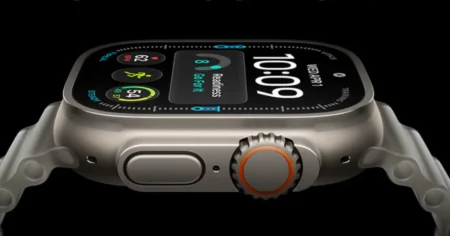
Apple Watch Ultra 4: The widely-reported “15% thinner” redesign did not happen. This resolves a source conflict we tracked closely pre-launch: DigiTimes had described the Ultra 4 as getting a “major redesign,” while Bloomberg’s Mark Gurman said he expected no major design changes. Gurman was right — the Ultra 4 keeps its familiar titanium case, flat display, and Action Button. The real upgrade is under the hood: the new S11 chip, Apple’s first meaningful CPU performance jump since the S9 in 2023.
Garmin Fenix 9: The rumored AMOLED + Power Glass solar hybrid display did not materialize here either. Instead, Garmin shipped a more conventional but still meaningful upgrade: AMOLED across the entire lineup, more than twice as bright as the Fenix 8, with the Pro tier reaching 3,000 nits. Solar/MIP remains a separate option, restricted to the Pro tier — not a combined AMOLED-solar panel. No MicroLED shipped at any price point.
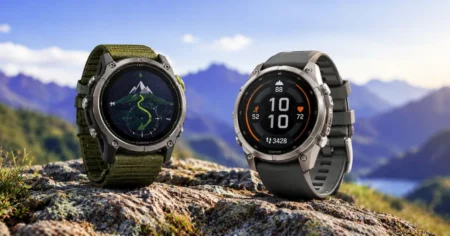
Both watches use titanium. Both have sapphire glass on premium variants. Both are built to take serious abuse.
For everyday wearability: Even without the rumored redesign, the Ultra 4’s existing profile is still comfortable for daily wear, and it’s the watch more people will feel comfortable wearing to work meetings and dinners as well as on trails. Fenix watches have always prioritized ruggedness and functionality over slim profiles.
Design — Both Confirmed, Both More Conservative Than the Rumors Suggested The Fenix 9’s design is fully confirmed: titanium bezel and sapphire lens standard even on the base model, a display over 2x brighter than the Fenix 8. The Ultra 4’s design is also now confirmed — and it’s the same core design as the Ultra 3, not the thinner redesign some reports predicted.
Battery Life
This is the round that decides the comparison for a lot of serious athletes — and it’s still not close, even with the Ultra 4’s confirmed improvement.
Apple Watch Ultra 4: Now confirmed at up to 50 hours of normal use, up to 84 hours in Low Power Mode, and up to 45 hours during long workouts. That’s a real, meaningful jump over the Ultra 3 — bigger than the “no major change” some pre-launch reporting suggested, though not quite the specific “72+ hours” figure some rumors floated as a single number.
Garmin Fenix 9: 10 days at 43mm, 16 days at 47mm, and 29 days at 51mm in the base tier — essentially flat versus the Fenix 8 at those sizes. The real story is the Fenix 9 Pro Solar (51mm): confirmed at up to 57 days of normal use, and an extraordinary 291 days in power-saving mode. That figure has no equivalent anywhere in Apple’s lineup, even with the Ultra 4’s improved numbers.
Here’s the real-world difference that spec sheets don’t capture well: with an Apple Watch Ultra 4, you plan your charging around your training — now more like every 2 days instead of every 1-2 days. With a Fenix 9, you charge when you remember to, sometimes weeks apart. That mental shift matters more than it sounds after a year of wearing either watch.
For endurance athletes specifically: If you’re doing anything longer than 18 hours of continuous GPS use — a 100-mile race, a multi-day alpine route, a bikepacking trip — the Apple Watch Ultra 4, even with its improved battery, is not the right tool. The Fenix 9 is. This is not a close call.
Want to see how Garmin battery compares across their lineup? Read our Garmin Fenix 9 vs Fenix 8 comparison — we break down battery differences across every Fenix variant.
Battery — Confirmed Gap Remains Wide Despite Ultra 4’s Real Improvement 10–29 days smartwatch mode (base) and up to 291 days power-saving (Pro Solar) vs. a confirmed 50–84 hours. The Ultra 4’s battery jump is genuine and worth acknowledging — but the gap for serious endurance use is still measured in days versus hours.
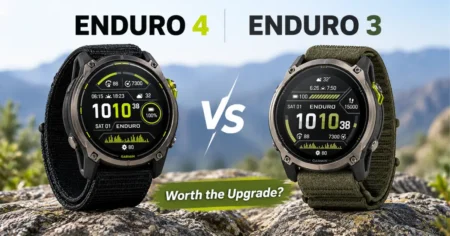
If battery matters most to you, Garmin’s own Enduro 4 goes further than either watch, and here is how it compares with the Fenix 9.
GPS & Navigation
Both watches use dual or multi-band GPS across multiple satellite constellations. In a city, on a road, or on a well-marked trail — they’ll both give you accurate tracks. Where they diverge is in the software layer built on top of that hardware.
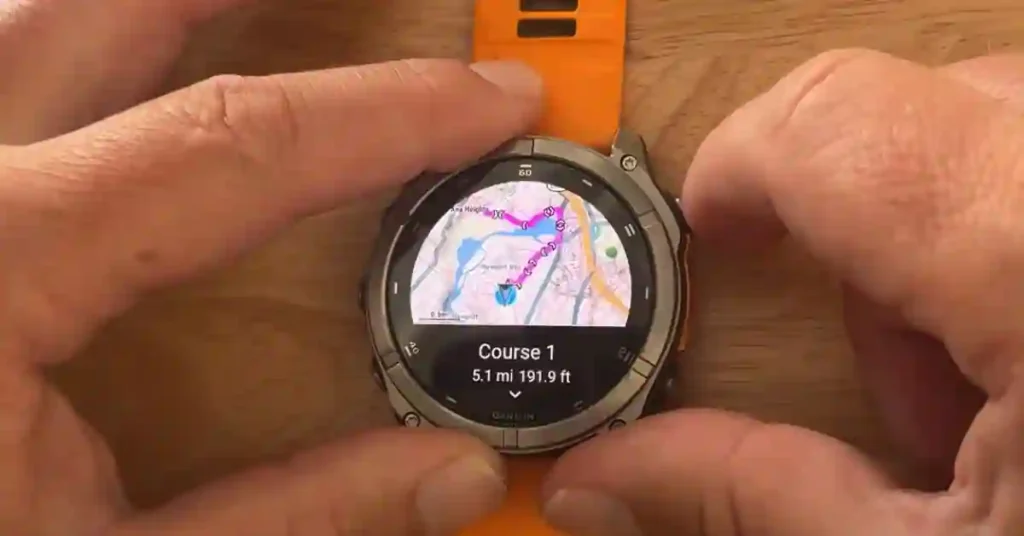
The Fenix 9’s GPS hardware is confirmed: multi-band GNSS with SatIQ, carried over from the Fenix 8. The pre-launch rumor of a third-gen SatIQ or a tri-band hardware upgrade did not appear as a headline spec — Garmin’s official messaging focuses on smoother map rendering and a new NextFork map guide rather than a positioning-accuracy claim.
On top of that, Garmin’s offline topographic maps let you navigate remote terrain turn-by-turn without any phone signal at all. ClimbPro shows you grade, ascent remaining, and pacing guidance in real time during ascents. These are tools that serious trail runners, alpinists, and hikers actually use.
The Apple Watch Ultra 4 has dual-band GPS and the Compass app, which is genuinely useful, plus its now-confirmed expanded satellite features — Apple Maps via satellite and Messages photo support via satellite. But it still does not have offline topo maps. For navigation in areas with reliable cell coverage, it’s fine, and the satellite expansion helps in true dead zones for messaging. For remote terrain where you genuinely need to know where the ridge drops off — you still want the Fenix.
Urban runners: You genuinely won’t notice a GPS difference between these two watches. Both will give you accurate pace, distance, and route data. The Fenix 9’s navigation advantage only matters when you leave the grid behind.
GPS — Fenix 9’s Software Depth Advantage Holds, Ultra 4 Gains Satellite Messaging Offline topo maps, ClimbPro, and SatIQ give the Fenix 9 a real navigation advantage in backcountry terrain. The Ultra 4’s confirmed satellite messaging expansion is a genuine addition for emergency communication, but it’s not a substitute for offline navigation maps.
Health & Training Analytics
This is the most nuanced round — because both watches are excellent, just in different ways, and both sides are now fully confirmed.
Apple Watch Ultra 4 — Confirmed Health Features The Ultra 4 ships with a redesigned Health Sensing System (shared with the Series 12), ECG, and improved heart rate accuracy with dramatically more frequent background readings. Blood pressure monitoring did not ship — despite being the most-discussed pre-launch health rumor across the whole 2026 Apple Watch lineup, it’s absent from both the Series 12 and Ultra 4. Blood glucose monitoring is also not included this generation. Apple’s health platform remains deep and well-integrated with the iPhone Health app and third-party services. Touch ID did not ship either, confirming the “increasingly unlikely” reporting from late in the leak cycle.
Garmin Fenix 9 — Best Training Analytics Platform (Confirmed) Garmin’s training analytics depth is fully confirmed. Body Battery, Training Readiness, Training Load Focus, VO2 max, HRV Status, Recovery Advisor, Race Predictor — Garmin Connect remains the most complete athletic performance platform available on any smartwatch, by a meaningful margin, and the Fenix 9 adds Garmin Epic on top: a feature that compiles multi-day activities into a single story with photos and stats.
The rumored “Muscle Battery” (SmO2) feature and pulse-spectroscopy blood glucose estimation did not ship on the Fenix 9. Garmin’s confirmed health feature set — HRV status, Body Battery, stress tracking, and ECG — is largely a continuation of the Fenix 8’s platform rather than a new health-sensor category.
There’s also a practical difference in how the two platforms give you information. Apple tells you how your body is doing. Garmin tells you how your training is going and what to do about it tomorrow. Both matter. But if performance is your priority over health monitoring, Garmin’s platform still has no equal in a smartwatch.
Interested in Garmin health tracking without the Fenix price? Our Garmin Venu 4 review covers the full Garmin health platform — Body Battery, ECG, HRV, and sleep tracking — at $549.
Health & Training — Both Confirmed Now, Neither’s Biggest Rumor Came True Apple’s blood pressure feature and Garmin’s Muscle Battery/glucose estimation both failed to materialize this generation. What’s left is each platform’s proven strength: Apple’s sensor accuracy and ecosystem integration, Garmin’s training-analytics depth. Know which one matters more to you before spending $799 or $999.
Smart Features & Ecosystem
The Apple Watch Ultra 4 is a genuinely smart watch. Not smart-ish, not smart enough — actually smart. The combination of watchOS, the App Store, cellular independence, Siri AI, and Apple’s hardware integration creates a daily-use experience that Garmin simply doesn’t match.
Siri AI that holds natural conversation, Apple Pay that works, AirPods that auto-switch, notifications that actually replicate your phone, thousands of third-party apps — it’s all there and it all works seamlessly.
The Garmin Fenix 9 is smart enough. Notifications work, Garmin Pay works, music storage and Spotify streaming work. But the Garmin Connect IQ app library is limited, the interface prioritizes function over finesse, and the watch depends more heavily on your phone for a complete experience.
If you want a watch that can genuinely replace your phone for hours at a time — the Ultra 4 with cellular does that, now with an even smarter Siri on top. The standard Fenix 9 doesn’t.
Android users: This comparison ends here. The Apple Watch Ultra 4 does not support Android — at all. If you use an Android phone, the Garmin Fenix 9 is your only option in this comparison. The Fenix works with both iOS and Android equally well.
Smart Features — Ultra 4 Leads by a Clear, Now-Confirmed Margin watchOS app ecosystem, cellular independence, seamless iPhone integration, and the new Siri AI — all now confirmed and shipping for the Ultra 4. Garmin covers the basics well, and confirmed — but basics is still the right word.
Price
The Garmin Fenix 9 pricing is official: $999.99 for the 43mm or 47mm base model, $1,099.99 for the 51mm base, and $1,099–$1,199 for the Fenix 9 Pro tier, with a $100 add-on for satellite messaging on any Pro size. That’s the same base entry price as the outgoing Fenix 8 — no price increase.
The Apple Watch Ultra 4 is now confirmed at $799 — Apple held the price flat for a fourth straight Ultra generation, despite some analysts suggesting $849–$899 was possible given the hardware improvements.
That puts the Ultra 4 at $200–400 less than the Fenix 9, depending on tier. For that lower price, you get genuinely improved smart features, satellite messaging expansion, and Apple ecosystem integration — though not a thinner design or Touch ID, as some pre-launch reports suggested. For the Fenix 9’s price, you get significantly better battery, deeper training analytics, and offline navigation.
Price — Both Confirmed, Ultra 4 Still the Cheaper Watch $799 (confirmed) vs. $999.99–$1,199 (confirmed). No more estimating — the Ultra 4 is definitively the less expensive watch at every tier, by a wider margin than some of the higher Ultra 4 price rumors suggested.
Who Should Buy Which
Buy Garmin Fenix 9 If You…
- Train for ultras, multi-day races, or expeditions
- Use Android — Ultra 4 doesn’t support it
- Need offline topo maps for remote navigation
- Want 20+ days battery between charges
- Rely on Body Battery and Training Readiness daily
- Track GPS activities longer than 18 hours
- Need dive mode (100m rating)
- Want a watch that works independently of phone brand
Buy Apple Watch Ultra 4 If You…
- Use iPhone and live in the Apple ecosystem
- Want cellular independence — calls without phone
- Do serious workouts but not multi-day expeditions
- Value satellite messaging as a safety backup
- Use AirPods, MacBook, or iPad regularly
- Want the deepest third-party app library on a watch
- Prefer saving $200+ at the base level
- Don’t need Touch ID or offline topo maps — neither shipped/exists on this watch
Final Verdict — Garmin Fenix 9 vs Apple Watch Ultra 4
There’s a version of this comparison where I tell you one watch is objectively better than the other. That would be dishonest.
The truth is that these two watches have almost no overlap in who they’re actually built for. The Fenix 9 is built for the person who spends weekends at altitude, trains for events that take more than a day to finish, and needs a watch that functions as a navigation tool — not just a fitness tracker.
The Ultra 4 is built for the serious athlete who also wants the best connected smartwatch experience available for iPhone, in a watch that didn’t get thinner this year but did get a genuinely longer battery and a smarter Siri.
Buy the Garmin Fenix 9 if: You’re a serious outdoor athlete, Android user, or anyone for whom multi-week battery and offline navigation are non-negotiable. The Fenix 9 is the best GPS adventure watch available right now.
Buy the Apple Watch Ultra 4 if: You’re an iPhone user who trains hard but doesn’t need multi-day expedition capability. You’ll get the best connected smartwatch experience on the market and save $200+ at the same time — just don’t buy it expecting Touch ID or a thinner case, since neither made it into this generation.
One final thing worth saying: if your training is mostly gym sessions, road runs, and weekend hikes near civilization — you don’t need either of these watches. Both are purpose-built for specific, demanding use cases. Spending $799–$999+ on a watch you’re using at 30% of its capability is a waste of money regardless of the brand.
Frequently Asked Questions
Is Garmin Fenix 9 better than Apple Watch Ultra 4?
For outdoor athletes who need multi-week battery life, offline topo maps, and precision GPS in remote terrain — yes, the Fenix 9 is better. For iPhone users who want seamless ecosystem integration, cellular independence, and a more refined everyday smartwatch experience — the Ultra 4 is the better choice. Neither is objectively superior. The right one depends entirely on how you train and which phone you carry.
Can the Apple Watch Ultra 4 replace a Garmin Fenix 9 for trail running?
For short to medium trail runs with cell coverage nearby — yes. For multi-day races, remote expedition running, or events requiring 30+ hours of continuous GPS tracking — no. Even with its confirmed battery improvement, the Ultra 4 cannot match the Fenix 9 in GPS-on scenarios, and it still lacks the offline topographic maps needed for remote navigation.
Which has better GPS — Garmin Fenix 9 or Apple Watch Ultra 4?
In urban environments and on marked trails with cell coverage, both are excellent. In remote terrain — canyons, heavy tree cover, high alpine routes — the Fenix 9’s multi-band SatIQ system and offline topo maps give it a clear advantage. The Ultra 4 has no offline navigation maps, though its expanded satellite messaging is a useful safety feature for remote areas.
Is Garmin Fenix 9 worth more than Apple Watch Ultra 4?
The Fenix 9 costs $200–400 more than the Ultra 4, confirmed. Whether that’s worth it depends on what you need from the watch. If battery life, GPS navigation, and training analytics are your priorities — yes. If smart features, cellular connectivity, and Apple ecosystem integration matter more — the Ultra 4 is the better value.
How does the Garmin Fenix 9 compare to the Apple Watch Ultra 4 for swimming?
Both are excellent for swimming. The Fenix 9 is rated to 100 meters with full dive mode support. The Ultra 4 has WR50 water resistance — suitable for swimming and shallow water activities but not certified for diving. For open water swimming and triathlon, both are solid. For actual diving, the Fenix 9 is the only choice.
Related Comparisons
- Garmin Fenix 9 vs Fenix 8 — Is the Upgrade Worth It?
- Apple Watch Series 12 & Ultra 4: Official Specs, Price & Release Date
- Galaxy Watch 9 vs Apple Watch Series 12 (2026)
Both watches in this comparison are now officially launched. The Garmin Fenix 9 launched August 25, 2026, and the Apple Watch Ultra 4 launched September 9, 2026 — every spec above is sourced from each brand’s official product pages, not leaks or estimates. Last updated: September 9, 2026.