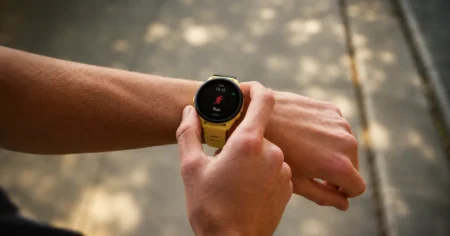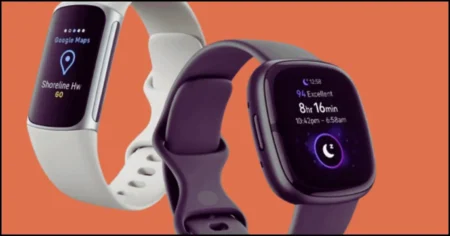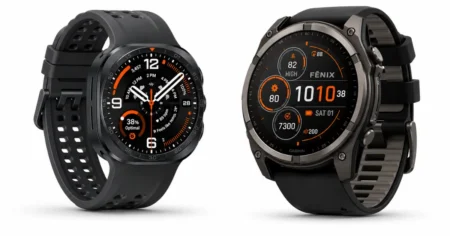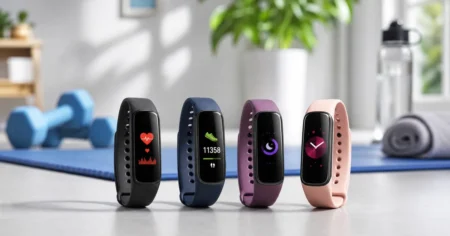

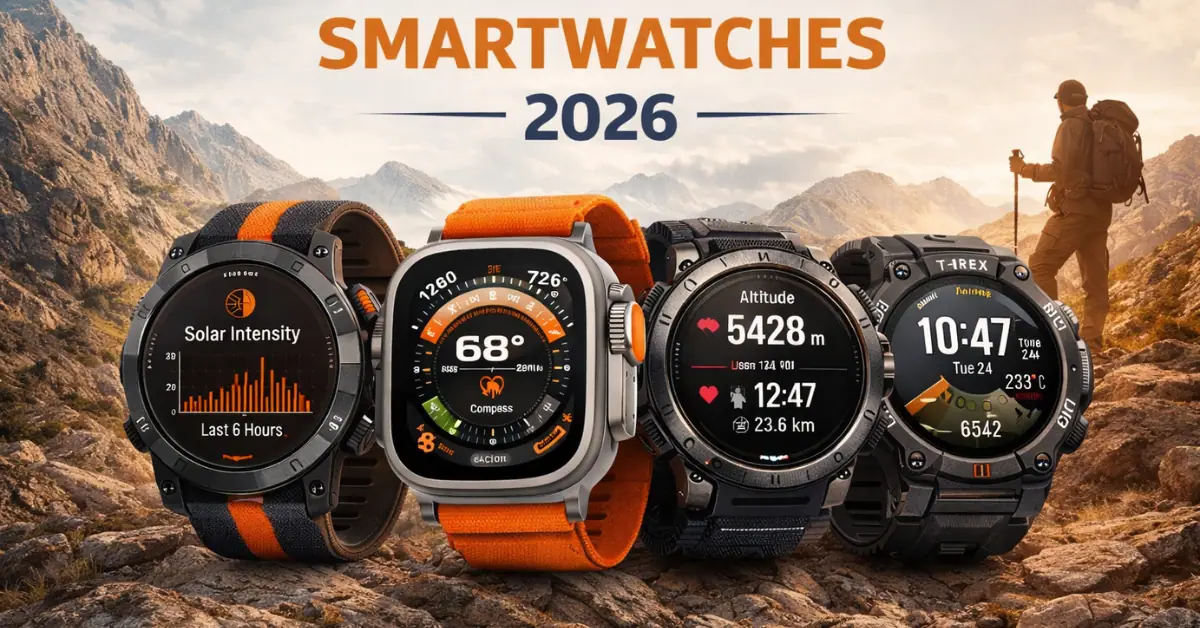
Most smartwatches aren’t built for real life outdoors.
Take one on a trail run in heavy rain, knock it against a rock, or leave it exposed to extreme heat, and the weaknesses of a regular smartwatch quickly become obvious. That’s where rugged smartwatches earn their place.
The good news? In 2026, you don’t have to spend $1,000+ to get one. From affordable options around $179 to flagship adventure watches pushing past $1,000, there’s now a rugged smartwatch for almost every type of outdoor user.
I’ve compared the leading models to find out which ones are actually worth your money. Below, I’ll break down what each watch does best, where it falls short, and who should buy it.
No hype. No spec-sheet padding. Just the watches worth considering in 2026.
Quick Picks (Skip the Scroll)
Not everyone wants to read 14 reviews. If you already know your situation, here’s the fast answer:
| If you want… | Get this |
|---|---|
| The best all-round rugged GPS watch, no budget limit | Garmin Fenix 9 |
| Maximum battery for multi-day expeditions | Garmin Enduro 3 |
| The best watch for iPhone users | Apple Watch Ultra 3 |
| The best watch for Android users | Samsung Galaxy Watch Ultra 2 |
| Strong battery life without solar, under $700 | Coros Vertix 2S |
| Deep training and recovery science | Polar Grit X2 Pro |
| The best value under $450 | Garmin Instinct 3 Solar |
| The toughest, most indestructible option | Casio G-Shock Mudmaster |
| The best budget pick under $230 | Amazfit T-Rex 3 |
Still not sure? Scroll down — every pick below has full reasoning, pros, and cons.
What Actually Makes a Smartwatch “Rugged”?
Before the picks, here’s the framework. These are the five things that separate a genuinely durable smartwatch from a watch that just looks tactical in a product photo.
MIL-STD-810H Certification is the gold standard durability benchmark, established by the U.S. Department of Defence. It covers thermal shock, vibration, altitude, humidity, immersion, shock, and more — all in controlled, measurable tests.
When a brand claims this certification, they’ve submitted their device to documented stress testing, not just written “rugged” in the marketing copy.
Water Resistance Rating matters enormously, and the numbers aren’t interchangeable. IP68 means submersible to a manufacturer-specified depth for 30 minutes.
10 ATM means the watch can withstand pressure equivalent to 100 meters of water depth. 100m depth rating (seen on Coros and Apple Watch Ultra) indicates serious aquatic durability.
200m (Casio Pro Trek territory) is diver-grade. For everyday adventure use, look for a minimum of 5 ATM — anything less, and you’re compromising on something you shouldn’t.
Display Protection separates the serious from the cosmetic. Sapphire crystal is the only scratch-resistant glass worth trusting for hard outdoor use — it scores 9 on the Mohs hardness scale, one step below diamond.
Gorilla Glass is acceptable for moderate use. Mineral glass is better than standard glass. Plastic or “crystal-clear polymer”? Walk away.
Battery Life Under Real Load is where most reviews mislead you. Manufacturers quote battery life in “smartwatch mode” — no GPS, minimal features running.
The number you need is GPS-active hours, and specifically, multi-band GPS hours, which drain batteries fastest. Cold weather can reduce lithium battery capacity by 40%.
Altitude and continuous heart rate monitoring add further drain. Always find real-world GPS battery numbers from users in your climate.
Build Materials and Construction determine whether the watch survives 18 months of real use or just looks impressive in unboxing content. Titanium bezels and cases are lighter and more corrosion-resistant than steel.
Carbon fibre DLC coating adds extreme scratch resistance to titanium. Reinforced polymer cases absorb impact differently from metal. The bezel design — whether it protrudes to protect the glass — is often overlooked and genuinely matters.
The Best Rugged Smartwatches of 2026
1. Garmin Fenix 9 — Best Overall Rugged Smartwatch
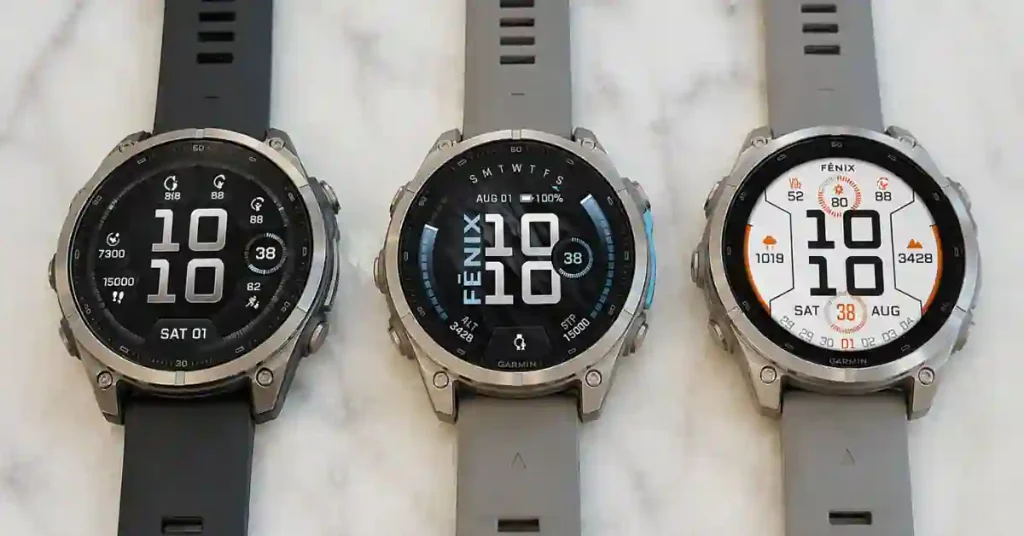
Price: $999.99–$1,099.99 | Display: AMOLED (up to 3,000 nits on Pro), Solar MIP on select Pro sizes | Water Resistance: 10 ATM | Storage: 64GB
Garmin’s flagship line finally got its generational leap. The Fenix 9 and Fenix 9 Pro launched on August 25, 2026, and it’s a meaningfully bigger jump than most Fenix refreshes — enough that it now takes the “Best Overall” spot from the Fenix 8 Solar.
The headline upgrades: an AMOLED display twice as bright as the Fenix 8’s, a first-ever titanium case option, 64GB of storage (double the Fenix 8), 50% more RAM, and up to 30% faster map panning. The Pro inReach variants add standalone satellite messaging without needing a phone nearby — a genuine safety upgrade for backcountry use. The Fenix 9 comes in 43mm, 47mm, and 51mm sizes, so smaller wrists finally get a proper flagship option too.
Feature-wise, it carries forward everything that made the Fenix line dominant — full-colour topo maps, multi-band GNSS, ClimbPro ascent planning, built-in LED flashlight, dive mode, and Garmin’s full training analytics suite (HRV status, Body Battery, Training Readiness, Recovery Advisor). Garmin Connect remains the most mature platform in the category.
The honest trade-off: AMOLED variants will drink more battery than the old MIP-only Fenix 8, and pricing has climbed — the Fenix 9 starts at $999.99, with the Pro at $1,099.99 and up. If you want maximum endurance over screen quality, the Garmin Enduro 3 below is still the better pick.
✅ Pros:
- AMOLED display twice as bright as Fenix 8, with a first-ever titanium case
- 64GB storage, 50% more RAM, faster map engine
- Standalone satellite messaging on Pro inReach variants — no phone required
- Full Garmin outdoor and training suite: topo maps, multi-band GNSS, ClimbPro, dive mode, HRV/Body Battery
- 10 ATM water resistance + full MIL-STD-810H certification
❌ Cons:
- Starting price $999.99, with Pro models over $1,000
- AMOLED power draw means battery life won’t match MIP-only Garmin watches
- Heavy and bulky for everyday casual wear
- Menu depth can still feel like a lot to learn for new users
Best for: Hikers, mountaineers, trail runners, ultra marathoners, triathletes, and anyone who wants Garmin’s most complete outdoor tool with a modern display.
Not sure which Fenix 9 to choose? Check our Fenix 9 Size & Tier Guide for a quick breakdown of sizes, tiers, prices, and our recommended pick.
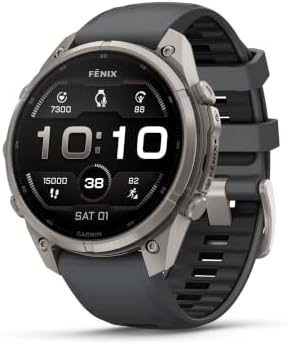
Still using a Fenix 7 or Fenix 7 Pro? Our Fenix 9 vs Fenix 7 / 7 Pro upgrade guide explains whether those upgrades are enough to justify replacing your current watch.
2. Garmin Enduro 3 — Best Rugged Smartwatch for Endurance Athletes
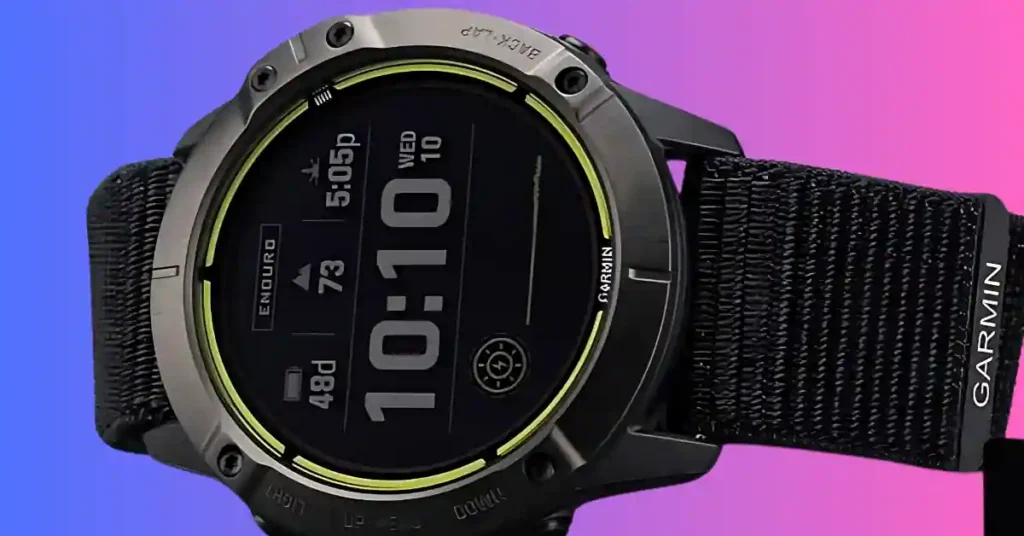
Price: ~$799–$899 | GPS Battery: Up to 320 hours (solar), 120 hours GPS-only | Water Resistance: 10 ATM | Display: MIP with Power Sapphire solar
If the Fenix 9’s screen made you do a double-take, the Enduro 3 will make you question everything you thought you knew about watch charging. 320 hours of solar GPS. 120 hours of GPS-only operation without solar assist. 90 days of smartwatch mode.
These aren’t theoretical figures — tested against real northern hemisphere outdoor conditions, the Enduro 3 delivers endurance performance that changes how you think about expedition planning.
The build is quietly premium: a carbon grey DLC-coated titanium bezel with exceptional scratch resistance, Power Sapphire crystal, and at just 63 grams, one of the lightest full-featured ultra performance GPS watches available. For ultra marathon and trail athletes who suffer from wrist fatigue during 24-hour events, that weight matters.
The Enduro 3 carries over nearly the full Fenix feature set — full-colour topo maps, multi-band GNSS, dynamic round-trip routing, ClimbPro, and the LED flashlight that’s become essential kit on predawn trail starts. It’s priced well below the Fenix 9 while offering comparable capability with superior battery endurance.
Where it doesn’t compete: no AMOLED display option, no dive mode, and the same menu navigation sluggishness present throughout the Garmin solar lineup.
✅ Pros:
- Industry-leading battery: 320 hours solar GPS, 120 hours GPS-only, 90 days smartwatch mode
- DLC-coated titanium bezel with exceptional scratch resistance
- Featherlight 63 grams — one of the lightest full-featured ultra performance GPS watches
- Full-colour topo maps, multi-band GNSS, ClimbPro, and LED flashlight included
- Priced lower than Fenix 9 with comparable core capability
❌ Cons:
- No AMOLED display option — MIP only
- No dedicated dive mode
- Same sluggish menu navigation as the broader Garmin solar lineup
- Large form factor — not a subtle or lifestyle-friendly daily watch
Best for: Ultra-endurance athletes, expedition runners, multi-day adventure racers, and fastpacking athletes who refuse to carry a charging cable.

The Garmin Enduro 4 has officially launched, bringing Garmin’s latest rugged smartwatch to the lineup. The Enduro line keeps the same battery across generations, so see how the Enduro 4 and Enduro 3 compare before choosing one.
Wondering how it compares with Garmin’s other rugged flagship? See our full Enduro 4 vs. Fenix 9 comparison to find out which watch is the better fit for your needs.
3. Apple Watch Ultra 3 — Best Rugged Smartwatch for iPhone Users
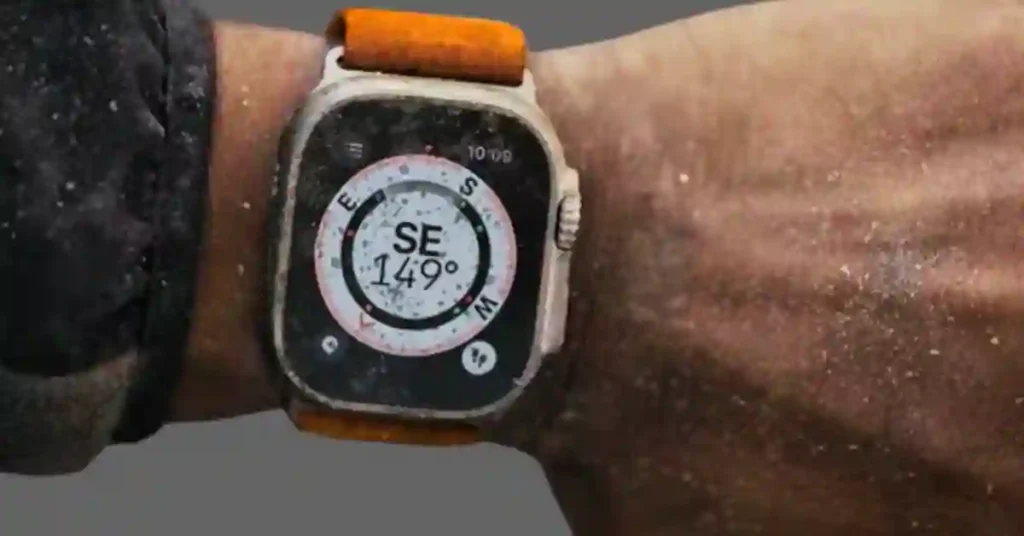
Price: ~$799 | GPS Battery: ~36 hours typical | Water Resistance: 100m rated | Display: AMOLED (LTPO), 2000+ nits
The Apple Watch Ultra 3 is the most capable smartwatch on this list from a daily-life perspective, and it’s legitimately rugged.
Titanium case, flat sapphire crystal protected by a raised bezel, and aluminium alloy case midframe give it a build that’s been tested against the same kinds of stress as dedicated outdoor watches.
What makes the Ultra 3 unique in this category is its refusal to ask you to choose between a connected smart life and outdoor capability. watchOS app ecosystem, cellular calling and messaging, Apple Maps, Siri, Apple Pay, satellite emergency SOS, Crash Detection — none of the dedicated GPS watches come close to this experience. If you spend 70% of your time in daily life and 30% outdoors, this watch threads that needle better than anything else here.
Dual-frequency GPS, precision compass, depth gauge to 40 meters for certified scuba diving, and a wide sport mode library make this a serious outdoor instrument, not just a tough-looking Apple Watch.
Battery life, while meaningfully improved from Ultra 2, remains the category weakness — approximately 36 hours of typical smart use, less with intensive GPS. For multi-day expeditions, you’ll need to plan charging. iOS-only compatibility is the other hard limit.
✅ Pros:
- Best smartwatch ecosystem on the market — apps, Siri, Apple Pay, cellular, satellite SOS
- Gorgeous 2000+ nit AMOLED display, easily readable in direct sunlight
- Titanium case, sapphire crystal, depth gauge to 40m — genuinely rugged build
- Dual-frequency GPS and Crash/Fall Detection for passive safety
- Most polished UI and daily-life usability of any watch on this list
❌ Cons:
- ~36 hours GPS battery — requires charging on multi-day expeditions
- iPhone only — Android users cannot use this watch
- Lacks the deep navigation, training analytics, and route tools of dedicated GPS brands
- Premium price for what is still fundamentally a smart lifestyle watch with outdoor capability
Best for: Active iPhone users, adventurous travelers, trail hikers, triathletes, and anyone who needs both smart connectivity and genuine outdoor durability.
![Apple Watch Ultra 3 [GPS + Cellular 49mm] Running & Multisport Sm...](https://m.media-amazon.com/images/I/41H6S7vjc+L._SL500_.jpg "Best Rugged Smartwatches (2026): Garmin, Apple, Samsung Tested 6")

Ultra 3 or wait for Ultra 4? If you’re considering an upgrade, our Apple Watch Ultra 4: Redesign Now Contested (2026 Update) covers the latest redesign reports, rumored features, and what remains uncertain.
4. Coros Vertix 2S — Best Battery Life (Non-Solar)
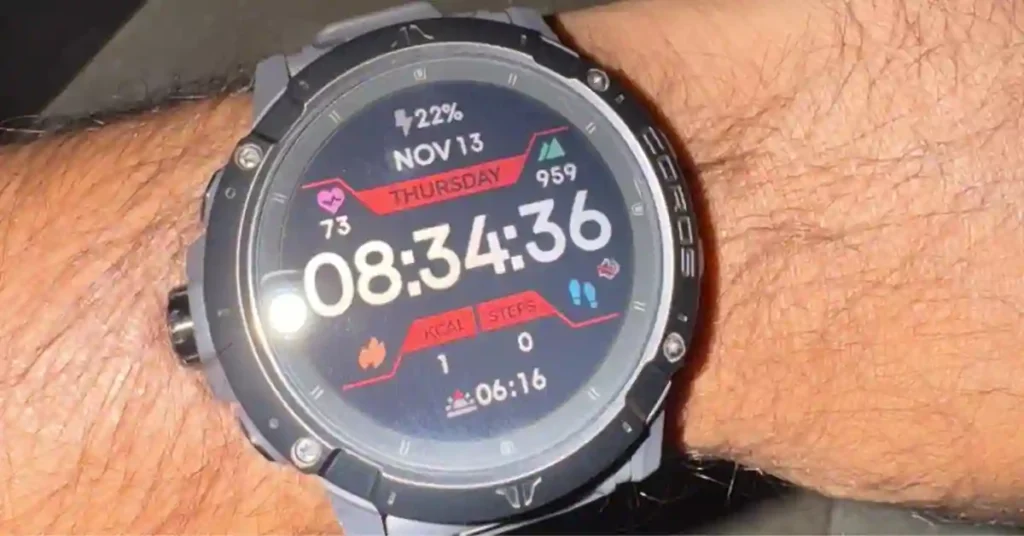
Price: ~$699 | GPS Battery: Up to 140 hours standard GPS, 90 hours multi-band | Water Resistance: 100m | Display: MIP
Coros has built its entire reputation on a single principle: put the battery first, then build everything else around it. The Vertix 2S is the fullest expression of that philosophy in 2026, and the results are genuinely impressive.
140 hours of standard GPS. 90 hours of multi-band GPS. 60 days of smartwatch mode. These numbers make multi-day mountain missions, thru-hikes, and ultra-distance events completely stress-free from a charging standpoint. No solar dependency, no power-mode rationing — just run.
The titanium bezel and sapphire crystal come standard across all Vertix 2S configurations, which is a direct contrast to Garmin’s tiered pricing model, where premium materials cost more.
The scroll dial interface is an underrated advantage in wet and cold conditions when touchscreens become unreliable — the Vertix 2S can be operated with wet hands, thick gloves, or ski mittens without issue.
GPS accuracy is consistently strong, thanks to a redesigned antenna that improved meaningfully on the original Vertix 2’s first-generation multi-band implementation. Real-world track accuracy in dense forest canopy and canyon terrain is excellent.
What you don’t get: a bright display (MIP only), no LED flashlight, limited third-party app integration compared to Garmin, and breadcrumb-style navigation rather than full map routing. No ANT+ sensor compatibility either, which matters to athletes using power meters or speciality chest straps.
✅ Pros:
- 140 hours standard GPS, 90 hours multi-band — the non-solar battery king
- Titanium bezel and sapphire crystal standard across all configurations (no upgrade tier needed)
- The scroll dial works perfectly in wet, cold, and gloved-hand conditions
- Excellent GPS track accuracy in dense forest and complex terrain
- 100m water resistance with no compromises
❌ Cons:
- MIP display only — no AMOLED option
- No LED flashlight built in
- No ANT+ sensor compatibility (rules out many cycling power meters and chest straps)
- Breadcrumb navigation, not full turn-by-turn map routing
- Coros ecosystem has fewer third-party integrations than Garmin Connect
Best for: Ultra-runners, thru-hikers, expedition athletes, and endurance competitors whose primary requirement is maximum GPS operation time between charges.
5. Garmin Tactix 8 — Best Rugged Smartwatch for Tactical Use
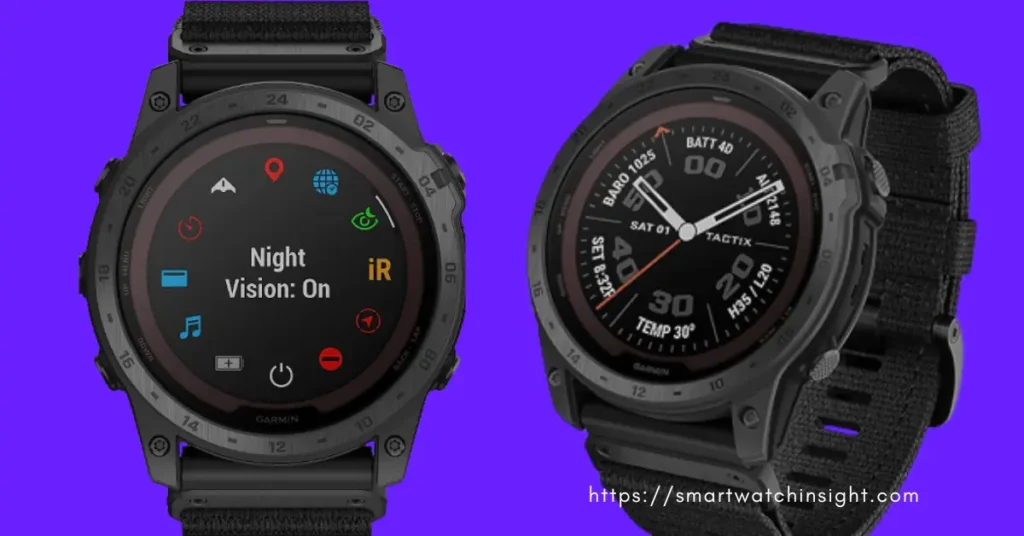
Price: ~$1,099–$1,299 | GPS Battery: Up to 29 days AMOLED mode | Water Resistance: 10 ATM | Display: AMOLED or MIP Solar (variant dependent)
The Tactix 8 takes the Fenix platform and adds a specialised feature set built explicitly for military, law enforcement, and tactical professional use cases. The hardware is premium: titanium bezel, sapphire crystal, MIL-STD-810H certified, and 10 ATM water-rated. The built-in LED flashlight is bright enough to be operationally useful.
Where the Tactix 8 separates itself is in the tactical software layer. Jumpmaster mode for precision parachute operations, waypoint projection, kill switch for remote data wipe, full stealth mode that disables all wireless transmission, dual-position GPS format display, and night-vision goggle compatibility are not marketing gimmicks for this user base — they are job requirements. The Applied Ballistics Elite solver on certain configurations turns this watch into a functional ballistics computer that athletes use in precision rifle competition.
For the users it was designed for, there’s nothing else in this category.
The honest caveat: If you’re buying this as a tough outdoor watch and don’t actually use the tactical feature set, the Fenix 9 delivers equivalent (and now better-screened) adventure capability at a similar or lower price. The Tactix premium is in the specialized software. A tactix 9 hasn’t been announced yet — based on Garmin’s past cadence, expect it in early-to-mid 2027, several months after the Fenix 9 launch.
✅ Pros:
- Unique tactical features: stealth mode, kill switch, Jumpmaster, Applied Ballistics Elite
- Night-vision goggle compatibility and dual-position GPS display
- Premium titanium/sapphire build with LED flashlight
- Full Garmin outdoor navigation suite (maps, ClimbPro, multi-band GNSS)
- Trusted by actual military and law enforcement professionals
❌ Cons:
- Tactical feature set wasted (and overpriced) for users who don’t need it
- AMOLED variant cuts battery life significantly vs MIP Solar version
- Heaviest and bulkiest watch on this list
- Near-identical outdoor capability to Fenix 9 at a higher cost, on older screen tech
Best for: Military personnel, law enforcement, search and rescue operators, and precision sport shooters.
Note: Garmin’s next tactical model, the tactix 9, has already surfaced in a regulatory filing — if you can wait, it may be worth checking before buying the tactix 8.

If you need a watch that can handle tougher conditions, take a look at our Best Tactical Smartwatches of 2026 roundup. We’ve compared the top options for durability, GPS, battery life, and off-grid features.
6. Suunto Vertical — Best Mid-Range Rugged Adventure Watch
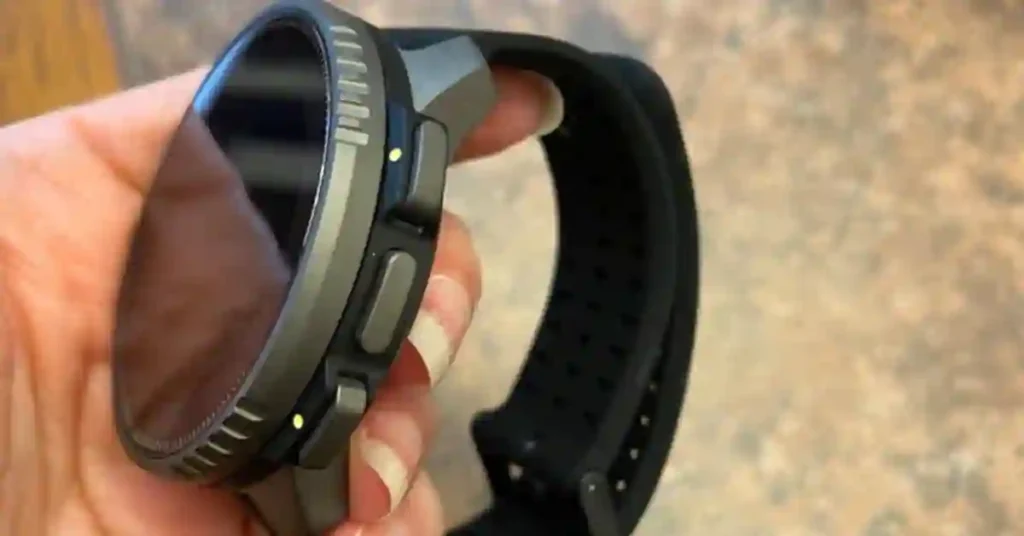
Price: ~$499–$629 | GPS Battery: Up to 60 hours GPS | Water Resistance: 100m | Display: MIP, Sapphire crystal
The Suunto Vertical is the watch that made people take the Finnish brand seriously again. After years of playing second fiddle to Garmin in the outdoor adventure category, Suunto refined its interface to a level that rivals the most intuitive watches in the space — and paired it with a hardware package that justifies serious consideration.
The construction is built around a stainless steel one-piece molded case with a sapphire crystal lens as standard. At 74 grams, it’s heavier than the Enduro 3 but lighter than several competitors in this price range. MIL-STD-810H certification covers temperature shocks, drops, pressure, sand, ice, and salt exposure — a full testing suite, not a selective one.
What the Vertical does particularly well is offline topographic mapping. The map interface is clean, readable, and genuinely usable as a primary navigation tool — not just a reference screen.
Navigation prompts are clear, and the back-to-start function works reliably. The interface has been simplified to a degree that new users are comfortable within hours, not days.
At $499–$629, the Vertical positions itself as a genuine Garmin Enduro 3 competitor at a significantly lower price, accepting battery life trade-offs (60 hours vs 120+ hours GPS) in exchange for value. For athletes who charge between adventures and don’t need extreme endurance, this trade is entirely reasonable.
✅ Pros:
- Clean, intuitive navigation interface — usable by new users within hours
- Offline topographic maps that are genuinely readable and reliable
- Full MIL-STD-810H certification across extensive test categories
- Sapphire crystal lens as standard across all configurations
- 100m water resistance with a stainless steel one-piece molded case
❌ Cons:
- 60 hours of GPS battery trails the Enduro 3 and Coros Vertix 2S considerably
- Heavier than comparable titanium watches at 74 grams
- Suunto’s ecosystem lacks Garmin Connect’s depth of third-party integrations
- MIP display — no AMOLED variant available
- Training analytics are less comprehensive than those of Garmin or Polar
Best for: Weekend trail runners, hikers, adventure athletes who charge regularly, and anyone who wants near-flagship outdoor capability without the flagship price.

7. Samsung Galaxy Watch Ultra 2 — Best Rugged Smartwatch for Android Users
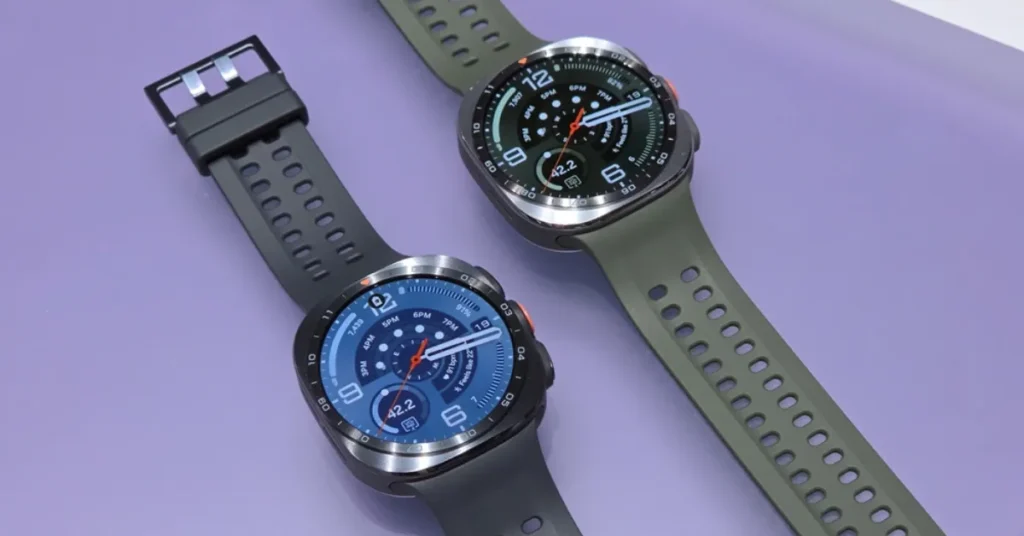
Price: $699.99 (47mm LTE) | GPS Battery: Improved multi-day endurance from a larger 800mAh battery | Water Resistance: 10 ATM, EN13319 recreational-diving certified | Display: AMOLED, up to 5,000 nits peak brightness
Samsung officially unveiled the Galaxy Watch Ultra 2 on July 22, 2026, with general availability from August 7, 2026 — it replaces the original Galaxy Watch Ultra as the brand’s rugged flagship. The redesign is a genuine step forward, not just a spec bump: a slimmer 10.7mm titanium case, an 800mAh battery (up meaningfully from the original), a display peaking at 5,000 nits, and Qualcomm’s new Snapdragon Wear Elite chip for smoother performance and on-device AI features, including raise-to-talk Gemini.
Diving credentials also improved — the Ultra 2 adds EN13319 recreational-diving certification on top of the same 10 ATM and MIL-STD-810H rating the original carried.
The full Samsung Health platform and Wear OS integration mean Google Maps, Spotify, Google Pay, and the Android ecosystem are fully accessible — a feature set no Garmin or Coros can match. Fitness tracking is comprehensive: FTP testing, multi-sport chaining, and a full health sensor suite, now backed by Samsung’s overhauled Health app that centers on five areas — Sleep, Activity, Nutrition, Mindfulness, and Vitals — with AI-driven insights.
The design still borrows liberally from Apple Watch Ultra in form factor, and dual-frequency GNSS provides accuracy comparable to the dedicated outdoor brands in most conditions. Battery life, while improved, still trails dedicated outdoor watches — expect multi-day smart use rather than week-plus endurance.
✅ Pros:
- Best rugged smartwatch option for Android users — full Wear OS + Samsung Health
- Larger 800mAh battery and 5,000-nit AMOLED display — meaningful upgrades over the original Ultra
- New Snapdragon Wear Elite chip enables on-device AI without needing the phone
- EN13319 diving certification added on top of 10 ATM water resistance
- Google Maps, Spotify, Google Pay, and the Android ecosystem are fully accessible
❌ Cons:
- Multi-day smart battery life — still far shorter than dedicated outdoor brands
- Optimized for Samsung/Android — limited functionality on iOS
- Training analytics and navigation tools don’t match Garmin or Coros depth
- Wear OS can feel inconsistent in UI execution compared to dedicated GPS platforms
Best for: Android users who want a premium rugged smartwatch with full smart connectivity and ecosystem integration.

For a closer look at the watch, read our Samsung Galaxy Watch Ultra 2 full review, covering its design, performance, health features, battery life, and overall value.
8. Polar Grit X2 Pro — Best Rugged Smartwatch for Training Analytics
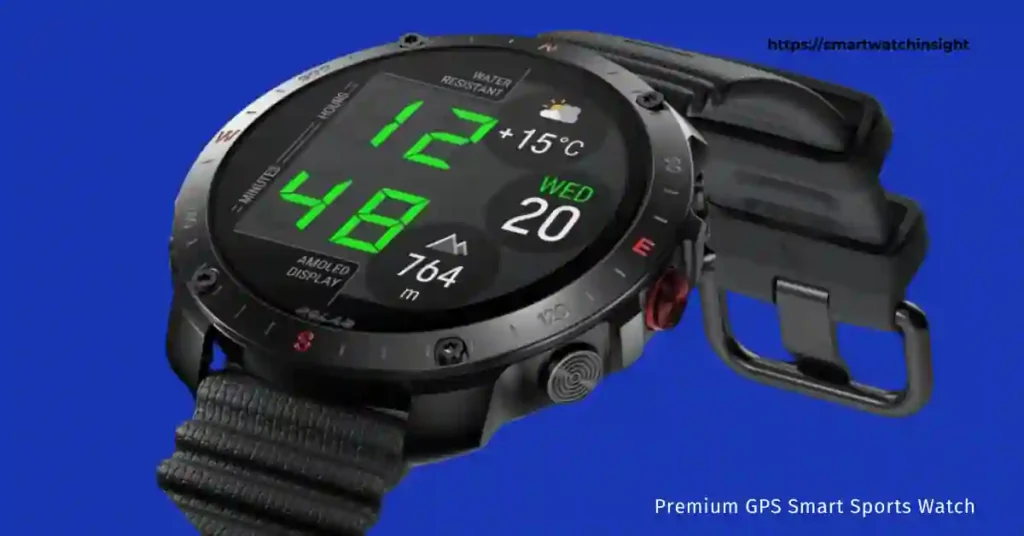
Price: ~$749–$869 | GPS Battery: Up to 43 hours dual-frequency GPS | Water Resistance: 100m | Display: AMOLED, 1.39-inch, 1050 nits
Polar doesn’t get the credit it deserves in the rugged smartwatch conversation, and the Grit X2 Pro is the clearest evidence of that gap. This is a serious outdoor watch with serious training science built in — and it’s priced more accessibly than Garmin’s comparable tier.
The 1.39-inch AMOLED display is one of the best screens in this category — 1050 nits of brightness, 326 PPI resolution, and sapphire crystal protection.
Where Polar genuinely leads is in training and recovery science. Training Load Pro, Recovery Pro, Orthostatic Test for physiological recovery assessment, and Nightly Recharge are built on years of Polar’s sports science research — and they work.
Athletes who use these features seriously get training guidance that’s more scientifically grounded than most competitors offer.
The standard stainless steel model weighs 79 grams; the Titan edition drops to 64 grams and comes in at ~$869. Both carry MIL-STD-810H certification across multiple test categories and 100m water resistance.
Battery life at 43 hours, dual-frequency GPS is competitive but not exceptional. Polar’s closed ecosystem means fewer third-party app integrations than Garmin.
✅ Pros:
- Stunning 1.39-inch AMOLED display (1050 nits, 326 PPI) — best screen at its price tier
- Industry-leading training and recovery science: Training Load Pro, Orthostatic Test, Nightly Recharge
- Dual-frequency GPS with consistently strong accuracy
- 100m water resistance and MIL-STD-810H certified
- Titan edition drops weight to 64g while keeping a premium sapphire crystal
❌ Cons:
- 43 hours GPS battery trails most dedicated outdoor watches
- Polar Flow ecosystem is closed — fewer third-party app integrations than Garmin
- Navigation tools less developed than Garmin or Coros equivalents
- Higher price for the Titan edition (~$869) pushes into flagship territory
Best for: Serious endurance athletes, triathletes, and data-driven competitors who want premium AMOLED outdoor hardware with deep recovery science.

9. Garmin Instinct 3 Solar — Best Value Rugged Smartwatch
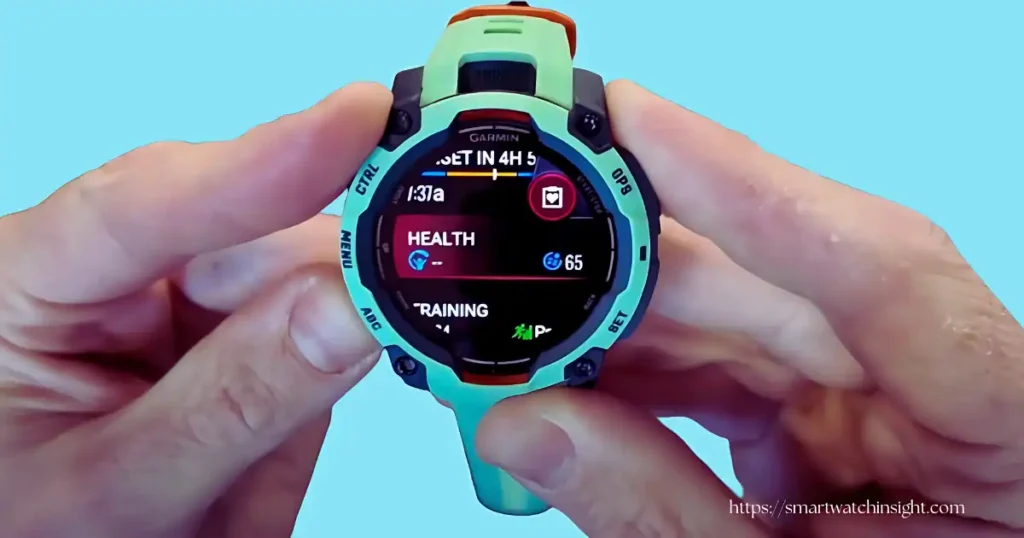
Price: ~$349–$449 | GPS Battery: Up to 50 hours GPS | Water Resistance: 10 ATM | Display: MIP Solar
The Instinct 3 Solar is where Garmin makes outdoor durability accessible without stripping out the things that matter most. MIL-STD-810H certified, 10 ATM water rated, solar-charging Power Glass — all at under $450.
The jump from the previous Instinct 2 Solar added multi-band GPS as standard, which was one of the key weaknesses holding that generation back in challenging signal environments.
The design is intentionally utilitarian — a monochrome MIP display in a polymer case, thick enough to survive drops but light enough for full-time wear. It’s not trying to compete aesthetically with the Fenix line, and it shouldn’t. At this price tier, it competes on reliability and feature depth.
The feature depth is real. Three-axis compass, barometric altimeter, GPS/GLONASS/Galileo/BeiDou with multi-band accuracy, Garmin’s full training load and health tracking suite scaled to this price, and smart notifications.
Solar charging in adequate sunlight conditions can meaningfully extend day-to-day battery life, making this watch genuinely manageable for multi-day outdoor use without obsessive charging.
Compromises at this price: no color maps, no AMOLED, no dive mode, less deep training analytics than the Fenix line. For hikers and trail runners who don’t need a wrist-based map display, these are perfectly acceptable trade-offs.
✅ Pros:
- Multi-band GPS standard — a major upgrade over the previous Instinct 2 Solar generation
- Solar charging meaningfully extends daily battery in outdoor conditions
- MIL-STD-810H certified with 10 ATM water resistance at an accessible price
- Full Garmin health suite: heart rate, Pulse Ox, Body Battery, sleep tracking
- Lightweight polymer case — comfortable for full-time everyday wear
❌ Cons:
- Monochrome MIP display only — no color maps or AMOLED option
- No dive mode and fewer advanced training analytics vs Fenix and Enduro lines
- Solar charging less impactful in winter or low-light climates
- The polymer case feels less premium than the titanium alternatives
Best for: Budget-conscious hikers, trail runners, campers, outdoor workers, and anyone who wants solid GPS durability in the sub-$450 range.

If you don’t need rugged, outdoor-grade tools, our Garmin Venu 5 release date and buying guide covers Garmin’s more everyday-friendly option.
10. Coros Nomad — Best Rugged Smartwatch for Hikers and Fishing
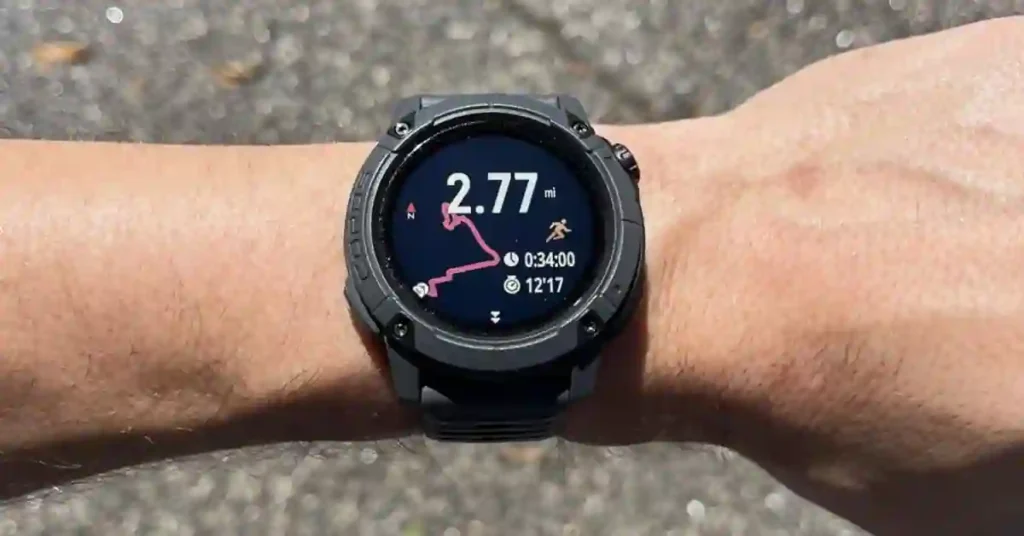
Price: ~$399 | GPS Battery: Up to 50 hours all-systems GPS | Water Resistance: 100m | Display: MIP touchscreen, 1.3-inch
Launched in mid-2025, the Coros Nomad represents a genuinely new category entry from Coros — an outdoor hiking and adventure watch with a built-in voice memo recorder, a feature that seems obvious in retrospect but no other mainstream rugged watch offers.
The ability to record voice notes with location tags during a hike — pinning audio memories of a summit, a turn, a campsite, a fishing spot — is the kind of thoughtful outdoor feature that trail users immediately understand.
Combined with clear turn-by-turn color map navigation, waypoint marking, a back-to-start function, and solid Coros app data analysis, this watch is built around actual outdoor use patterns rather than lab-designed spec checklists.
The 1.3-inch MIP touchscreen is easy to read in direct sunlight and contributes to the strong battery performance — 50 hours of all-systems GPS or three weeks of daily smartwatch use. The build is rugged enough for backcountry use, and the 100m water rating handles rivers, rain, and water crossings without concern.
The Nomad won’t win on training analytics or smart features. But for hiking, trail navigation, fishing, and general outdoor exploration, it brings a set of thoughtfully designed tools at a price that makes the decision easy.
✅ Pros:
- Unique built-in voice memo recorder with GPS location tags — no other rugged watch offers this
- Color map navigation with turn-by-turn routing and back-to-start
- 50 hours all-systems GPS with 3-week smartwatch battery life
- 100m water resistance — handles river crossings, rain, and paddling
- Thoughtfully designed around real outdoor use patterns, not spec-sheet optimization
❌ Cons:
- Limited training analytics — not designed for serious performance athletes
- Smart notification experience is basic
- MIP display only — no AMOLED
- No ANT+ compatibility
Best for: Hikers, backcountry travelers, fishing and hunting enthusiasts, and outdoor explorers who want purpose-built adventure navigation at a reasonable price.
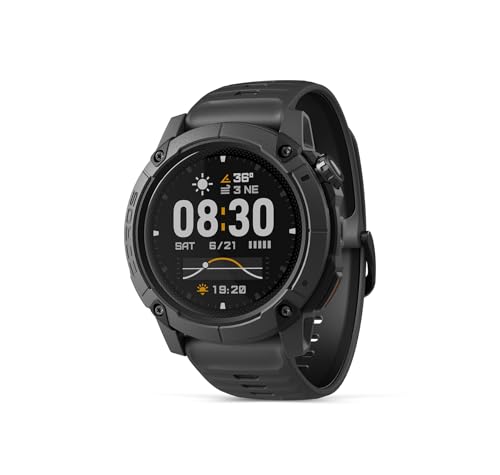
11. Casio G-Shock Mudmaster GG-B100 — Most Rugged Watch on This List
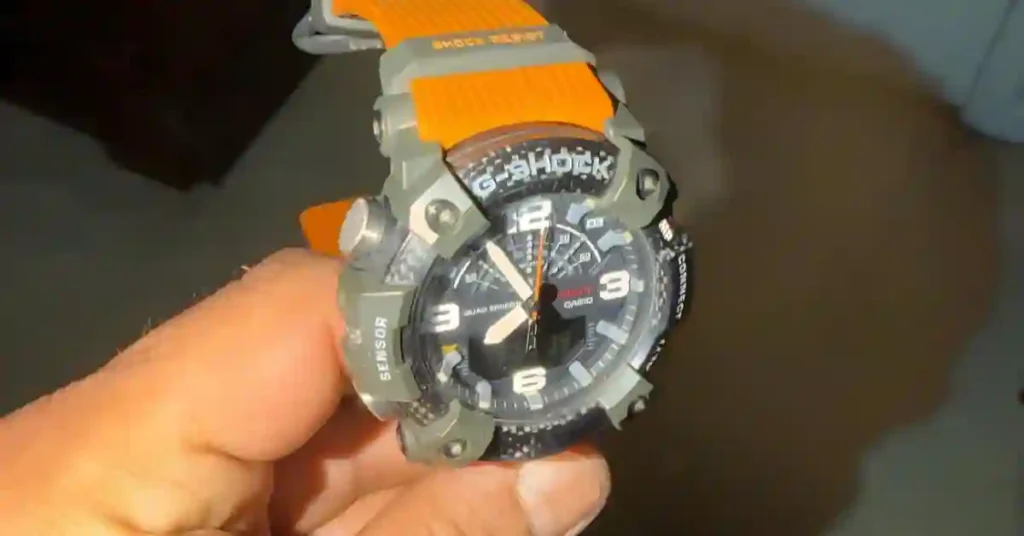
Price: ~$250–$350 | GPS Battery: N/A (Bluetooth connected, no built-in GPS) | Water Resistance: 200m | Display: Mineral glass, digital
When the question is purely “what is the toughest thing you can put on your wrist in 2026,” the answer might not be the most expensive watch — it might be this one. The Casio G-Shock Mudmaster GG-B100 is an anomaly in this category, and intentionally so.
The case uses what Casio calls Carbon Core Guard construction — a carbon fibre-reinforced resin frame inside the outer case layer that absorbs and distributes impact energy in a way no metal watch can replicate. 200 meters of water resistance exceeds every other watch on this list.
The protruding bezel physically guards the mineral glass from direct impact. It is, by almost every structural metric, the most physically rugged device here.
What you’re trading for that indestructibility: this is not a smartwatch in the conventional sense. There’s no onboard GPS, no heart rate monitor, no app ecosystem.
Instead, you get a magnetic compass, altimeter, barometer, accelerometer, gyro meter, step counter, and thermometer. GPS tracking is possible via phone Bluetooth connection.
For users in industrial environments, military adjacent roles, or anywhere the primary requirement is survival and secondary requirement is activity logging, the Mudmaster occupies a category of one.
✅ Pros:
- Carbon Core Guard construction absorbs impact better than any metal case
- 200m water resistance — highest on this entire list
- Magnetic compass, altimeter, barometer, accelerometer, thermometer all built in
- Protruding bezel physically guards the display from direct impact
- Affordable price for an indestructible, professionally tested tough watch
❌ Cons:
- No onboard GPS — requires phone Bluetooth connection for GPS tracking
- No heart rate monitor, no health tracking, no smartwatch features
- Companion app is clunky and unintuitive
- Digital-only display is functional but visually dated
Best for: Industrial workers, military personnel, construction professionals, and anyone who prioritizes absolute physical durability above all else.


12. Casio Pro Trek PRW3500 — Best Solar-Powered Rugged Watch Without Smartwatch Features
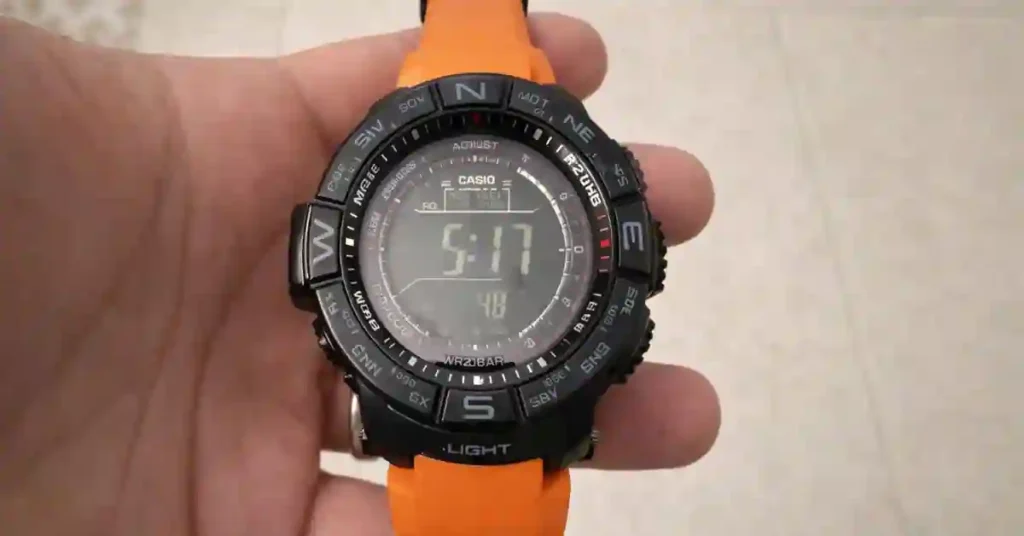
Price: ~$350–$450 | GPS Battery: N/A (no onboard GPS) | Water Resistance: 200m | Display: Digital/analog hybrid
The Pro Trek PRW3500 is a different kind of entry on this list — a solar-powered ABC watch (altimeter, barometer, compass) that has been a trusted backcountry companion since its launch and continues to hold relevance in 2026 for a specific user.
No GPS. No heart rate. No apps. What it has instead: unlimited battery life through solar charging, 200m water resistance, a rotating bezel for navigation, precise barometric altitude tracking, a digital compass, and multi-band radio time syncing for accuracy.
In terms of pure outdoor instrument reliability, this watch has virtually no failure points. Solar means no dead battery scenarios. Simple sensor-focused design means nothing complex to malfunction.
For hikers who want a compass, altimeter, and barometer that will literally never run out of power, wrapped in a 200m waterproof case that will survive anything, the Pro Trek PRW3500 is still an excellent answer. It’s also one of the most readable watches in direct sunlight due to its hybrid analog/digital display.
✅ Pros:
- Truly unlimited battery life via solar charging — no dead battery scenarios ever
- 200m water resistance — diver-grade waterproofing
- Precise altimeter, barometer, compass, and multi-band radio time syncing
- No complex systems to malfunction — simple sensor-only design
- Hybrid analog/digital display is extremely readable in direct sunlight
❌ Cons:
- Zero smartwatch features: no GPS, no heart rate, no app ecosystem
- Heavy and dated in design compared to modern adventure watches
- No activity tracking beyond step counting
- Limited appeal to modern outdoor athletes who expect wrist-based navigation
Best for: Minimalist backcountry hikers, mountaineers who want a dependable instrument over a digital platform, and outdoor professionals who value absolute simplicity and unlimited battery life.

13. Amazfit T-Rex 3 — Best Budget Rugged Smartwatch Overall
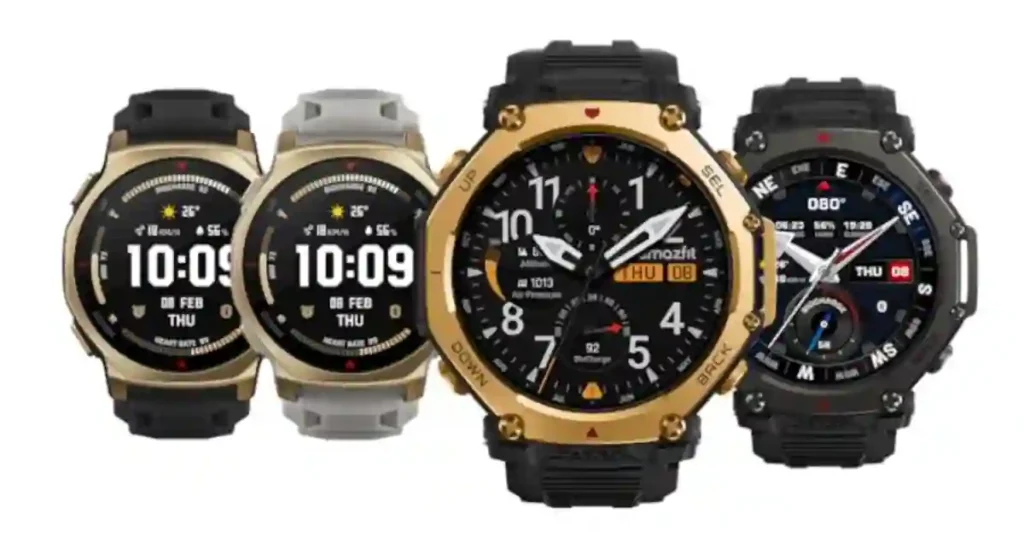
Price: ~$179–$229 | GPS Battery: Up to 40+ days smartwatch, 18–20 hours GPS | Water Resistance: 10 ATM | Display: AMOLED, 1.45-inch
The Amazfit T-Rex 3 changed the conversation about what’s possible under $230. MIL-STD-810H certification across 15 military-grade test categories — shock, extreme temperature ranges, humidity, salt fog, and more — plus a 1.45-inch AMOLED display with 1000 nits brightness. At this price point, that combination was not supposed to exist.
Dual-band GPS and 170+ sport modes give this watch genuine outdoor functionality. SpO2 monitoring, heart rate, sleep tracking, and battery life that stretches to 40+ days in smartwatch mode all contribute to a value case that’s difficult to argue against.
Honest limitations: GPS battery drains faster than dedicated outdoor brands, dropping significantly below the smartwatch mode figures once active GPS tracking begins. The training analytics don’t approach Garmin or Polar depth. And the Amazfit ecosystem remains less mature for third-party integrations.
✅ Pros:
- MIL-STD-810H certified across 15 test categories at under $230 — exceptional value
- Bright 1.45-inch AMOLED display (1000 nits) at a budget price point
- Dual-band GPS and 170+ sport modes — genuine outdoor functionality
- 40+ days smartwatch battery life
- Solid build quality that doesn’t feel cheap for the price
❌ Cons:
- GPS active battery drops sharply in real use — well under the smartwatch mode figure
- Training analytics are basic — not suitable for serious performance athletes
- Amazfit/Zepp ecosystem is less mature and has fewer third-party integrations
- No ANT+ connectivity; limited sensor compatibility
Best for: Budget-conscious adventurers, students, casual hikers, and anyone who wants real MIL-spec durability and bright AMOLED visuals without spending over $250.

Full Comparison Table
| # | Watch | GPS Battery | Water Resistance | Display | Best For |
|---|---|---|---|---|---|
| 1 | Garmin Fenix 9 | AMOLED / Solar MIP variants | 10 ATM | AMOLED / Solar MIP | Best Overall |
| 2 | Garmin Enduro 3 | 320 hrs (solar) / 120 hrs GPS | 10 ATM | MIP Solar | Endurance Athletes |
| 3 | Apple Watch Ultra 3 | ~36 hrs typical | 100m | AMOLED | iPhone Users |
| 4 | Coros Vertix 2S | 140 hrs GPS | 100m | MIP | Max Battery Life |
| 5 | Garmin Tactix 8 | 29 days AMOLED | 10 ATM | AMOLED/MIP | Tactical/Military |
| 6 | Suunto Vertical | 60 hrs GPS | 100m | MIP | Mid-Range Adventure |
| 7 | Samsung Galaxy Watch Ultra 2 | Multi-day (800mAh) | 10 ATM | AMOLED, 5,000 nits | Android Users |
| 8 | Polar Grit X2 Pro | 43 hrs dual-freq | 100m | AMOLED | Training Analytics |
| 9 | Garmin Instinct 3 Solar | 50 hrs GPS | 10 ATM | MIP Solar | Best Value |
| 10 | Coros Nomad | 50 hrs GPS | 100m | MIP | Hiking/Fishing |
| 11 | Casio G-Shock Mudmaster | N/A (phone GPS) | 200m | Mineral glass | Pure Durability |
| 12 | Casio Pro Trek PRW3500 | N/A (solar ABC) | 200m | Digital/Analog | Minimalist Outdoors |
| 13 | Amazfit T-Rex 3 | 18–20 hrs GPS | 10 ATM | AMOLED | Best Budget |
| 14 | Garmin Instinct E 40mm | 14 days smartwatch | 10 ATM | MIP | Compact/Affordable |
(Note: prices above are now consistent with each watch’s individual price range listed in its review section.)
How to Pick the Right One for You
Think about how long you’re actually out there
A weekend hiker who plugs in every Sunday night is in a completely different situation from someone doing 5-day fastpacking trips.
If you’re out for more than 2 days regularly and don’t want to carry a charging cable, your shortlist is: Garmin Enduro 3, Coros Vertix 2S, or Garmin Fenix 9 in its Solar MIP configuration.
If you charge every night like a normal person, battery life becomes less of a dealbreaker and you can focus on other things like screen quality, smart features, or price.
Know your phone situation
If you’re on iPhone, the Apple Watch Ultra 3 is worth a serious look — nothing else gives you that level of smart integration.
If you’re on Android, the Samsung Galaxy Watch Ultra 2 is the answer. If you want the best GPS watch and don’t care about deep phone integration, Garmin and Coros both work fine on either platform.
Screens: AMOLED vs. MIP
AMOLED screens look great. Vibrant colors, deep blacks, smooth animation. They also eat battery faster.
MIP screens look boring indoors. Monochrome, flat, nothing special. But outdoors in direct sunlight? They’re actually easier to read. And they’re the reason the Garmin Enduro 3 can go 120 hours on GPS — the screen barely uses any power.
If you spend most of your time outdoors and battery matters, go MIP. If you want a watch you’ll enjoy looking at every day, go AMOLED.
Don’t trust the spec sheet battery numbers
I’ll say it again: manufacturers quote battery life in ideal lab conditions with minimal features running. Real-world GPS battery — especially multi-band GPS with continuous heart rate in cold weather — can be 40-50% of that advertised number.
If a watch says 40 hours GPS and you’re planning a 30-hour mountain event in January, plan for 18–20 actual hours and bring a backup plan.
The app ecosystem is part of the watch
Garmin Connect is the best outdoor watch ecosystem available. Deep analytics, tons of third-party integrations, active community, constant updates.
If you care about long-term data analysis, training load tracking over years, and connecting to other devices and apps — Garmin wins this.
Coros is clean, fast, and improving. Polar is excellent for training science specifically. Suunto is much better than it used to be. Apple has the best overall smart ecosystem but lags in outdoor-specific analytics.
Questions People Ask
Can I use a rugged smartwatch with both iPhone and Android?
Garmin, Coros, Suunto, and Polar all work with both. Apple Watch Ultra 3 is iPhone-only. Samsung Galaxy Watch Ultra 2 is built for Android and works poorly with iPhone.
What’s the difference between IP68 and 10 ATM?
IP68 means the watch can handle being submerged to a specified depth for 30 minutes — but manufacturers set that depth, so it varies. 10 ATM means the watch can withstand pressure equal to 100 meters of water, which covers swimming, kayaking, and most surface water activities. For actual scuba diving you want a watch with a dedicated dive mode and 40m+ depth rating.
Is MIL-STD-810H certification legit or just marketing?
Legit, but with context. It means the device passed documented tests covering specific stress conditions. It doesn’t mean the watch is indestructible — it means it was actually tested and verified, not just described as “rugged.” Watches that say “military-inspired” without the certification are just using the aesthetic. That’s worth knowing.
When does multi-band GPS actually matter?
If you run on open roads or hike above treeline with clear sky visibility, standard GPS is fine. Multi-band GPS makes a real difference in dense forests, canyon terrain, and areas with lots of signal obstruction. If you run trails through heavy tree cover or in narrow canyon landscapes, it’s worth having.
Bottom Line
There’s no single best rugged smartwatch for everyone — but there’s definitely a right one for you.
If money isn’t the issue and you want the most capable outdoor GPS watch available, go with the Garmin Fenix 9. It’s the new benchmark, and the AMOLED upgrade makes it easier to recommend than ever.
If you’re doing multi-day endurance events or expeditions, the Garmin Enduro 3 has battery life that nothing else can match.
If you’re on iPhone and want one watch for everything, the Apple Watch Ultra 3 is the move.
If you’re on Android, get the Samsung Galaxy Watch Ultra 2.
If you want to spend under $700 and need serious GPS endurance without solar, the Coros Vertix 2S is your watch.
For training science and recovery data, nobody beats Polar’s Grit X2 Pro.
And if you’re working in environments where everything breaks, the Casio G-Shock Mudmaster is still the toughest thing on the market at any price.
Buy what fits your life. That’s the watch you’ll actually use.
Last updated: September 2026 | Prices are approximate and may vary by retailer. Specs based on manufacturer data and independent field testing.