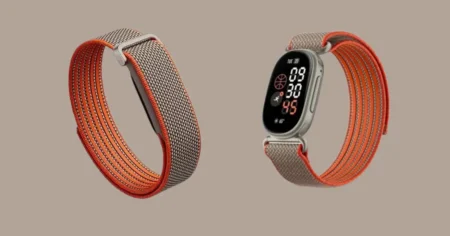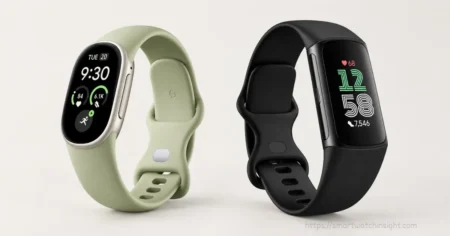

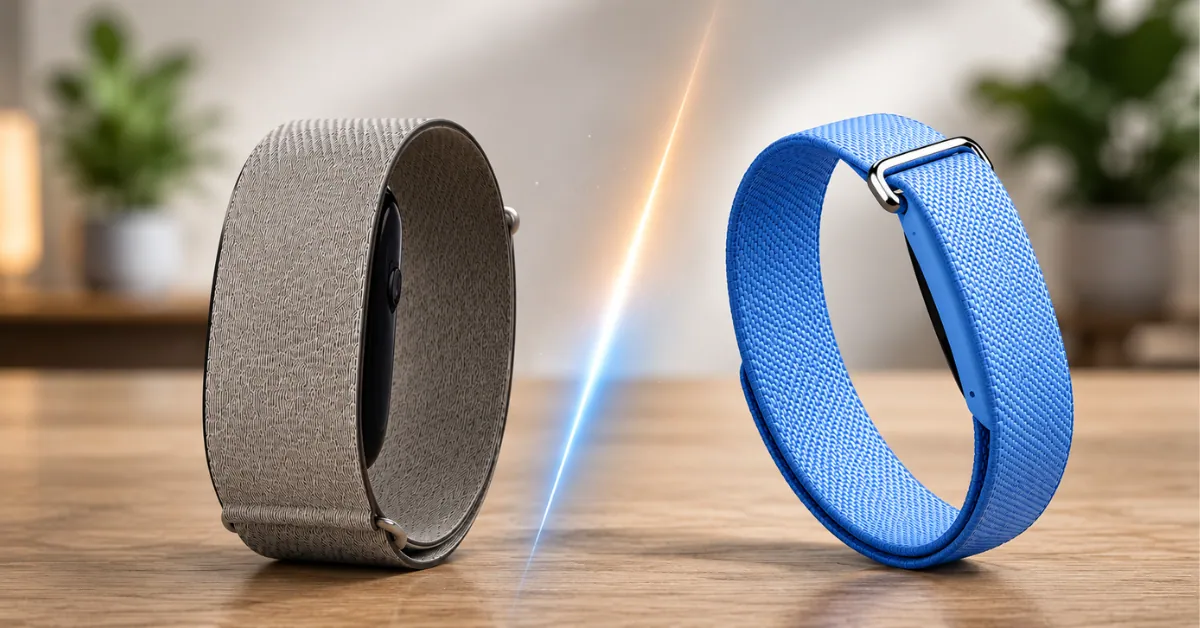
The Fitbit Air costs $99.99 and has been out since May. The Garmin Cirqa was announced July 21 and went on sale July 24 at $199.99. Both are screenless trackers with no display, both track heart rate, sleep, and HRV around the clock, and both pair with a phone app. Past that, they’re built for different people.
The Fitbit Air is for anyone who wants simple health tracking without extra cost or complexity. The Cirqa is built for people who want deeper recovery data things like Body Battery and Training Readiness especially if you already own a Garmin watch.
The two bands follow different philosophies: the Fitbit Air helps you understand your daily habits, while the Cirqa helps you understand how your training affects your body.
Want the full breakdown of every Cirqa feature first? Read our Garmin Cirqa smart band review.
Garmin Cirqa vs Fitbit Air Quick Overview
Fitbit Air Available now — $99.99, plus an optional $9.99/month for Premium. See it on Amazon
Garmin Cirqa Available now — $199.99, plus an optional Garmin Connect+ subscription for extra features. See it on Amazon
Neither has a screen. Both track heart rate, sleep, and stress passively. Both need a phone app to see your data.
If you’d rather have a tracker with a screen, or a full smartwatch instead of a screenless pebble, check our roundup of the best Fitbit models for 2026.
Direct Comparison
| Fitbit Air | Garmin Cirqa | |
|---|---|---|
| Price | $99.99 | $199.99 |
| Release date | May 2026 | July 24, 2026 (announced July 21) |
| Screen | None | None |
| Weight | 5.2 g (module only), about 12 g with band | About 20.7 g (S/M) or 21.2 g (L/XL); module alone 14.8 g |
| Battery life (tested) | About 8 days | About 10 days |
| Fast charge | 5 min = 1 day | Not specified |
| Charging | Magnetic plug | Proprietary cable, physical connection |
| Internal storage | 64 MB (7 days detailed data, 30 days daily summaries) | 128 MB (7 days detailed data) |
| Sizes | One, adjustable band | S/M and L/XL |
| Colors | Multiple loop colors | 4 colors (Black, French Gray, Captain Blue, Mauve) |
| Water resistance | Yes 5 ATM | 5 ATM |
| Heart rate | 24/7 | 24/7 |
| SpO2 | Overnight | Yes |
| Sleep tracking | Yes, with Smart Alarm | Yes, with Smart Wake |
| HRV | Yes | Yes, with HRV Status |
| Skin temperature | Yes | Yes |
| AFib alerts | Yes (irregular rhythm notifications) | No (no AFib or ECG; only high/low heart rate alerts) |
| Body Battery | No | Yes |
| Training Readiness | No | Yes |
| VO2 Max | No | Yes |
| Workout logging | Automatic detection (about 10 activities now; Google announced 100+, rolling out later in October 2026) | Manual (80+ types) + automatic for some sports |
| GPS | No | Connected GPS via phone |
| App | Google Health | Garmin Connect |
| Subscription needed for core features | No | No |
| Optional subscription | $9.99/month | $6.99/month or $69.99/year (30-day free trial) |
| iPhone support | Full | Full |
| Android support | Full | Full |
Price
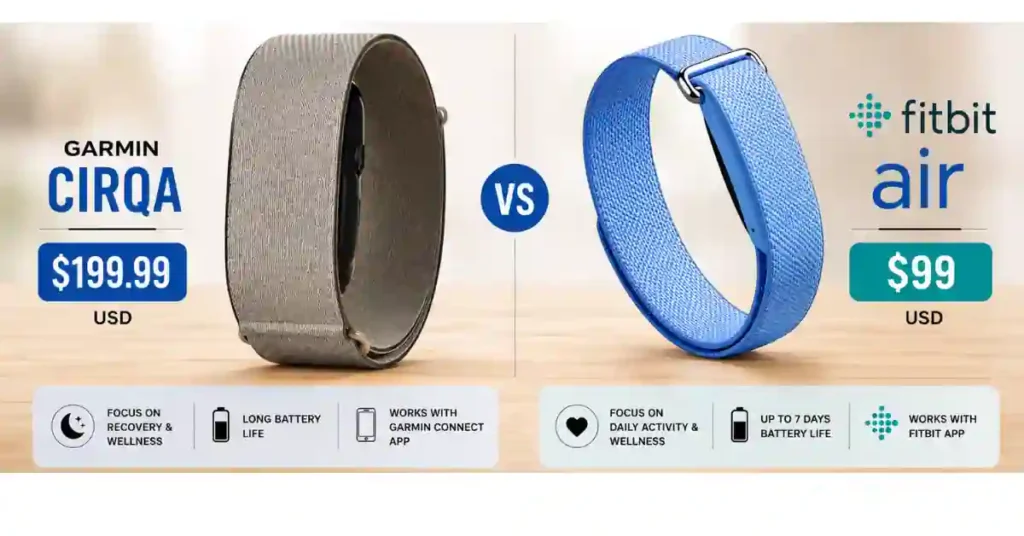
The price difference is pretty significant. Fitbit Air starts at $99, while Garmin CIRQA costs $199.99 in the US (£179.99 in the UK and €199.99 across much of Europe). In other words, CIRQA costs about twice as much.
So, what does that extra $100 get you? Longer battery life more detailed recovery insights, and access to Garmin’s well-established fitness ecosystem. If you train regularly or already use Garmin devices, those extras can be worth paying for.
On the other hand, if your goal is simply to track your steps, sleep, and daily activity, Fitbit Air delivers the essentials for half the price.
Winner (Price): Fitbit Air (Value for Money). If you’re focused on basic health tracking and don’t need Garmin’s advanced training features, it’s hard to justify spending the extra $100.
Design and Comfort
The Fitbit Air is small 5.2 grams without the band. It clips into a soft loop and has no buttons and no screen. You charge it with a magnetic plug that snaps on easily. A double-tap gesture turns off alarms. A small status light shows while charging.
The Cirqa is a fabric band, similar to Whoop’s design. It comes in two sizes (S/M and L/XL) and four colors. Unlike the Fitbit Air, it has one physical side button, used mainly for logging activities manually.
If you’re training hard and want a secure fit, the Cirqa’s band style may suit you better. If you want something you can forget you’re wearing, the Fitbit Air is simpler.
Size, weight and charging: the real differences
The Cirqa is noticeably wider, thicker and bulkier than the Fitbit Air. It weighs about 21.2 g in L/XL (about 20.7 g in S/M, 14.8 g for the module alone) against roughly 12 g for the Air with its band (5.2 g for its module). Its module is larger in every dimension and the sensor sits further out from the back, while the Air has a flatter profile.
Comfort is a closer call than the numbers suggest. The Air feels almost weightless after a few days. The Cirqa’s soft-touch strap has a decent stretch and sits well on the wrist, and reviewers report it stays comfortable even for sleeping.
Swapping the module is easier on the Air: you push it out of the strap. The Cirqa uses a more watch-like strap attachment, so changing bands takes a little more effort. For charging, the Cirqa uses Garmin’s proprietary cable that connects physically to the module, while the Air uses a magnetic plug.
Storage on both is for your recorded data when the phone is not nearby, not for music or photos. The Air has 64 MB and the Cirqa 128 MB. Both keep up to 7 days of detailed data, and the Air also keeps up to 30 days of daily summaries. Both are rated 5 ATM, so swimming and showering are fine.
Fit and wearing options
| Fitbit Air | Garmin Cirqa | |
|---|---|---|
| Wrist fit | One size, adjustable, 130 to 210 mm | S/M 120 to 200 mm, L/XL 145 to 240 mm |
| Upper-arm wear | No | Yes, with an optional upper-arm band sold separately |
| Replacement bands | Start at $34.99 | Sold separately (check Garmin’s store for current prices) |
If you’re training hard and want a secure fit, the Cirqa’s band style may suit you better. If you want something you can forget you’re wearing, the Fitbit Air is simpler.
Health and Fitness Tracking
How accurate are they? Neither band has been independently verified in this comparison, and we do not claim either one is more accurate than the other. Wrist-based optical sensors are generally good at heart rate trends and sleep duration, and less reliable for exact calorie counts, SpO2 and sleep-stage details.
Treat all of these as estimates, not medical measurements. AFib alerts and similar notifications are screening hints, not a diagnosis, so talk to a doctor if you get one.
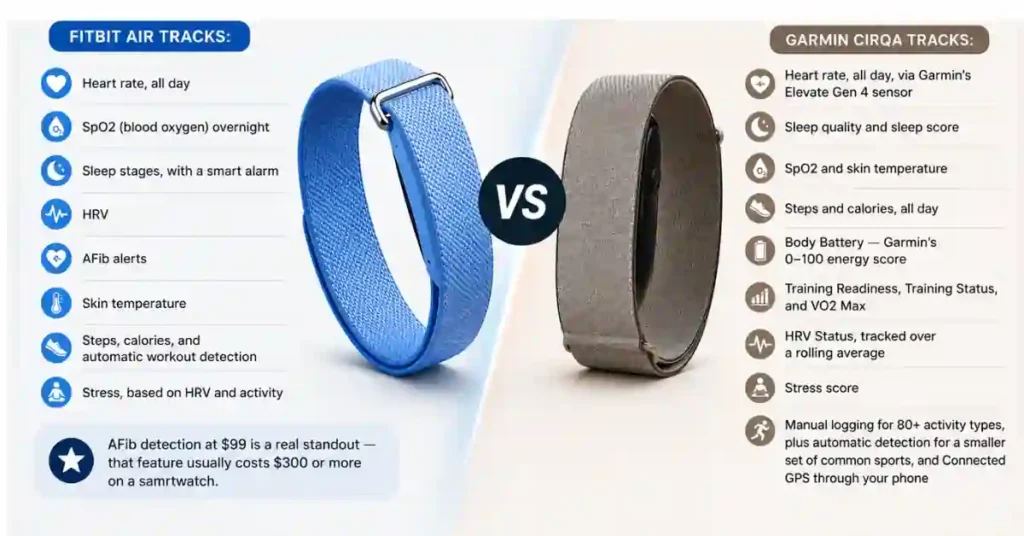
Fitbit Air tracks:
- Heart rate, all day
- SpO2 (blood oxygen) overnight
- Sleep stages, with a smart alarm
- HRV
- AFib alerts
- Skin temperature
- Steps, calories, and automatic workout detection (Google announced on October 12 an expansion from about 10 core activities to 100+, using your history and context, rolling out later in October 2026; early users say detection has been inconsistent so far)
- Distance, resting heart rate and naps, plus sleep duration, stages and score
- Active Zone Minutes, and Cardio Load with Google Health Premium
- Manual entry for measurements such as weight and glucose readings
- Stress, based on HRV and activity
AFib detection at $99 is a real standout: the Air gives irregular rhythm notifications, while the Cirqa has no AFib or ECG feature at all. These are screening alerts, not a diagnosis.
Need ECG or AFib detection? If those features matter to you, look at Garmin’s premium smartwatches instead, such as the Venu 3, Venu 4 (see our Garmin Venu 4 review) or Fenix 8 series.
They use Garmin’s Elevate Gen 5 heart rate sensor, which supports the Garmin ECG app. The Cirqa uses the older Elevate Gen 4 sensor, which has no ECG hardware. ECG availability depends on your region, so check Garmin’s ECG availability page before you buy.
The ECG app is a screening tool, not a medical diagnosis. If you want heart rhythm features at a lower price, the Fitbit Air gives irregular rhythm notifications, and the new Fitbit Edge also supports ECG.
Garmin Cirqa tracks:
- Heart rate, all day, via Garmin’s Elevate Gen 4 sensor
- Sleep quality and sleep score
- SpO2 (off by default to save battery) and skin temperature (measured during sleep)
- Steps and calories, all day
- Body Battery — Garmin’s 0–100 energy score
- Training Readiness, Training Status, and VO2 Max
- HRV Status, tracked over a rolling average
- Stress score
- Manual logging for 80+ activity types, plus automatic detection for a smaller set of common sports, and Connected GPS through your phone
- Automatic activity detection that uses movement data, exertion and information from your account
- Sleep Coach, which suggests how much sleep you may need based on your data and goals
- Fitness Age, an estimate of your fitness relative to your actual age (not a clinical measurement)
- Lifestyle Logging, which compares logged habits with sleep score, HRV and stress to show patterns. Fitbit’s Premium coaching offers some similar possibilities, but Garmin’s logging is built into its own platform
The Cirqa does track workouts, not just steps both manually through the side button and automatically for some sports.
What you see after a workout
This is where the two bands differ most. After a workout on the Fitbit Air you can review duration, distance, steps, average pace, average heart rate, calories burned and time in each heart rate zone. That is plenty for walks, runs and everyday exercise.
The Cirqa goes further. Depending on the activity, it can show average and maximum heart rate, aerobic and anaerobic training effect, exercise load, active and resting calories, estimated sweat loss and the change in Body Battery.
Over time it adds training readiness, training status, recovery time estimates, acute training load and estimated VO2 max, so you can see whether you are recovering and how ready you are for another hard session.
The button and alerts
Both bands vibrate to wake you, and you set alarms in each band’s companion app. The Cirqa’s single button does more than log activities. A short press snoozes an alarm and holding the button stops it. The Air has a double-tap to stop an alarm but no dedicated snooze control.
You can also set the Cirqa button to start and stop a chosen activity, which removes the guesswork of automatic detection, and, once you enable it in settings, hold it for about three seconds to broadcast your heart rate to compatible gym equipment.
The button starts and stops activities but cannot pause them; pausing is done in the Garmin Connect app. The Air can also share heart rate with compatible equipment, but the button makes it more direct on the Cirqa.
Alerts differ too. The Cirqa can alert you to high or low heart rate, activity goals, hourly movement, bedtime and sleep score, and it supports LiveTrack to share your location during activities through your phone. Its high and low heart rate alert only checks your rate, not your rhythm. The Air offers high and low heart rate alerts and irregular heart rhythm notifications.
Garmin positions it as a companion to its watches, not a replacement — the idea is to wear a Garmin watch on one wrist and the Cirqa on the other, so you get data from both without giving up your main training device. Some existing Garmin owners also use it on nights or rest days when they’d rather not wear a full watch.
Already own a Garmin? Our Garmin Venu 4 review covers why it might make a better all-day tracker than the Cirqa, since it has a full display and ECG built in.
Winner (Training Features): Garmin Cirqa, for anyone who wants training-specific recovery data. Body Battery and Training Readiness are two of the more respected recovery metrics available right now. For general health tracking without training data, the Fitbit Air covers what most people need at half the price.
Battery Life
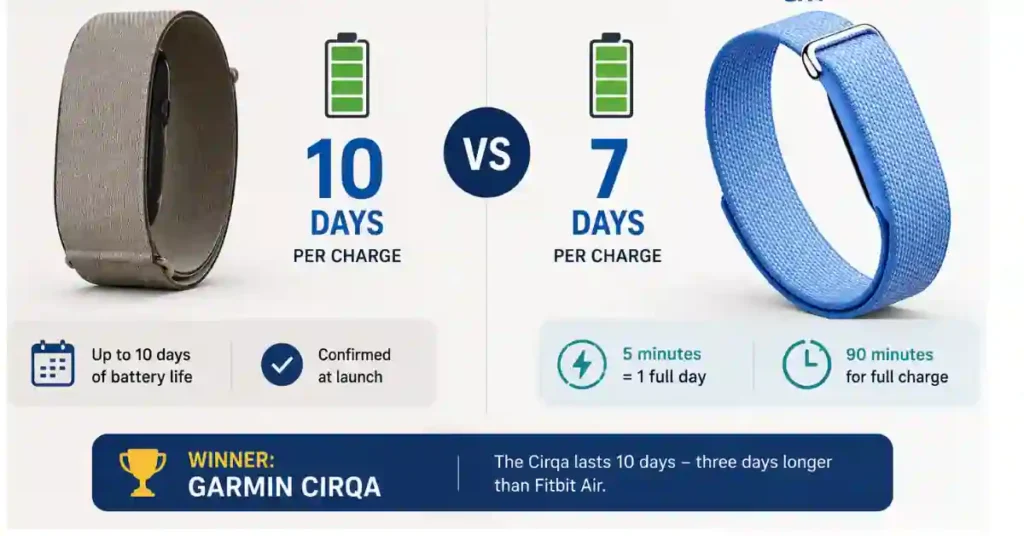
The Fitbit Air lasts 7 days per charge, and charges fast — 5 minutes gets you a full day, and a full charge takes about 90 minutes.
The Cirqa lasts 10 days per charge, according to Garmin’s claim at launch.
Claimed vs real-world: in one hands-on test with notifications on and regular activity tracking, the Fitbit Air lasted about 8 days, slightly better than its 7-day claim. The Cirqa also lasted about 8 days, short of Garmin’s 10-day figure. Both comfortably get you through a week.
Winner (Battery): Tie in real-world use. The Cirqa leads on paper (10 vs 7 days), but tested results were about equal at roughly 8 days each. The Air’s fast charging is a real convenience for quick top-ups.
App Experience
Fitbit’s app has been rebuilt into Google Health, with Gemini AI at the center. The Health Coach builds a plan based on your data and gives suggestions, rather than just showing numbers. It works with Android 11+ and iOS 16.4+, and a 3-month Premium trial comes with the purchase. The top section of the home screen is customizable, so you can pin the metrics you care about, and a fitness tab lets you start workouts and browse wellness content like meditation and yoga.
Garmin Connect is a deep, detailed platform — strong if you want to track training load, VO2 Max trends, and HRV over time. It has a steeper learning curve than Google Health and tends to show you data without telling you what to do with it.
It is less polished but packed with data: a customizable home tab, a 7-day glance of your recent activity, a challenges tab with leaderboards against other Garmin users, a monthly calendar view, a news feed for your tracked activities, and a deep “More” section for every tracked metric.
Garmin Connect+ unlocks extra features, but it isn’t required — sleep, Body Battery, HRV Status, and stress tracking all work without paying for it. Connect+ adds Active Intelligence (AI insights based on sleep, stress and training), calorie and macro tracking, a customizable performance dashboard, live activities, enhanced LiveTrack, trail maps, training guidance and exclusive badges.
Google Health Premium is built around a Gemini-powered AI coach with personalized plans, sleep summaries, post-workout summaries and an “ask coach” feature. The coach can also look at supported health records and test results that you add, so you can see your data in a broader context. On both platforms, core activity and health tracking stays free, and you never lose access to your data without a subscription.
Winner (App): Google Health, for most users. It’s easier to use day to day. If you already live in Garmin Connect, the Cirqa fits naturally into that — and you don’t have to pay extra to get the core recovery features.
This screenless-tracker category may be about to get more crowded — there are already rumors of a Garmin smart ring following CIRQA’s band launch.
Cost Over Time
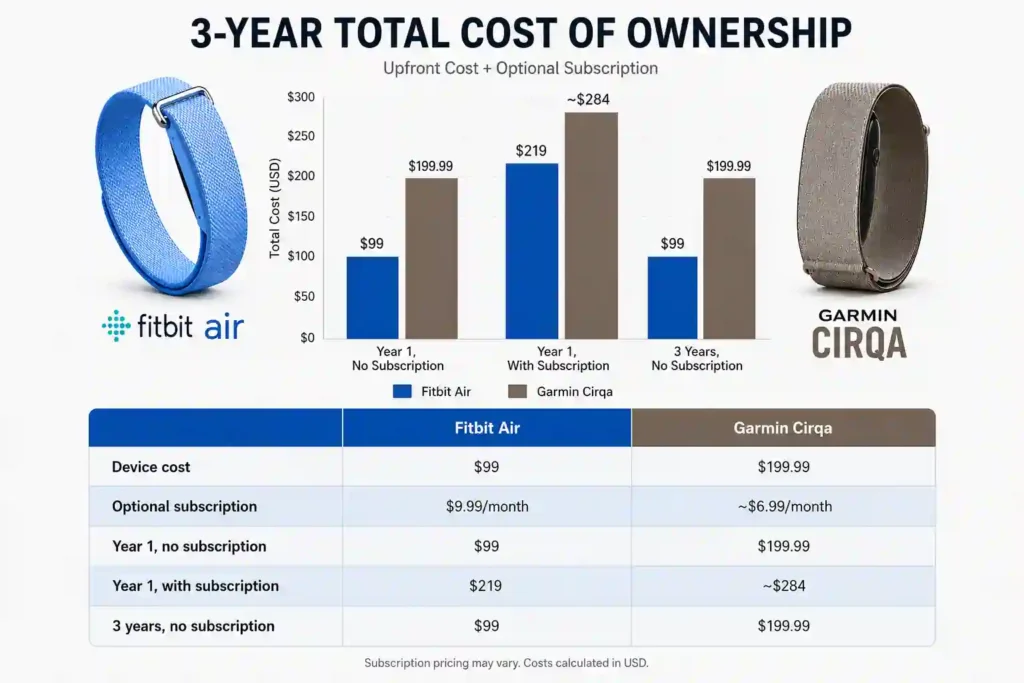
CIRQA gives you all of its core health and fitness tracking features without requiring a monthly plan. Garmin Connect+ is entirely optional and costs $10.99 per month, adding extras like advanced nutrition insights, structured workout plans, and additional training features.
For most people, the real difference between these two devices is the $100 higher upfront price, not an ongoing subscription cost.
Who Should Buy Which
Buy the Fitbit Air if you:
- Want the lowest price for screenless tracking
- Have a budget under $150
- Are new to health tracking and want something simple
- Use an iPhone or Android phone — it works with both
- Want AFib detection without paying for a full smartwatch

Buy the Garmin Cirqa if you:
- Already own a Garmin watch and use Garmin Connect
- Want Body Battery and Training Readiness for recovery
- Don’t want to sleep in your main training watch
- Train seriously enough that recovery data matters
- Want a longer battery and don’t mind paying $100 more
- Don’t want to pay for a subscription just for the basics

Already own a CIRQA and having connection issues? Here’s our full guide to fixing Garmin CIRQA sync problems.
Want a screen and GPS for more money? See how the Air compares with the $179.99 Fitbit Edge.
Final Verdict
Our pick by type of user:
| If you are… | Get this | Why |
|---|---|---|
| New to tracking, or want simple daily data | Fitbit Air ($99) | Half the price, AFib alerts, easy app, fast charging |
| Budget under $150 | Fitbit Air ($99) | Cirqa costs about twice as much |
| A gym-goer or following a training plan | Garmin Cirqa ($199.99) | Body Battery, Training Readiness, a button to start workouts |
| Already using a Garmin watch | Garmin Cirqa ($199.99) | Fits into your existing Garmin Connect data |
| Wanting a button for alarms and workouts | Garmin Cirqa ($199.99) | The Air has no button, only a double-tap |
| Wanting the lightest, flattest band | Fitbit Air ($99) | About 12 g with band vs about 21.2 g |

Category winners: Price: Fitbit Air. Training features: Garmin Cirqa. App: Google Health. Battery: Tie.
For most people, the Fitbit Air is still the easier buy — $99, simple, and it covers what most non-athletes need. The Cirqa costs more, but it’s a real option if you want Garmin’s recovery tools specifically, especially since the core features don’t require a subscription.
New to screenless trackers, or not training for anything specific? Get the Fitbit Air. Already living in Garmin Connect and want your Body Battery and HRV data without wearing a full watch to bed? The Cirqa is worth the extra $100.
If you work out regularly and want depth, such as training effect, recovery time and a button that starts workouts, the Cirqa is the better pick. If you mainly want to count steps, track sleep and record the occasional walk or run, the Air is more than capable.
Is the Cirqa worth it without a Garmin watch? Yes, you do not need a Garmin watch. The Cirqa works on its own with the free Garmin Connect app, and you can start workouts from the button or let it detect common sports.
It has no built-in GPS, so it borrows your phone’s GPS for routes. It makes the most sense if you want recovery data and a comfortable band for sleeping. If you mainly want a GPS training device, a Garmin watch or the new Fitbit Edge is a better fit.
If you’re a Garmin athlete who already has a Fenix 9 or Forerunner 970, the Cirqa is positioned as a recovery companion that integrates seamlessly with your existing Garmin data.
If Garmin ships the CIRQA Smart Band Pro, this comparison could shift — early leaks suggest a second button and audio feedback, the two things both current bands lack. The Pro was found in Garmin Connect app code and has not been confirmed by Garmin.
FAQ
What’s the difference between Garmin Cirqa and Fitbit Air?
The Fitbit Air is built for simple, everyday health tracking. The Cirqa adds Body Battery, Training Readiness, and activity logging, aimed at people who want recovery data alongside training info. It also has a physical button, a larger and heavier module, and a proprietary charging cable.
Is the Fitbit Air worth buying?
Yes, for most people. AFib detection, a 7-day battery, sleep tracking, and Google Health’s AI coach at $99 is a strong deal.
Does the Fitbit Air need a subscription?
No. Fitbit Air’s basic health and fitness tracking works without a subscription. If you want extra insights and premium features, Google Health Premium costs $9.99/month or $99.99/year, and new users get a 3-month free trial.
Is the Cirqa better than the Fitbit Air?
It depends on your needs. Garmin CIRQA is the better choice if you want longer battery life, more advanced fitness features, and a subscription-free core experience. Fitbit Air is the better value if you’re looking for a more affordable fitness band with reliable everyday health tracking and optional premium features through Google Health Premium.
How long does the battery last on the Cirqa and Fitbit Air in real use?
Garmin claims up to 10 days for the Cirqa and Google claims up to 7 days for the Fitbit Air. In one hands-on test, both lasted about 8 days with notifications on and regular activity tracking.
Related Read:-
- Latest Apple Watch Features 2026: Series 12, Ultra 4 & watchOS 27 — Everything Confirmed
- Garmin Forerunner 975: Release Date, Expected Features & Should You Wait? (2026 Update)
- Oura Ring 5 vs Ring 4: Is It Worth Upgrading in 2026?
- Galaxy Watch 9 vs Apple Watch Series 12 (2026): Which One Should You Actually Buy?
- Garmin Cirqa vs Whoop 5: The $800 Decision Nobody Is Talking About (2026)
- Best Screenless Fitness Trackers 2026: A Full Side-by-Side Comparison