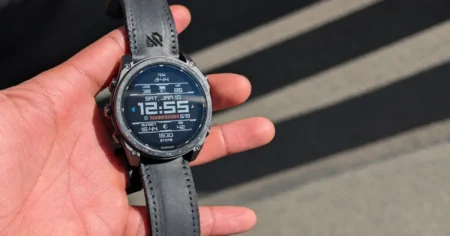


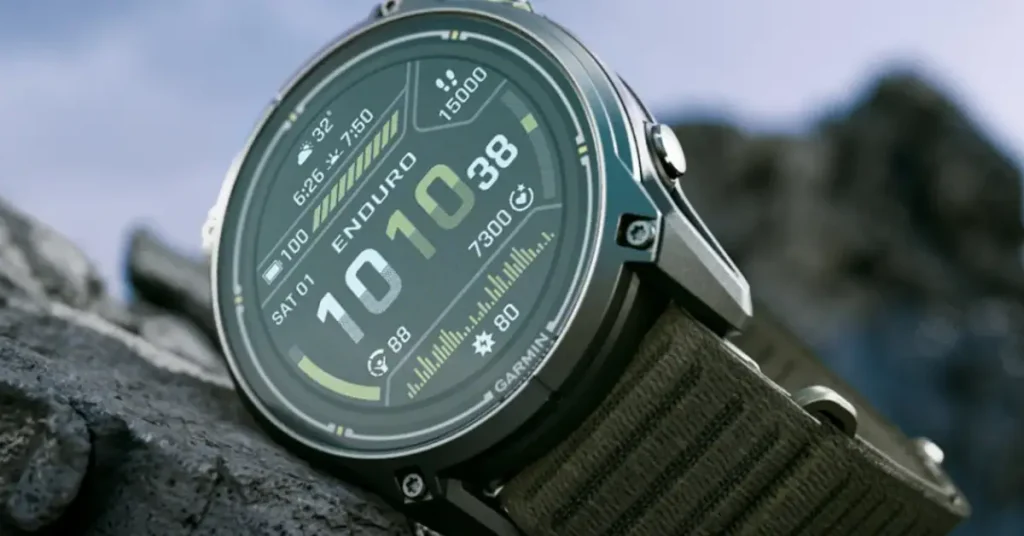
Update, October 6, 2026: The Garmin Enduro 4 is official. Garmin’s US page lists it (part number 010-04799-00) as “New” at $899.99, available to order October 9. Garmin’s Australian page lists it (010-04799-01) at AU$1,449.00, available October 10. Both highlight a durable sapphire lens, LED flashlight, fabric band, and solar charging that supports up to 90 days of battery life. UK, European and Indian pricing wasn’t shown in the pages we reviewed.
The short version: it’s less a next-generation Enduro and more an “Enduro 3.5.” Same case, same MIP display, same headline 90-day solar battery life. The real upgrades are doubled storage, a new strap, and a big push on the software side with Garmin Epic, pack weight, and a proper ultra-race planner.
The pre-launch declaration (first registered July 23, replaced by an updated version dated August 31) named Garmin Enduro 4 alongside Garmin tactix 9 and tactix 9 Ballistics Edition.
What’s New Enduro 4 vs. Enduro 3
The Fenix 8 and Enduro 3 launched together in September 2024 . New Garmin Enduro 4 is a mild hardware refresh wrapped around a bigger software update:
Hardware changes
- Storage doubled – 32GB on Enduro 3 to 64GB on Enduro 4, more room for offline maps, music, and downloaded content
- New ComfortFit strap replaces the Enduro 3’s ultra-light elastic nylon loop pushes total weight from 63g to 66g (the watch body itself is unchanged at 57g)
- Case size, display, lens, bezel, case material, and water resistance are all unchanged
Software/feature changes
- Garmin Epic (new) – pulls performance and health data from multi-day activities into one continuous view instead of treating each day separately, so you can review and share how a multi-day race or expedition actually unfolded
- Pack weight – factors the extra load you’re carrying into running, hiking, and walking activity data
- Race/course planner – add cut-off times, notes, rest plans, checkpoints, and aid stations for ultra-distance events
- Automatic rest timer – tracks time spent at an aid station or checkpoint without manual button presses
- Ultrarun activity with rest timer, plus an adventure racing activity that records GPS but hides it from view, in keeping with race rules
- Grade-adjusted pace workouts now factor in climbs and descents when setting pace targets
- Expanded indoor rowing support (VO2 max, FTP, power curves, lactate threshold with compatible equipment)
- Trail run VO2 max, which adjusts for terrain conditions, and enhanced stamina metrics that show how your endurance changes with training
- Rucking activity and mixed multisport profiles added
- Newer everyday features carried over from Garmin’s current software generation: Evening Report (joins Morning Report), Smart Wake Alarm, Health Status, breathing/respiration variations, lifestyle logging
- LED flashlight, built into the case
- Navigation: preloaded multicontinent TopoActive maps, dynamic round-trip routing, NextFork map guide, ClimbPro, PacePro, Up Ahead checkpoint alerts, SatIQ multi-band GPS
- Training: Training Readiness, Training Status, Endurance Score, Hill Score, Running Tolerance, Garmin Coach plans, race predictor, altitude and heat acclimation
- Health: Sleep Coach, nap detection, HRV status, Body Battery, Health Snapshot, ECG app, Pulse Ox, hydration tracking, jet lag adviser
The Enduro 4 also has a dedicated rucking activity with pack weight, and if you own an older Garmin without it, here is how to enable rucking on any Garmin watch.
Officially Confirmed Specs
| Specification | Garmin Enduro 4 | Garmin Enduro 3 |
|---|---|---|
| Case size | 51 × 51 × 15.7 mm | 51 × 51 × 15.7 mm |
| Display | 1.4″ MIP (transflective), 280 × 280 px | 1.4″ MIP, 280 × 280 px |
| Lens | Power Sapphire | Power Sapphire |
| Bezel | Titanium | Titanium |
| Case material | Fibre-reinforced polymer | Fibre-reinforced polymer |
| Weight | 66g (57g case only) | 63g (57g case only) |
| Strap | ComfortFit | Ultra-light elastic nylon loop |
| Storage | 64GB | 32GB |
| Water resistance | 10 ATM | 10 ATM |
| Smartwatch battery | Up to 36 days, 90 days with solar | Up to 36 days, 90 days with solar |
| Long-duration GPS | Up to 120 hours, 320 hours with solar | Up to 120 hours, 320 hours with solar |
| Max-accuracy GPS | Up to 60 hours, 90 hours with solar | Up to 60 hours, 90 hours with solar |
| Battery saver mode | Up to 92 days, unlimited with solar | Up to 92 days, unlimited with solar |
| LTE / Satellite | No confirmed absent | No |
| Connectivity | Bluetooth, ANT+, Wi-Fi | Bluetooth, Wi-Fi, and ANT+ |
| Price | $899.99 (US) | $899.99 |
Core sensors: GPS, GLONASS, Galileo, QZSS, BeiDou, SatIQ technology, Garmin Elevate wrist heart rate, Pulse Ox, barometric altimeter, electronic compass, gyroscope, accelerometer, thermometer, ambient light sensor, skin temperature.
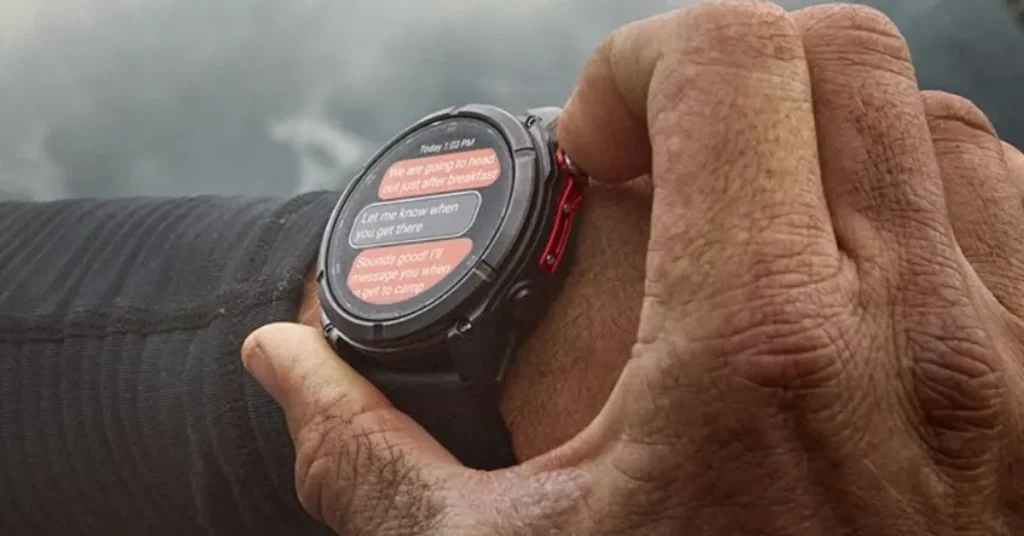
Also onboard: Garmin Pay, Garmin Messenger (two-way text messaging via paired phone, Bluetooth-based not satellite), Garmin Connect+ compatibility, music storage/playback, ECG app, safety and tracking features that send your live location when paired with a phone, and the LED flashlight
QuickFit bands (26mm) are supported for swapping straps, with sizing available for silicone (127–210mm wrist), ComfortFit Medium (145–220mm), leather (135–213mm) and metal (135–225mm) bands.
Full official battery breakdown (Enduro 4), straight from Garmin’s spec sheet:
| Mode | Without solar | With solar |
|---|---|---|
| Smartwatch mode | Up to 36 days | Up to 90 days |
| Low Power Watch Mode | Up to 92 days | Unlimited |
| Activity Mode (Normal) | Up to 80 hours | Up to 144 hours |
| Activity Mode + Music | Up to 22 hours | Up to 25 hours |
| Activity Mode (Max Battery) | Up to 210 hours | Unlimited |
| Activity Mode (Extended Battery) | Up to 120 hours | Up to 320 hours |
| Activity Mode (Max Accuracy) | Up to 60 hours | Up to 90 hours |
| Expedition Mode | Up to 77 days | Unlimited |
Solar figures for smartwatch, low-power and expedition modes assume all-day wear with 3 hours/day outside at 50,000 lux. Activity-mode figures assume 50,000 lux and typical use with SatIQ technology. The headline 90-day smartwatch figure and the “unlimited” activity/expedition figures are the two numbers worth remembering; everything else is a tradeoff between accuracy and runtime
Battery figures are essentially identical to Enduro 3 across the board Garmin didn’t chase a bigger headline number this generation, it just kept what already worked.
Price and Availability
- US: $899.99, identical to the Enduro 3’s $899.99 launch price. Available to order October 9.
- Australia: AU$1,449, available to order from October 10
- Garmin has rolled the listing out to its regional websites as of October 6; check your local Garmin.com storefront for your region’s exact price and ship date, since order dates differ between regions (October 9 in the US, October 10 in Australia)
No satellite or LTE connectivity this is now fully confirmed, not just an FCC inference. If you need true backcountry satellite messaging, you’ll still need a separate Garmin inReach device, exactly as with the Enduro 3.
The MIP vs. AMOLED Question — Settled
This was the single biggest open debate in the leak-stage coverage, and it’s now resolved: Enduro 4 keeps the MIP display. Same 1.4-inch, 280×280 transflective panel as Enduro 3, same Power Sapphire lens.
Garmin clearly isn’t willing to trade the Enduro line’s defining trait genuinely absurd battery life — for a prettier always-on screen.
AMOLED stayed exactly where we expected: on the Fenix 9 and Fenix 9 Pro, with Solar kept as a separate MIP-based tier rather than merged into AMOLED. That’s the same logic that applied to Enduro 4, and it played out exactly as predicted.
Standout Features Buyers Often Miss
The full Garmin spec sheet runs far deeper than the headline bullet points, and a few details are worth calling out for anyone comparing watches closely:
- 100+ activity profiles across categories you wouldn’t expect from an “endurance” watch not just running/cycling/swimming, but full team-sport profiles (cricket, soccer, rugby, ice hockey, lacrosse, American football), racket sports (tennis, pickleball, padel, squash, badminton), motor sports (motorcycling, overlanding, ATVing, snowmobiling), boxing/MMA, and winter sports
- Dual grid coordinates a tactical/military-style navigation feature, unusual to see spelled out on a consumer product page
- Gaming activity profile + GameOn app compatibility — Garmin is positioning the watch for tracking gaming sessions, not just physical activity
- Wearable trolling motor remote support a genuinely niche boating feature for anglers
- Golf: 43,000+ preloaded courses, Virtual Caddie, Green Contours (with Garmin Golf membership), automatic shot distance
- Garmin Epic, Physio TrueUp, and Unified Training Status all ship together Epic for multi-day review, Physio TrueUp for keeping training metrics consistent across multiple Garmin devices if you own more than one
- QuickFit 26mm compatibility means the stock ComfortFit strap can be swapped for any QuickFit-compatible band, including leather or metal options, each with its own listed wrist-size range.
- Preloaded SkiView maps for 2,000+ ski resorts, plus a surf activity with Surfline Sessions video capture and MTB Grit and Flow metrics
- Preloaded multicontinent TopoActive maps, so you can navigate without downloading anything first
For a review or buying-guide angle, the activity-profile breadth and the QuickFit band compatibility are the two details most competing coverage is likely to skip worth leading with for long-tail search traffic.
Garmin Enduro 4 vs. Fenix 9
Both watches are now official, so this is a real comparison rather than a leak-vs-launched mismatch.
| Feature | Garmin Fenix 9 | Garmin Enduro 4 |
|---|---|---|
| Display | AMOLED, over 2x brighter than Fenix 8; Pro reaches 3,000 nits | MIP solar, unchanged from Enduro 3 |
| Design | Titanium bezel + sapphire lens (base); full titanium case (Pro) | Titanium bezel + sapphire lens, fibre-reinforced polymer case |
| Battery (smartwatch) | 10–29 days depending on size | Up to 36 days, 90 with solar |
| Battery (GPS) | Not separately published | Up to 120 hours, 320 with solar |
| Solar charging | Pro tier only (47/51mm) | Standard across the line |
| Weight | 61g (43mm) to 91g (51mm) | 66g |
| Storage | 64GB | 64GB |
| Price | $999.99–$1,199 | $900 |
| Best for | Daily wearer who also adventures, wants a great screen | Ultra-runners, thru-hikers, multi-day expedition athletes who need to go the longest without charging |
If display quality matters to you day-to-day, the Fenix 9 wins easily and costs about the same. If your priority is a watch that simply will not die mid-expedition, Enduro 4 remains the specialist tool for that one job now with double the storage and a proper multi-day Epic view to review the trip afterward.
See our Garmin Fenix 9 Review Price, Specs & Which Tier to Buy (2026) guide.
Should You Upgrade From Enduro 3?
Buy the Enduro 4 if:
- You’re coming from an Enduro 2 or older this is a meaningful generational jump
- You run ultras or multi-day events and want Garmin Epic, the race planner, and pack weight tracking
- The extra 32GB of storage for offline maps/music genuinely matters to your trips
Already own the previous model? I break down what you gain and what you give up in Enduro 4 vs Enduro 3: should you upgrade?
Stick with the Enduro 3 if:
- You already own one the hardware is nearly identical, and Garmin Epic plus the training tools are a software story, not a reason to spend $899.99 on new hardware
- You can find Enduro 3 at a discount, which is likely now that Enduro 4 is the current model

Consider the Fenix 9 instead if:
- You want AMOLED and don’t need 90-day solar battery life
- You’re a daily wearer first, adventurer second

Looking for something more premium than the Enduro 4? Garmin’s luxury line may be next, and I cover the MARQ Gen 3 leak here.
How Our Predictions Held Up
Since this post originally ran as leak-stage coverage, here’s an honest scorecard rather than quietly rewriting history:
- MIP display continuing (80% confidence called): ✅ Correct
- No LTE/satellite (called at 0% probability of LTE, based on FCC filing): ✅ Correct, now fully confirmed
- Price in the $899–$949 range: ✅ Correct – landed at $899.99
- Launching alongside Fenix 9 on August 25 (called at 85%): ❌ Wrong – it didn’t happen that day, launching instead on its own roughly six weeks later in early October
- Launching somewhere in 2026 (called at 95–97%): ✅ Correct
Three out of five called correctly, with the joint-launch timing being the one genuine miss useful to acknowledge rather than bury.
Torn between this and Garmin’s other flagship? I put them side by side in Garmin Enduro 4 vs Fenix 9, including battery by mode and weight.
FAQ
Is the Garmin Enduro 4 officially released?
Yes. Garmin added it to its regional websites on October 6, 2026, with ordering opening October 10 in at least some regions (Australia confirmed; check your local Garmin store for your region’s exact date).
How much does the Garmin Enduro 4 cost?
$899.99 in the US. Australia lists it at AU$1,449. Check your regional Garmin site for local pricing.
Sources: Garmin.com (US product page 010-04799-00, Australian product page 010-04799-01, and full spec sheet)
Does the Enduro 4 have an AMOLED display?
No. It keeps the same 1.4-inch MIP transflective display as the Enduro 3, to preserve the solar-powered battery life the line is known for.
Does the Enduro 4 have satellite messaging or LTE?
No. Neither is present, same as Enduro 3. For satellite messaging you’ll need a separate Garmin inReach device.
What’s actually new over the Enduro 3?
Doubled storage (64GB vs. 32GB), a new ComfortFit strap, and a software-heavy update: Garmin Epic for multi-day activity review, pack weight tracking, a race/course planner with aid stations and cut-off times, automatic rest timing, expanded rowing metrics, and grade-adjusted pace workouts that account for elevation change.
What is Garmin Epic?
A new feature that combines performance and health data from a multi-day activity — like an ultra-race or expedition — into one continuous view instead of splitting it by day, so you can review and share how the whole event played out.
Is it worth upgrading from Enduro 3 to Enduro 4?
Only if Garmin Epic, the race-planning tools, or the extra storage specifically solve a problem for you. The hardware itself is nearly unchanged — same case, same display, nearly identical battery figures, just 3g heavier due to the new strap.
Is it worth upgrading from Enduro 2 or older?
Yes, clearly — you’d be picking up two generations of Fenix-platform hardware and software improvements at once.
Related Read
- Garmin Fenix 9 vs Apple Watch Ultra 4 (2026)— full comparison for outdoor athletes
- Best Smartwatches for Seniors with Fall Detection — if emergency SOS features matter most
- Best Rugged Smartwatches 2026 — comparing all tough outdoor options
- Garmin Fenix 9 vs Fenix 8 (2026) Now Official : Is the Upgrade Worth It?
- How to Enable Rucking on Any Garmin Watch (2026 Guide)
Sources
- Garmin.com (official Enduro 4 product page and full spec sheet, regional)