
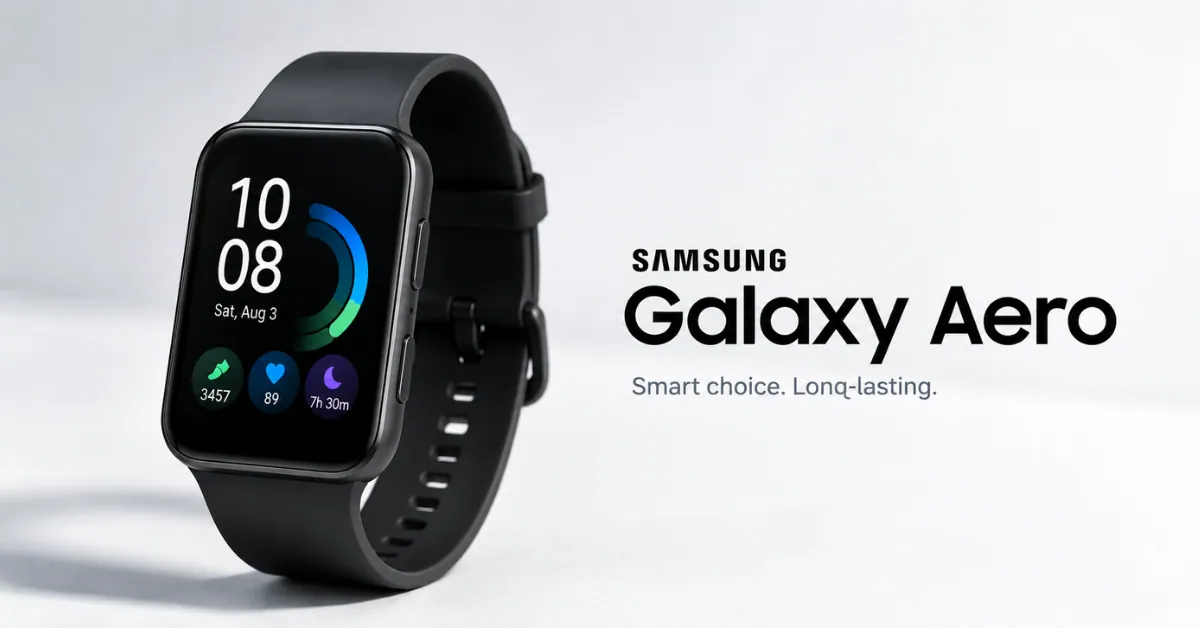
Samsung may have another watch in the works, and early details are starting to show up in the Galaxy Wearable app.
The device is reportedly being developed under the name Galaxy Aero, with the app code pointing to a watch that could sit between the Galaxy Fit 4 and Galaxy Watch FE.
The leak is still early. There is no confirmed price, release date, or full list of features yet. But the app code gives us a few clues about what Samsung may be planning, including the software it could use and the kind of battery life the watch may be targeting.
Two Samsung Wearables, Different Evidence
The Galaxy Aero and Galaxy Fit4 have shown up in different ways.
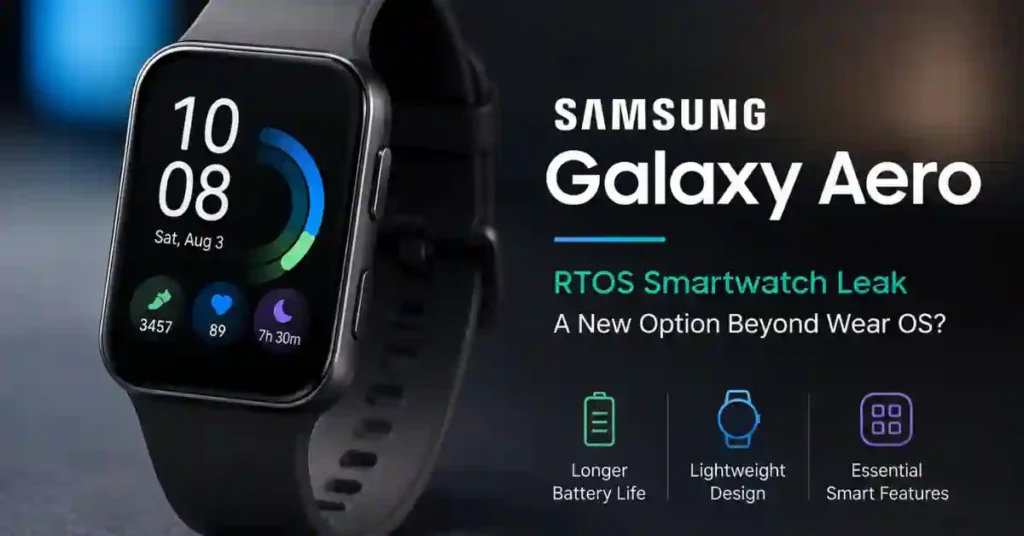
Galaxy Aero is still just a leak. Samsung’s Galaxy Wearable app contains a reference to a device reportedly called Aero, with the code name “galaxy_rtos_watch.”
That points to an RTOS-based watch instead of Wear OS. There are no confirmed specs, price, or release date yet.
Galaxy Fit4 is further along. Samsung’s SM-R391 has appeared in FCC records, which means the hardware has gone through regulatory testing.
The filing points to Bluetooth 5.4, while the design looks close to the Galaxy Fit3. A Goodix GH3036 sensor has also been reported, but Samsung has not confirmed the full hardware list.
We already covered the Fit4’s Bluetooth 5.4 upgrade and the unanswered GPS question in our Samsung Galaxy Fit 4: Bluetooth 5.4 Is Confirmed, But GPS Is the Real Question.
For this story, the Fit4 is mainly useful as a reference point. The Aero appears to be a different device, one that could sit above the Fit series and below Samsung’s Wear OS watches. Samsung has not confirmed that positioning, but current reports suggest it could be the role the Aero is being developed for.
The bigger question is what Samsung wants to do with RTOS. The Aero is the first clear sign of a Samsung watch outside the Wear OS lineup in this leak.
If it launches with longer battery life and more watch features than the Fit series, Samsung could have another option for people who don’t want a full Wear OS watch.
Where each one would sit
| Device | Platform | Evidence level | What we know |
|---|---|---|---|
| Galaxy Fit3 | Lightweight wearable platform | Shipping | Up to 13-day rated battery life |
| Galaxy Fit4 | OS not confirmed | FCC certified | SM-R391, Bluetooth 5.4, familiar Fit design |
| Galaxy Aero | RTOS reported | App-code reference | RTOS tag; everything else largely unknown |
| Galaxy Watch FE / Watch 9 | Wear OS | Shipping | Full smartwatch platform |
Read this way, there’s a gap between a basic band (Fit3, and presumably Fit4) and a full Wear OS watch (Watch FE and up).
If the Aero is real, it would sit in that gap — more capable than a band, without the battery cost of Wear OS. For a sense of what that top end already costs you in charging, see our Galaxy Watch Ultra 2 review.
Why this matters more than either leak alone
A fitness-band refresh isn’t unusual on its own — Samsung ships those every couple of years. A code string referencing an unreleased watch isn’t unusual either; these turn up in app teardowns constantly and plenty never ship.
What’s harder to wave off is the combination: an RTOS-linked smartwatch appearing in app code while a new fitness band is simultaneously moving through FCC certification.
That doesn’t prove Samsung has an RTOS roadmap, but it makes the possibility more interesting than either leak would be on its own.
The battery-first approach isn’t new
Samsung wouldn’t be inventing the battery-first smartwatch category. Garmin and Amazfit have already built successful wearables around long endurance and more tightly controlled software platforms, while OnePlus has taken a different approach — combining Wear OS with a low-power secondary architecture rather than abandoning Wear OS altogether.
If the Aero turns out to be real, the more useful comparison isn’t which OS it runs, but which of these playbooks Samsung is following: a Garmin/Amazfit-style dedicated device, or a OnePlus-style hybrid.
Either way, it puts Samsung closer to companies that built their whole pitch around not charging your watch every night.
If a band-level device is more your speed right now, our best fitness trackers under $100 roundup covers where the current Fit3 and its rivals land.
The trade-off with any of these battery-first platforms is the same: no Play Store, no open third-party app ecosystem. You get the maker’s own health tracking, watch faces, and notifications — not a full app platform.
What we don’t know
- Whether the Aero and Fit4 share any hardware or software lineage — this is inference, not confirmed by Samsung
- The Aero’s battery capacity, price, sensors, or GPS
- Whether “Galaxy Aero” is a final product name or an internal codename
- The Fit4’s OS, full spec sheet, and launch date
- Any Samsung acknowledgment of either device
Treat the RTOS-strategy read as an informed connection between two leaks, not a confirmed roadmap.
Should you wait?
If you’re choosing between a full Wear OS watch that needs frequent charging and a fitness band that feels too limited, Samsung’s next move is worth watching.
The Fit4 appears to be moving toward release, while the Aero remains little more than an intriguing app-code reference. Whether those two products are actually part of the same strategy is something we’ll have to wait for Samsung to reveal.
If you want to see how Samsung’s current Wear OS lineup stacks up against the competition in the meantime, check our Galaxy Watch 9 vs. Apple Watch Series 12 comparison.

Related on SmartwatchInsight:
- Galaxy Watch Ultra 2 — full specs and buyer guide
- Best Fitness Trackers Under $100
- Galaxy Fit 3 Top Features Under $60
Sources: SamMobile , NotebookCheck, Trusted Reviews, Technobezz