
Update, Sept 25, 2026: Bloomberg’s Mark Gurman now reports Apple’s screenless fitness band has moved past early exploration Apple engineers are reportedly building actual prototypes. Nothing is confirmed, and Gurman says a launch is unlikely before 2028.
This started as one of several Apple Watch redesign ideas Gurman had reported Apple was exploring. If Apple ships one, it would enter a category where Whoop, Fitbit Air, and Garmin Cirqa have each already claimed a different strength (battery, price, or no-subscription), but none has all three. That gap is Apple’s real opportunity, not the missing screen itself.
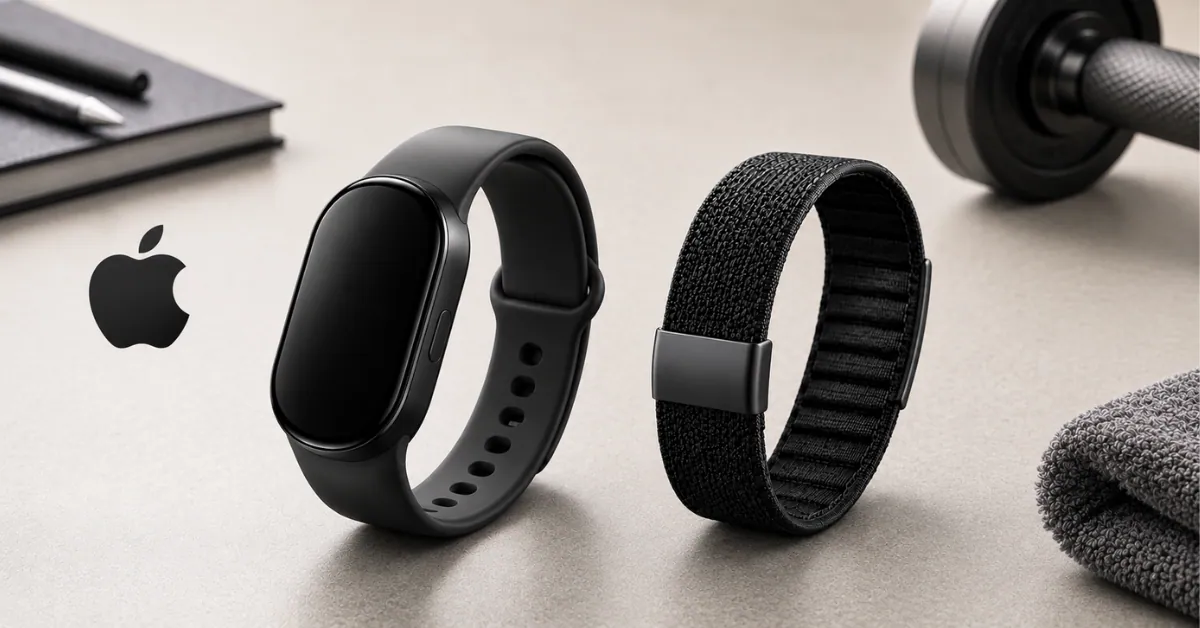
Every major wearable brand has now made its screen-free move except one. Whoop pioneered the category. Google answered with the Fitbit Air. Garmin joined in July 2026 with the Cirqa. And now, according to Bloomberg’s Mark Gurman, Apple is exploring a screenless fitness band of its own.
That’s the headline. But the more interesting question — the one most coverage of this story skips — is whether Apple can even compete in this category as it currently exists, given how differently Whoop, Fitbit, and Garmin have each priced and positioned their screen-free trackers. So instead of just repeating the rumor, this post breaks down exactly what Apple would be walking into, feature for feature, dollar for dollar.
The Rumor, Briefly
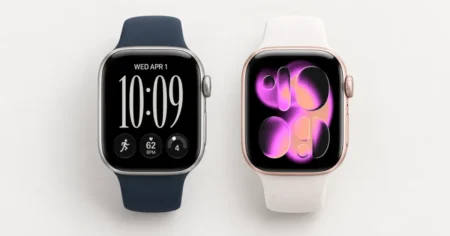
Per Gurman’s reporting, Apple’s industrial design team has spent roughly the last year working through a broader rethink of the Apple Watch lineup. The ideas in play reportedly include a screenless fitness band, a circular smartwatch case, new display sizes and technologies, cheaper models below the SE, and pricier ones above the Ultra and Hermès tiers.
Update, Sept 25, 2026: This has moved forward a step. Per Bloomberg’s Mark Gurman, reported on by Tech Advisor, Apple’s developers have moved on from early-stage exploration to actually building prototypes of the screenless tracker.
That’s a meaningful step up in confidence from a rumor still floating around internal design discussions — but it isn’t a guarantee either. Gurman explicitly points to the cancelled Apple Car as the reminder here: plenty of Apple projects reach the prototype stage and still never ship.
None of it is confirmed, and Gurman himself doesn’t expect a screenless Apple Watch in 2026 this is R&D exploration, not a product on a roadmap with a release date. That estimate has since been narrowed: the newer reporting puts a realistic launch no earlier than 2028, not just “unlikely in 2026.
That framing matters, because it means the real story right now isn’t “what will Apple ship” it’s “what would Apple have to beat.” Whoop, Fitbit Air, and Garmin Cirqa aren’t the only screenless trackers on the market Amazfit’s Helio Strap and Polar Loop are also part of this category but they’re the three most relevant competitors Apple would immediately face, given their scale, brand recognition, and how directly the recent coverage of Apple’s plans has referenced them.
Battery Life: Can Apple Even Get Close to 14 Days?
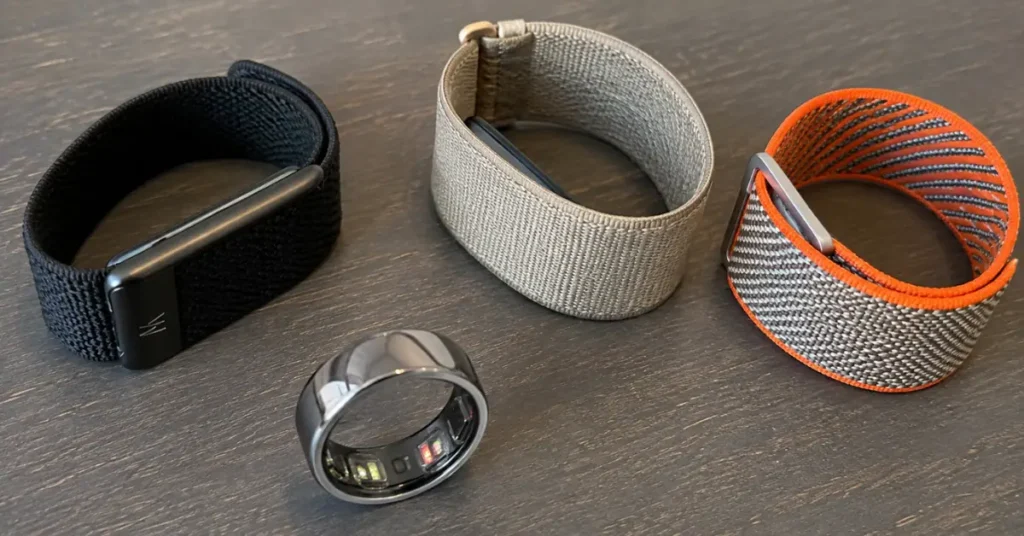
This is the single biggest reason a screenless device exists at all — kill the display, kill the biggest power drain. And the field has already set a high bar. Whoop 5.0/MG claims 14 days, and independent lab testing backed that up almost exactly, finding the device still had 27% charge left after a full two weeks of continuous wear.
Garmin Cirqa lands at 10 days, and Fitbit Air trails at 7 days though Fitbit compensates with the fastest top-up in the category, a 5-minute fast charge for a full day of use.
Apple has never had to solve this problem before, because it has never shipped a display-free wearable. Its current benchmark is the Apple Watch Ultra 3 at roughly 42 hours — a number that exists specifically because of the screen.
The uncomfortable truth for Apple is that simply removing the display doesn’t automatically put it in Whoop territory; Whoop and Garmin have spent years tuning sensor duty-cycling and radio efficiency specifically for always-on wear, something Apple’s watch silicon has never been optimized for.
Realistically, Apple’s first screenless device landing anywhere in the 7–10 day range — matching Fitbit Air or Cirqa rather than beating Whoop would already be a genuine first for the company.
Beating Whoop’s 14 days on a first attempt would be a surprise. (This is our estimate based on Apple’s existing hardware history, not a reported spec.)
Subscription Model: Does Apple Repeat Whoop’s Mistake, or Fitbit’s?
This is where the category actually splits into two philosophies, and it’s the question that matters most for whether an Apple screenless tracker is actually competitive or just a pricier rebrand of an existing idea.
Whoop’s model is built entirely around membership: WHOOP One ($199/year) and WHOOP Peak ($239/year) both ship the standard WHOOP 5.0 hardware, while WHOOP Life ($359/year) is the only tier bundled with the medical-grade WHOOP MG device with ECG and blood pressure insights.

There’s no way to buy WHOOP 5.0 or MG hardware outright and walk away — the device only exists as part of an active membership, and cancelling stops most of the data insights from working, even though the hardware sits on your wrist.
Retailers do sometimes list WHOOP MG bundled with a discounted 12-month membership as a single checkout price, but that’s still a subscription with the first year prepaid, not an ownership model.
Fitbit Air and Garmin Cirqa both flipped that structure a one-time hardware cost ($99.99 and $199.99 respectively) with core health tracking included free, and only the deeper AI-driven coaching layer (Google Health Premium at $9.99/month, Garmin Connect+ at $6.99/month) sitting behind an optional paywall.
Apple’s existing playbook doesn’t inspire confidence that it will pick the second model cleanly. Apple already runs Fitness+ as a standalone monthly subscription layered on top of hardware you’ve already bought, and a long-rumored AI health coach is exactly the kind of feature Apple has historically chosen to gate behind a service rather than give away free.
The realistic scenario isn’t “Apple undercuts everyone with a subscription-free device” it’s Apple selling the hardware once, the way Fitbit and Garmin do, while quietly slotting its AI coaching layer into Fitness+ or a new health-specific tier.
That would put Apple’s effective pricing closer to Whoop’s ongoing-cost model than its marketing will probably admit, just wrapped in the psychologically friendlier “buy it once” framing that Fitbit and Garmin have already trained the market to expect.
Health & Sensor Features: Apple’s Actual Advantage
This is the one category where Apple doesn’t start behind, though the advantage is more about experience than a confirmed spec.
Garmin’s Cirqa drew real criticism for shipping an older Gen 4 heart rate sensor instead of the newer Gen 5 already used in Garmin’s own Index Sleep Monitor reportedly a tradeoff made to keep the module thin.
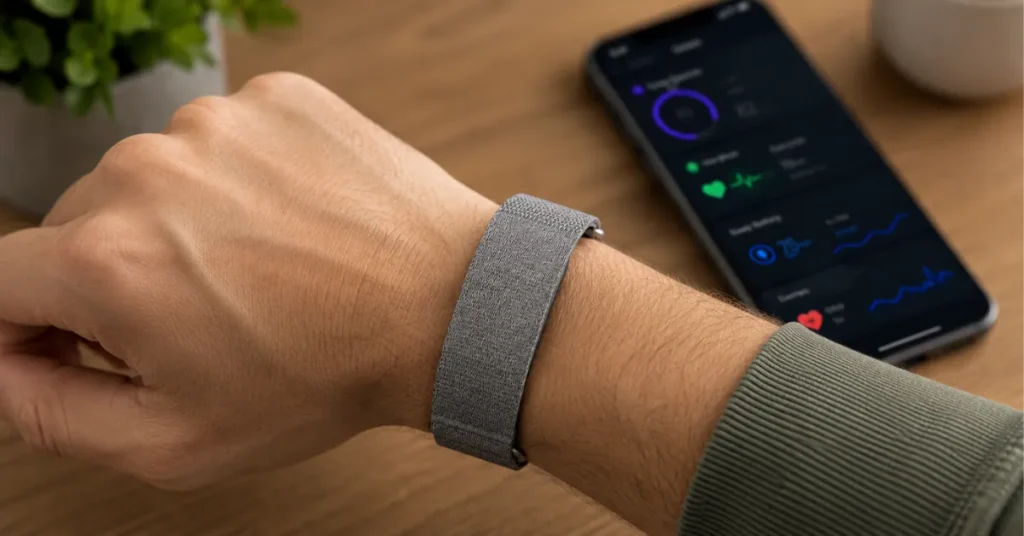
That’s the kind of compromise a first-generation screenless device makes when sensor hardware has to shrink dramatically.
Apple would have a real edge here in leveraging nearly a decade of Apple Watch sensor development and its existing regulatory experience getting ECG and AFib detection cleared for the wrist although Apple hasn’t announced or confirmed which sensor package would actually go into a screenless device, and Apple’s own blood-oxygen feature has run into well-documented regulatory complications in the US, so it isn’t an uncomplicated advantage.
Where Apple would need genuine new ground is AFib and ECG-level detection at the passive-tracking tier — currently that lives on Whoop’s most expensive Life tier ($359/year, WHOOP MG hardware) and on Fitbit Air, while Cirqa skips ECG entirely on its base sensor.
If Apple’s screenless device shipped with any form of passive arrhythmia detection at a mid-tier price, that alone would be a meaningful point of separation, given Apple’s track record getting similar features cleared on the standard Apple Watch.
Worth noting: this same software-first shift is already visible on Apple’s shipping hardware. The Samsung Galaxy Watch9 and Apple Watch Series 12 both landed light on new hardware this year but heavy on new software-driven fitness metrics (Galaxy Watch9’s Fitness Index and Daily Cardio Load are Whoop-style additions) evidence the whole industry, Apple included, is already moving toward the software-first approach a screenless device would just take further.
Hardware & Design: The One Category Nobody Has Nailed
Weight and form factor is genuinely split three ways with no consensus winner. Fitbit Air is the lightest at 12 grams and disappears on the wrist; Whoop 5.0 is marketed as smaller and lighter than its predecessor but isn’t independently confirmed lighter than Fitbit Air; Garmin Cirqa is the heaviest and bulkiest of the three at around 20 grams, and reviewers have specifically called out its sensor module and strap options as feeling too sporty for everyday, all-day wear.
Garmin’s one genuine hardware differentiator is a physical button for manually starting and stopping workouts something neither Whoop nor Fitbit Air offers, both relying entirely on auto-detection.
Apple, which has spent a decade refining the Digital Crown and side button on the Apple Watch, could plausibly bring the most tactile, ergonomically considered hardware of any screenless device yet but this is also the category where Apple’s habit of premium materials (titanium, ceramic, Hermès leather) could work against the entire point of a lightweight, disappear-on-your-wrist tracker if it doesn’t resist the urge to make it feel expensive.
What Would Actually Make People Buy Apple’s Version Over the Rest?
Battery, ownership, and AI depth are the three things that matter here, and it comes down to two areas where Apple is genuinely well positioned:
Ecosystem depth. Google/Fitbit has its own large health-data platform, Garmin has years of training data inside Garmin Connect, and Whoop has built its whole pitch around longitudinal recovery data so ecosystem strength isn’t unique to Apple.
What Apple can combine that the others can’t fully match is a massive existing iPhone install base, years of Apple Health data already sitting on most of those phones, and iPhone-level integration with AirPods and other Apple hardware most rivals don’t touch.
The AI health coach angle specifically. This is reportedly the actual strategic point of the device, not the missing screen. If Apple’s long-rumored AI health coach launches leaning on Apple’s existing FDA-cleared ECG and AFib history on the Apple Watch, that’s a harder thing for Whoop, Google, or Garmin to simply out-spec with a newer sensor generation.
What Apple can’t credibly win on is price. Fitbit Air already owns “cheap,” Cirqa owns “mid-range no-subscription,” and Whoop owns “premium subscription” Apple isn’t slotting in below $99, and going above Whoop’s $359/year tier would be a hard sell with zero track record.
Our estimate, not a reported or leaked figure, is a $250–$350 one-time hardware cost with an optional AI-coaching subscription on top, competing on what’s behind that paywall rather than on being the cheapest thing in the room.
Side-by-Side: What Apple Would Actually Be Up Against
| Whoop 5.0 / MG | Fitbit Air | Garmin Cirqa | Apple — What We’d Expect If It Ships | |
|---|---|---|---|---|
| Price | $199–$359/year (membership only, hardware included) | $99.99 one-time | $199.99 one-time | Our estimate: $250–$350 one-time |
| Battery life | Up to 14 days (verified) | Up to 7 days | Up to 10 days | Our estimate: 7–10 days |
| Subscription required? | Yes, mandatory | No (Premium optional) | No (Connect+ optional) | Likely no for hardware, but AI coaching probably gated |
| Weight | Smaller/lighter than 4.0 (unconfirmed vs. rivals) | 12g (lightest confirmed) | 20g | Unknown |
| Standout feature | Deepest longevity/recovery data, ECG on Life tier | Best value, fastest charging | Physical button, 80+ workout profiles | Ecosystem depth + Apple Health history |
| Biggest weakness | Ongoing cost, no ownership | Shortest battery, AI locked behind Premium | Older sensor gen, bulkier | No track record in this category yet |
| AI coaching | Built into all tiers | Gemini AI, Premium only | Garmin Active Intelligence, Connect+ only | Rumored AI health coach, likely subscription |
The Apple column is analysis, not reported specs nothing about pricing, battery, or features has been confirmed by Apple or leaked through supply-chain sources.
WHOOP Peak – 12-Month Membership – 5.0 Health and Fitness Wearable – $239.00 – Buy on Amazon
Google Fitbit Air – Screenless Activity Tracker with Fitness, Health – $99.99 – Buy on Amazon
Garmin CIRQA Smart Band, No Subscription – $199.99 – Buy on Amazon
The Realistic Timeline
Update, Sept 25, 2026 leading with what’s new: Gurman’s status on this has moved forward a notch. The project is no longer just “ongoing exploration” Apple’s developers are reportedly building actual prototypes of the screenless tracker.
That’s a real step, but it comes with an important caveat Gurman himself flags: a product reaching the prototype stage is not a guarantee it ships. His own reporting points back to the Apple Car, which was cancelled well after it had reached prototyping. The realistic launch window has also shifted with this update instead of “unlikely within 2026,” the current estimate is no earlier than 2028.
There’s a cautionary parallel worth tracking alongside this: per the same Sept 22 Bloomberg report, Apple has reportedly stalled development on a separate rumored device an AI-driven pendant with a built-in camera.
No confirmed reason has been given for the stall, but it’s a reminder that even Apple hardware further along than “exploration” doesn’t always reach shipping shelves. Coverage has drawn comparisons to the poorly received Humane AI Pin, which pursued a similar concept and struggled badly at launch.
None of this is imminent. To recap what’s actually confirmed versus speculative:
Confirmed near-term: Apple Watch Series 12 and Ultra 4, both iterative updates, plus possibly the first ceramic Apple Watch model since 2016
Not expected: Any new wearable form factor announcement at Apple’s September 2026 event
Explicitly uncertain: Gurman says a screenless Apple Watch is unlikely even within 2026, describing this as ongoing exploration rather than a committed product
Apple has a long track record of prototyping design directions internally that never ship — the original Apple Watch’s fashion positioning is a good example of an idea Apple walked back entirely after launch.
A screenless tracker, a circular case, or both could just as easily end up shelved as a future generation.
Bottom Line
Nobody in this category has combined long battery life, no subscription, and genuinely smart AI coaching in one device yet — each brand picked two out of three and built its pitch around that trade-off.
If Apple actually ships a screenless wearable, the interesting question was never “will it have a screen.” It’s whether Apple can be the first major player to give people all three at once. Based on Apple’s subscription habits elsewhere in its ecosystem, that’s the part worth watching skeptically not the hardware.
The project clearing prototyping doesn’t change that conclusion it just moves the timeline conversation from “if” toward “when, and at what price,” with 2028 now the more realistic earliest window rather than 2026.
FAQ
Is Apple actually making a screenless wearable?
Not confirmed yet
Bloomberg’s Mark Gurman reports that Apple is exploring the idea as part of a broader Apple Watch redesign. However, Gurman says it’s unlikely to happen even in 2026. As of Sept 25, 2026, Gurman reports the project has advanced to internal prototyping still not a confirmed product.
When would an Apple screenless tracker launch?
No official timeline exists. The latest reporting (Sept 25, 2026) suggests a launch no earlier than 2028, and Apple’s September 2026 event is not expected to include any new wearable form factor.
How much would an Apple screenless wearable cost?
Apple hasn’t leaked or confirmed anything on pricing. Going by where the three existing players have already staked out their territory (cheap, mid-range, premium-subscription), Apple has room to land somewhere in the $250–$350 one-time range without directly undercutting anyone and staying meaningfully below the Apple Watch SE 3’s $219/£249 starting price would also help Apple avoid the device cannibalizing its own watch lineup.
Would Apple’s screenless tracker require a subscription?
Probably not for the hardware itself, going by how Fitbit and Garmin structured their devices. But Apple has a habit of gating advanced features behind services like Fitness+, so don’t be surprised if the rumored AI coaching layer ends up being a paid add-on rather than included.
How does Garmin Cirqa compare to Whoop and Fitbit Air right now?
Cirqa sits in the middle: a $199.99 one-time cost like Fitbit Air rather than Whoop’s mandatory subscription, with a deeper fitness feature set than Fitbit Air but an older sensor generation than what’s expected from a first Apple device. See our full Garmin Cirqa breakdown for the complete picture.
Sources:-Bloomberg and Tech Advisor