
Last Updated: August, 2026 — Fitbit Air available now at $99.99 — reviewed after real-world testing — Garmin Vivosmart 6 confirmed via regulatory filings — launch imminent — Smart Alarm feature confirmed on Vivosmart 6 – free, no subscription needed Fitbit Air GPS accuracy tested: only 40 meters short on a 5K vs dedicated Garmin watch Google Health app replaced Fitbit app May 7, 2026 — all reviews updated — Garmin Connect+ concerns remain — what stays free on Vivosmart 6 is still unclear
Here is the actual question most people are asking right now — not “which has better specs,” but something closer to this:
“I want to track my sleep, steps, and maybe some runs. I don’t want to pay a monthly fee forever. The Fitbit Air is $99 right now. Should I just buy it, or wait for the Garmin Vivosmart 6?”
That is the real decision. And it has a clear answer — it just depends on one thing: whether you need GPS or not.
I’ll explain exactly what I mean.
⚡ SmartWatchInsight Quick Answer
- You walk, do yoga, gym, or casual runs
- You primarily want sleep and recovery data
- Saving $50–$80 matters to you
- You want it working this week
- You run or cycle outdoors regularly
- You want GPS without carrying your phone
- You’re already using Garmin Connect
- Body Battery metric matters to you
Buy neither if:
You train seriously and need GPS + training analytics → The Garmin Forerunner 70 at $249 gives you everything these bands do plus real GPS accuracy, VO2 max, training load, and Garmin’s full coaching platform. Read our – Garmin Forerunner 70 review before deciding or Check price on Amazon.
You want a screen on your wrist → Either the Fitbit Charge 6 (~$85 on Sale) with built-in GPS and ECG, or the Garmin Vivoactive 6 (~$299) for the best AMOLED display and training tools in a slim watch.
The One Thing That Decides It
The Fitbit Air has no built-in GPS. If you go for a run without your phone, the Air cannot track your route, distance, or pace. It uses Connected GPS — which means your phone has to be with you.
The Garmin Vivosmart 6 has built-in GPS — the first time in the Vivosmart series’ history. You can leave your phone at home and still get accurate distance and pace data.
That single difference determines which one is right for you.
If you regularly run or cycle outdoors and sometimes go without your phone — wait for the Vivosmart 6.
If you mostly walk, go to the gym, do yoga, or always carry your phone anyway — the Fitbit Air at $99 makes more financial sense.
Everything else — sleep tracking, heart rate, HRV, stress, recovery — both devices do reasonably well.
Fitbit Air — What It Actually Is
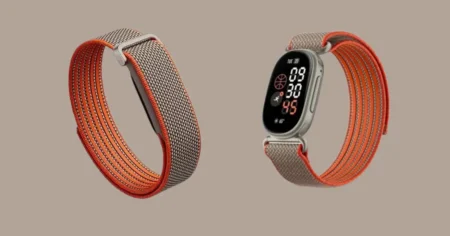
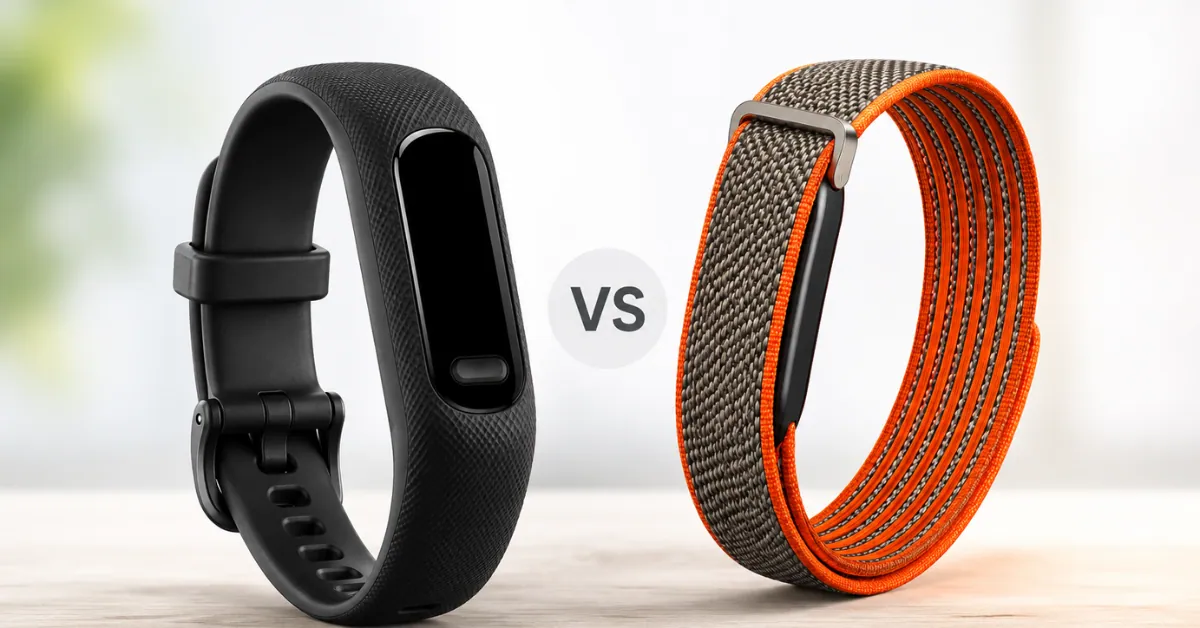
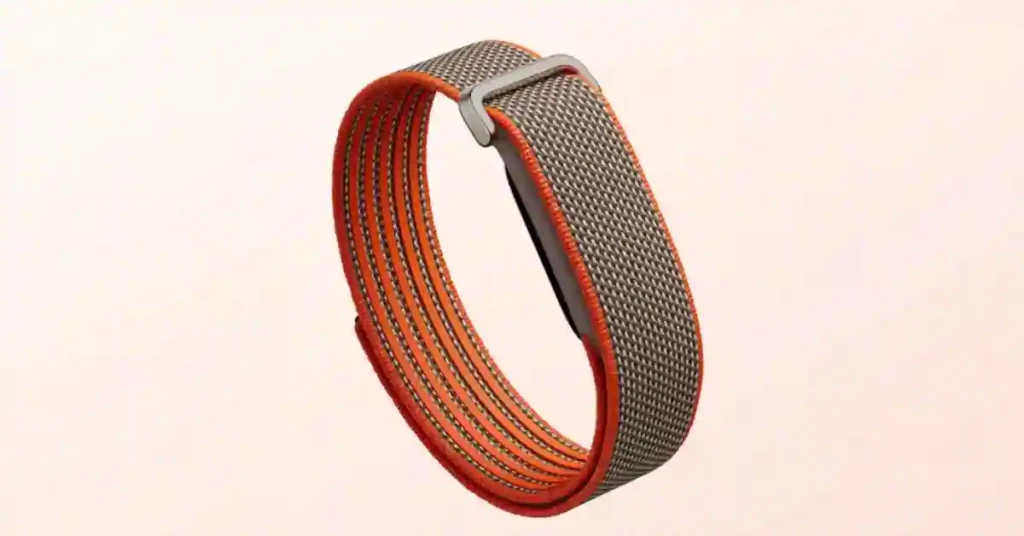
The Fitbit Air launched on May 26, 2026 at $99.99. It’s a screenless fitness band — no display at all, just a small pebble-shaped tracker that clips into a soft band. Google’s answer to Whoop, at less than half the price.
I’ve been tracking user reports, real-world test data, and the DC Rainmaker deep-dive since launch. Here is what the data actually shows.
Sleep tracking is the headline feature — and it delivers.
Tom’s Guide tested the Fitbit Air against a Garmin Forerunner 70 for a full week of nightly sleep. The results were pretty close across the board, suggesting the Fitbit Air is just as capable of logging sleep quality as a device 2.5 times its cost. That’s a strong result for a $99 device.
Heart rate during runs is better than expected.
A real-world 5K test comparing Fitbit Air against a high-end Garmin Forerunner showed an identical 135 bpm average heart rate and only a 1 bpm difference in max heart rate. Fitbit Air came in 40 metres shorter on distance — a small difference over 5K.
Honestly? For a $99 screenless tracker using Connected GPS, that’s impressive. I wasn’t expecting it to hold up that well.
Where it falls short:
The gap appears when you look beyond the headline numbers. Garmin gives much more training context — training effect, exercise load, stamina, power, cadence, stride length, and running dynamics. Fitbit Air keeps things much simpler.
Also — there’s no screen. That means no live heart rate, no pace, no distance mid-run. You just run and check results on your phone afterward. For some people, that’s freeing. For runners training to a pace target, it’s a real limitation.
The Google Health app situation:
The original Fitbit app was replaced by Google Health on May 7, 2026. The new app is cleaner and more organized than the old Fitbit app.
Google Health Premium — AI coaching powered by Gemini — is $9.99/month, but core features including sleep tracking, heart rate, HRV, and activity are completely free. No subscription needed for the basics.
What Fitbit Air tracks (free):
- 24/7 heart rate
- Sleep stages — light, deep, REM
- HRV status
- SpO2 blood oxygen
- AFib rhythm alerts
- Steps and active minutes
- Stress management score
- Cardio Load — accumulates across the full day, not just logged workouts
- Smart Wake alarm — wakes you in a lighter sleep phase
What requires Google Health Premium ($9.99/month):
- Daily Readiness Score
- Advanced AI coaching from Gemini
- Detailed nutrition guidance
For most people, the free tier is enough. But worth knowing before you buy.
Wondering how Fitbit Air’s $99.99 price point holds up against Whoop, Garmin Cirqa — and a possible Apple entrant? We broke down the full screenless tracker landscape here
Garmin Vivosmart 6 — What We Know So Far
The Vivosmart 6 has not officially launched as of August, 2026. But enough has leaked that we have a clear picture.
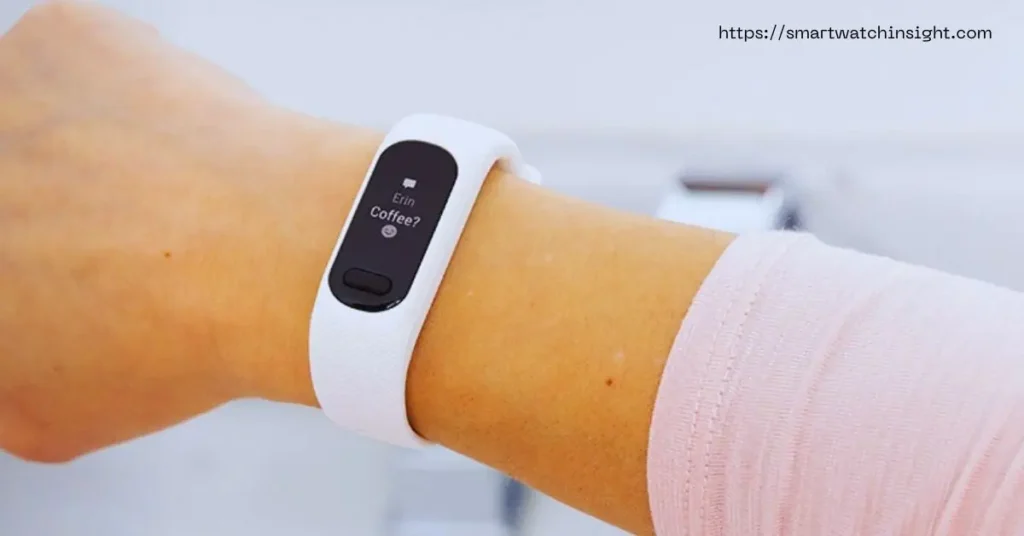
What’s confirmed via regulatory filings:
- Built-in standalone GPS — first time in Vivosmart history
- 30+ sports modes (up from 13 on Vivosmart 5)
- Garmin’s Smart Alarm feature — free, no subscription required
- Model number A04986 registered in Korea’s regulatory database
- Described on Garmin’s Indonesian website as a “stylish sports watch suitable for both men and women”
- Garmin Connect app compatible
- Expected price: $149 to $180
What’s leaked but not confirmed:
- AMOLED display — would be a big upgrade from Vivosmart 5’s monochrome OLED
- Elevate Gen 5 heart rate sensor — same as Fenix 8 and Forerunner 970
- Battery life: 7+ days expected
- Body Battery metric — Garmin’s energy monitoring system
What we don’t know yet:
- Whether Connect+ gates any advanced features
- Exact launch date — twin launch with Garmin Cirqa is possible
- Final US retail price
One confirmed feature that nobody else is covering:
Garmin’s Smart Alarm is currently only available on the Vivosmart 6 — it works similarly to Fitbit’s smart wake alarm, except you don’t have to pay a monthly premium to access it. It’s not one of those Connect+ paywalled features.
Users preselect a 30-minute wake-up window. The Vivosmart 6 decides when to start waking you based on your sleep cycle — if you’re in REM at the start of the window, it waits until you’ve moved into a lighter stage. That’s genuinely useful, and it’s free.
Read our detailed report on the Garmin Vivosmart 6 repair database leak, which confirms the upcoming launch in June 2026.
Head to Head — What Actually Matters
| Fitbit Air | Garmin Vivosmart 6 | |
|---|---|---|
| Price | $99.99 — available now | $149–$180 — not launched yet |
| Screen | ❌ No screen | ✅ Small display (likely AMOLED) |
| Built-in GPS | ❌ Connected GPS only | ✅ Standalone GPS |
| Sports modes | Limited | 30+ including swimming |
| Heart rate sensor | Elevate Gen 4 | Elevate Gen 5 (expected) |
| Sleep tracking | ✅ Excellent | ✅ Excellent + Smart Alarm free |
| HRV | ✅ Yes | ✅ Yes |
| Body Battery | ❌ No | ✅ Yes |
| AFib detection | ✅ Yes | ✅ Yes (expected) |
| Stress tracking | ✅ Yes | ✅ Yes |
| Women’s health | ✅ Yes | ✅ Yes |
| Subscription needed | Optional $9.99/mo | Optional Connect+ $6.99/mo |
| App | Google Health | Garmin Connect |
| Water resistance | 50m | 5 ATM (expected) |
| Battery | 7 days | 7+ days (expected) |
| iPhone support | ✅ Full | ✅ Full |
| Android support | ✅ Full | ✅ Full |
Who Should Buy Fitbit Air Right Now
You are the right buyer for the Fitbit Air if you fit one of these situations:
You mostly walk, do yoga, or go to the gym. You don’t need GPS for any of these. The Fitbit Air handles all of them well, costs $99, and is available today.
Sleep tracking is your primary reason for buying a tracker. Tom’s Guide tested it against a Garmin Forerunner 70 nightly for a week and found results close across the board. For $99, the sleep data quality is genuinely impressive.
You always have your phone with you when you work out. If your phone comes along on every run, Connected GPS works fine. The distance data isn’t far off — only 40 meters short on a 5K in real-world testing.
You want to try screenless tracking without a big commitment. At $99 with no required subscription, the Fitbit Air is the lowest-friction way to experience this category. If you don’t like it, you haven’t lost much.
You don’t use Garmin for anything else. The Vivosmart 6’s best advantage — Body Battery, Garmin Connect integration, training ecosystem — only matters if you’re already in Garmin’s world. If you’re not, Fitbit Air is simpler and cheaper.

Who Should Wait for Garmin Vivosmart 6
You run or cycle outdoors without your phone. This is the clearest reason to wait. Built-in GPS on the Vivosmart 6 means you can leave your phone at home on runs and still get accurate tracking. Fitbit Air cannot do this.
You’re already using a Garmin watch. If you train with a Forerunner or Fenix, your data already lives in Garmin Connect. Adding a Vivosmart 6 to that setup means one platform, one app, one complete picture of training and recovery. Adding a Fitbit Air means a second app that doesn’t talk to Garmin Connect.
Body Battery matters to you. Garmin’s Body Battery is one of the most practically useful health metrics available — a 0-100 energy score that combines HRV, sleep, stress, and activity. It tells you whether your body is ready to push hard or needs rest. Fitbit Air doesn’t have an equivalent. The Vivosmart 6 will.
You want a screen. Fitbit Air has absolutely no display. Some people love that simplicity. Others find it frustrating to have zero on-wrist feedback. If you want even a basic screen to check the time or see a notification, wait for the Vivosmart 6.
You swim regularly. The Vivosmart 6 is expected to include swim tracking as one of its 30+ sports modes. Water resistance is expected at 5 ATM. Fitbit Air is water resistant but has limited swim-specific tracking.
The Subscription Question — Both Devices
Neither device requires a subscription for core health tracking. But both have optional paid tiers.
Fitbit Air:
- Free: sleep, HRV, heart rate, AFib, steps, Cardio Load, Smart Wake
- Google Health Premium ($9.99/month): Daily Readiness Score, Gemini AI coaching, detailed nutrition
Garmin Vivosmart 6:
- Free: sleep, HRV, heart rate, Body Battery, stress, GPS tracking, sports modes, Smart Alarm
- Connect+ ($6.99/month): advanced coaching, some Connect features — exact gating unknown
The concern in the Garmin community is real: Connect+ is growing, and Garmin has been gradually moving features behind it. What stays free on the Vivosmart 6 is unknown until it officially launches.
Based on the Smart Alarm confirmation — which is explicitly free — Garmin seems aware they can’t charge for basics. But it’s worth watching.
At face value, Garmin’s $6.99/month is cheaper than Google’s $9.99/month if you choose to subscribe. Most buyers for both devices will likely stay on the free tier.
What About Fitbit Charge 6 — Is That a Better Option?
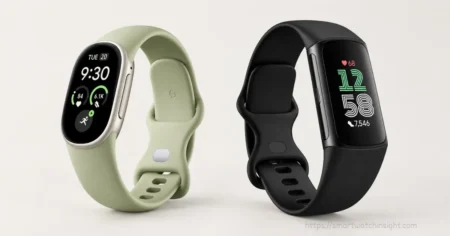
Fair question. The Fitbit Charge 6 at ~$159 sits between these two in price and is available right now with a screen and built-in GPS.
Choose Charge 6 over Fitbit Air if: You want a screen and GPS from Fitbit today. The Charge 6 has ECG, Google Wallet, Google Maps integration, and a color AMOLED display.
Choose Fitbit Air over Charge 6 if: You prefer screenless tracking and want to save $60. Sleep tracking and passive health monitoring are comparable.
Choose Vivosmart 6 over Charge 6 if: You want Garmin’s ecosystem, Body Battery, and a more complete training platform.
For a complete hands-on analysis, check our Fitbit Charge 6 Review After 30 Days: Honest Real-World Experience covering battery life, tracking accuracy, and daily usage.
Prefer a tracker with a screen? Leaks put Google’s Fitbit Edge between the Fitbit Air and the Pixel Watch. See how it compares with the Charge 6 in our Edge vs Charge 6 guide.
What About the Garmin Cirqa?
If you’ve been following the screenless tracker space, you’ve probably heard about the Garmin Cirqa — Garmin’s direct Whoop competitor, expected at ~$420 with no screen and no mandatory subscription.
The Cirqa and Vivosmart 6 are different products for different buyers:
- Vivosmart 6 — has a screen, has GPS, targets everyday fitness users
- Cirqa — screenless, no GPS, targets recovery-focused athletes who want Whoop-style tracking
If recovery data is your primary interest and you’re already deep in Garmin’s ecosystem, read our Garmin Cirqa vs Whoop comparison for the full picture.
Quick Decision Guide
I walk and go to the gym. I mostly care about sleep: → Fitbit Air at $99. No GPS needed. Available now.
I run outside 3-4 times a week without my phone: → Wait for Vivosmart 6. Built-in GPS changes everything for this use case.
I already use a Garmin watch: → Wait for Vivosmart 6. Keep your data in one place.
I want a screen: → Fitbit Air is not for you. Consider Fitbit Charge 6 (~$159) or Garmin Vivoactive 6 (~$299) instead.
Budget is the deciding factor: → Fitbit Air at $99. Nothing else in this category comes close at that price.
I want to track swimming seriously: → Wait for Vivosmart 6. Fitbit Air has limited swim tracking.
If you’d rather stick with a screen, Samsung’s upcoming Galaxy Fit 4 is worth watching — early FCC filings confirm a Bluetooth upgrade, though key specs like battery and GPS are still unconfirmed.

Related Reading
- Screenless tracker comparison: Garmin Cirqa vs Whoop 5.0 — Should You Wait or Buy Now?
- Best Garmin running watches: Best Garmin Running Watches 2026
- Full Garmin Vivosmart 6 leaks: Garmin Vivosmart 6 — Everything We Know
- Best fitness trackers for women: Best Smartwatches for Women 2026
- Garmin Cirqa vs Fitbit Air (2026): Is Garmin’s $500 Tracker Really Worth 5x the Price?
Sources
- Google official Fitbit Air product page — confirmed specs and $99.99 pricing
- Garmin official Vivosmart 5 product page — current generation specs for comparison
FAQ
Is Fitbit Air worth buying in 2026?
At $99 with no required subscription, yes — for casual fitness trackers who want sleep tracking, heart rate, HRV, and AFib monitoring without a screen or monthly fee. It’s not the right choice for runners who need GPS or anyone who wants live on-wrist stats.
Does Fitbit Air have GPS?
No standalone GPS. It uses Connected GPS — meaning your phone needs to be nearby to track route and distance. For casual runs with your phone, the accuracy is solid. For phone-free outdoor activity tracking, wait for the Garmin Vivosmart 6.
When does Garmin Vivosmart 6 come out?
No official date. Regulatory filings cleared in late 2025, and Garmin’s product pages briefly showed it in January 2026. A twin launch with the Garmin Cirqa is possible. Based on current signals, launch is expected soon — most likely before the end of summer 2026.
How much does Garmin Vivosmart 6 cost?
No official price. Based on the Vivosmart 5’s $149 launch price and the GPS addition, most analysts estimate $149 to $180. Official pricing will be announced at launch.
Is Garmin Vivosmart 6 better than Fitbit Air?
For runners who need GPS and Garmin ecosystem users — yes, the Vivosmart 6 will likely be the better choice. For casual fitness trackers on a budget who don’t need GPS — Fitbit Air at $99 is the smarter buy right now.
Does Fitbit Air require a subscription?
No. Core features including sleep tracking, heart rate, HRV, AFib alerts, steps, and Cardio Load are all free. Google Health Premium at $9.99/month adds Daily Readiness Score and Gemini AI coaching — optional, not required.
Will Garmin Vivosmart 6 need a subscription?
Core features are expected to be free, including GPS, sleep, heart rate, Body Battery, and the new Smart Alarm. Garmin’s Connect+ subscription at $6.99/month exists and there are community concerns about feature gating — but Smart Alarm has been confirmed as free, which is encouraging.
Is Fitbit Air good for sleep tracking?
Yes. Tom’s Guide tested it nightly for a week against a Garmin Forerunner 70 and found results close across the board. For $99, the sleep data quality is significantly better than most buyers expect.
Can I swim with Fitbit Air or Garmin Vivosmart 6?
Fitbit Air is water resistant (50m) but has limited swim-specific tracking. Garmin Vivosmart 6 is expected to include dedicated swim tracking as part of its 30+ sports modes.
Disclaimer: Garmin Vivosmart 6 specs are based on regulatory filings and leaks as of August, 2026 — not official Garmin announcements. Fitbit Air data is based on real-world testing reports from multiple independent sources.