
Smartwatch fall detection can save lives. It has also missed falls that mattered. Both things are true — and understanding why the accuracy varies so widely is what actually helps you make a good decision.
You will see accuracy numbers ranging from 4.7% to 99% depending on what you read. That range is not a contradiction — it reflects genuinely different situations, devices, and study conditions.
This guide explains what the numbers actually mean, where each major brand sits, and what the research says before you rely on any of them.
Looking for the best smartwatch with fall detection? See our complete ranked guide.
Why Accuracy Numbers Vary So Widely
Before jumping to brand-specific figures, it helps to understand why you will see such a wide range of numbers across different sources.
Fall detection accuracy depends on three things:
1. Who was tested Studies using young, healthy adults performing scripted falls produce higher numbers than studies involving elderly adults with mobility limitations in real-world settings.
2. What type of falls were included High-impact falls from standing height are far more reliably detected than slow slides from a chair, falls onto soft surfaces, or falls by wheelchair users. A study focused only on hard falls will always show higher accuracy.
3. Lab conditions vs. real world Controlled lab testing consistently produces higher detection rates than real-world use. In a lab, falls happen at the right speed, with the right impact, on a hard surface. Real-world falls rarely cooperate.
Keep these three factors in mind as you read every accuracy figure below — they explain the entire range.
The Research — What Studies Actually Show
Peer-Reviewed Study: 77% Sensitivity, 99% Specificity
The most methodologically rigorous independent study on smartwatch fall detection was published in JMIR Formative Research (NIH/PubMed). Researchers tested 226 induced falls — forward, backward, left, and right — using three different smartwatches with two different operating systems.
Results:
- Overall sensitivity (detecting real falls): 77%
- Specificity (avoiding false alarms): 99%
- False-positive rate: 1.7%
- False-negative rate: 16.4%
- Overall accuracy: 89%
The study also found that falls were more likely to be detected if they occurred on the same side as the wrist wearing the watch — a practical detail most guides miss.
Source: Brew B, et al. “Effectiveness of a Smartwatch App in Detecting Induced Falls.” JMIR Formative Research, 2022. Read on PubMed
Industry Testing: 73%–98% Accuracy Range
Independent testing by SecuLife found that fall detection devices are 73% to 98% accurate overall. The wide range reflects the same variables — fall type, device, and conditions.
The key finding: sudden trips and hard drops are detected easily. Slower, sliding falls are missed more frequently.
Source: SecuLife. “How Accurate Are Fall Detection Devices?” March 2026. Read at SecuLife
Head/Torso/Wrist Comparison
Research shows fall detection sensors worn on the head, torso, or pelvis can achieve approximately 95% accuracy — significantly higher than wrist-worn smartwatches.
This benchmark does not apply to wrist-worn consumer smartwatches. The wrist is not the optimal sensor location for fall detection — it is simply where people wear watches. Purpose-built medical alert devices worn closer to the center of gravity consistently outperform wrist-worn consumer smartwatches.
Source: SafeHome.org testing data, citing published research. Read at SafeHome.org
Deep Learning Research: Up to 99.59% in Lab Conditions
A study published in ScienceDirect using deep learning algorithms on smartwatch accelerometer data demonstrated fall detection accuracy of 99.59% under controlled conditions.
Important context: this represents the theoretical ceiling of what smartwatch hardware can achieve with optimal algorithms — not what current consumer devices deliver in real-world use.
Apple Watch Fall Detection Accuracy
Apple does not publish official accuracy figures. Here is what independent research shows:
81.9% — 2024 Medical Analysis
A 2024 analysis concluded that Apple Watch was generally effective in identifying actual falls, with a sensitivity of 81.9%. However, the same analysis noted a significant number of false positives.
Source: Davis Phinney Foundation. “Wearable Tech and Fall Detection: Opportunities and Limitations.” April 2025. Read at Davis Phinney Foundation
60% — Consumer Reports Independent Testing
Independent testing by Consumer Reports found that Apple Watch fall detection successfully identified only about 60% of severe falls in controlled simulations.
This gap between 81.9% and 60% reflects Apple’s conservative algorithm design. Apple deliberately tunes its system to minimize false positives — prioritizing fewer false alarms over maximum sensitivity. The logic: frequent false alarms cause users to disable the feature entirely, which results in zero falls detected. A conservative algorithm that misses some real falls is better than a disabled feature that misses all of them.
Source: Consumer Reports findings cited in Retirement Living Apple Watch Fall Detection Review. Read at Retirement Living
4.7% — Wheelchair Users
A University of Illinois study of Apple Watch fall detection among wheelchair users found that from 300 fall trials, the Apple Watch detected only 14 falls — a sensitivity of 4.7%, with a false negative rate of 95.3%.
This is not a minor footnote. Apple Watch fall detection was designed for standing falls. The physics of a wheelchair fall produce completely different sensor data, and the algorithm misses almost all of them.
Source: University of Illinois. “Sensitivity of Apple Watch fall detection feature among wheelchair users.” Published on Illinois Experts.
Apple Watch Accuracy Summary
| Study / Source | Detection Rate | Notes |
|---|---|---|
| 2024 Medical Analysis | 81.9% | Controlled conditions, active adults |
| JMIR Peer-Reviewed Study | 77% | Multiple smartwatches, 4 fall directions |
| Consumer Reports | ~60% | Severe falls, independent consumer testing |
| Wheelchair users (U of I) | 4.7% | Algorithm not designed for this use case |
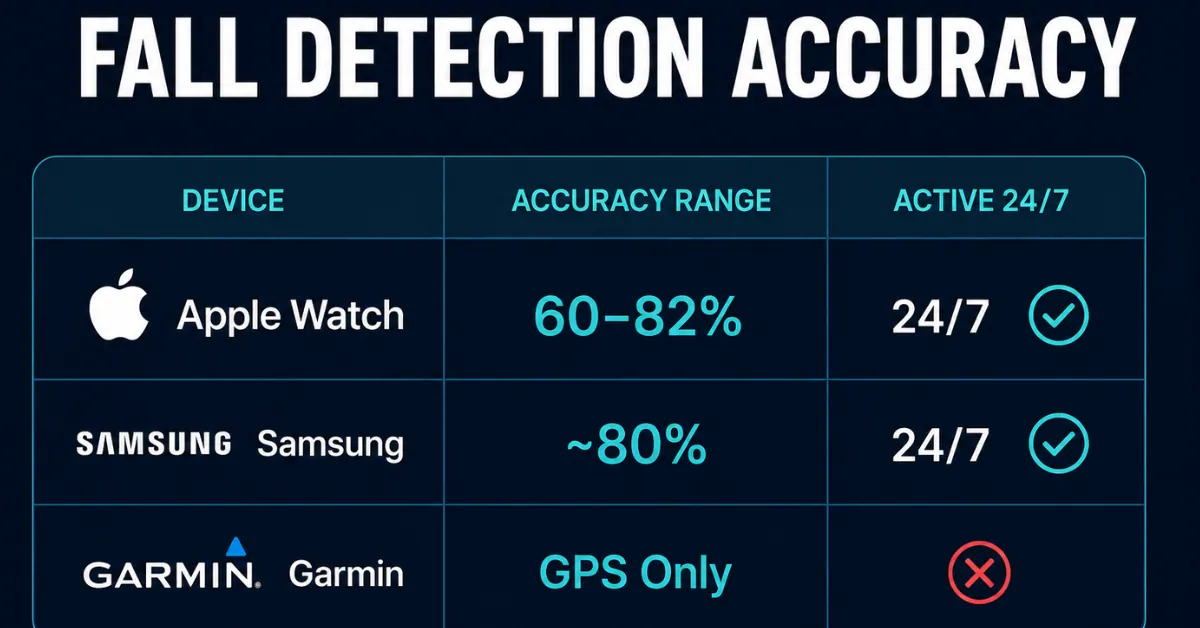
Honest summary: Apple Watch detects between 60% and 82% of real falls for active, mobile adults. For wheelchair users, it is effectively non-functional as a fall detection device.
All these options include fall detection with no monthly fee — see our dedicated no-subscription guide.
Samsung Galaxy Watch Fall Detection Accuracy
Samsung does not publish official accuracy figures. Independent consumer testing by SafeHome.org found Samsung Galaxy Watch 7 correctly detected approximately 8 out of 10 falls in simulated testing — slightly higher than Apple in comparable conditions.
Samsung’s key advantage: adjustable sensitivity
Unlike Apple, Samsung lets you set fall detection sensitivity to High, Medium, or Low in the Galaxy Wearable app under Safety and Emergency settings.
- High sensitivity: Lower threshold — more falls detected, including lighter ones. Better for less mobile seniors. Slightly more false positives.
- Medium: Balanced default.
- Low: Fewer false positives, but misses lighter falls.
This adjustment matters. For a senior who takes slower or lighter falls, setting sensitivity to High can meaningfully improve real-world detection — something Apple’s fixed algorithm cannot offer.
Critical setup reminder: Samsung fall detection is NOT active by default. It must be manually enabled in the Galaxy Wearable app. This is the most common mistake buyers make.
On a budget? See our picks for best fitness trackers under $100.
Garmin Fall Detection — A Fundamentally Different Situation
Garmin’s Incident Detection only works during GPS-tracked activities — walking, running, or cycling. It does not monitor passively throughout the day.
This means Garmin will not detect a fall at home, in the kitchen, or getting out of bed at night. The majority of senior falls happen in exactly these situations.
Within its intended use case — falls during outdoor GPS activities — Garmin’s incident detection is reliable. When triggered, it sends an automated SOS text and email with GPS coordinates to emergency contacts via the Garmin Connect app. It does not call 911 directly.
The right question is not “how accurate is Garmin fall detection” — it is “does Garmin fall detection cover the situation I actually need it for?”
For active adults who want safety during outdoor walks or hikes: Garmin is a solid choice with the added benefit of much longer battery life.
For anyone whose main concern is falling at home: Apple Watch or Samsung Galaxy Watch are the appropriate tools.
When Fall Detection Fails — Situations That Trip It Up
Falls It Commonly Misses
Slow or soft falls The algorithms are trained primarily on high-impact falls. Slower, controlled falls where the person partially catches themselves register differently and are more likely to be missed.
Falls onto soft surfaces Falling onto a bed, sofa, or thick carpet produces a different impact signature than a hard floor. Detection rates are lower.
Falls from a seated or lying position Sliding out of a chair or rolling off a bed produces different motion data than a standing fall. These are more likely to be missed across all consumer smartwatches.
Wheelchair falls As covered above — Apple Watch is near-useless for wheelchair users. Samsung with High sensitivity is a better option but has not been studied as specifically.
Getting up too quickly The automatic emergency contact trigger requires sustained motionlessness after the fall. If the person gets up quickly — even while injured — the watch assumes they are okay and does not trigger the automated response.
False Positives — When It Fires When It Shouldn’t
Vigorous arm movements — chopping vegetables, clapping, contact sports, suddenly braking in a vehicle — can occasionally trigger fall detection alerts. Apple’s conservative algorithm minimizes these. Samsung on High sensitivity experiences more of them.
How to Maximize Fall Detection Performance
Wear it correctly One to two finger-widths above the wrist bone. Snug against the skin with no gap. Not on the wrist bone. Not loose.
Enable it — it may not be on by default
Apple Watch (under 55): Watch app on iPhone → Emergency SOS → Fall Detection → Toggle on → Always On
Samsung Galaxy Watch (all users): Galaxy Wearable app → Safety and Emergency → Hard Fall Detection → Toggle on → Set sensitivity to High for less mobile users
Garmin: Start a GPS activity — Incident Detection activates automatically once configured in Garmin Connect → Safety & Tracking
Add emergency contacts before you need them Fall detection that fires with no contacts configured cannot alert anyone.
Test it Drop the watch firmly onto a hard floor from standing height. Confirm your emergency contacts receive the test alert. A watch that has not been tested is not a watch you can rely on.
Consumer Smartwatch vs. Dedicated Medical Alert Device
Research shows fall detection sensors worn on the head, torso, or pelvis achieve approximately 95% accuracy — meaningfully higher than wrist-worn consumer watches. Purpose-built medical alert devices consistently outperform consumer smartwatches for fall detection reliability.
| Consumer Smartwatch | Medical Alert Device | |
|---|---|---|
| Detection rate | 60–82% (standing falls) | 90%+ |
| 24/7 monitoring | Apple, Samsung: Yes | Yes |
| Calls 911 | Apple, Google: Yes | Via operator |
| Monthly fee | None | $30–$50/month |
| Works without phone | Cellular models only | Yes — always |
| Professional monitoring | No | Yes |
For most active, lower-risk adults with reliable emergency contacts, a consumer smartwatch provides meaningful protection at zero ongoing cost. For high-risk individuals, wheelchair users, or anyone living completely alone, dedicated medical alert devices provide a higher reliability level.
Accuracy Comparison — Quick Reference
| Watch | Detection Rate | 24/7 | Calls 911 | Adjustable |
|---|---|---|---|---|
| Apple Watch | 60–82% (active adults); 4.7% (wheelchair) | Yes | Yes | No |
| Samsung Galaxy Watch | ~80% | YEs | Texts contacts | Yes |
| Garmin (all models) | Reliable during GPS activity only | GPS only | No | No |
| Medical alert device | 90%+ | Yes | Via operator | Varies |
Frequently Asked Questions
What percentage of falls does Apple Watch detect?
Between 60% and 82% for active, mobile adults depending on the study. Consumer Reports testing found approximately 60% of severe falls detected. A 2024 medical analysis found 81.9%. For wheelchair users, detection is approximately 4.7% — essentially non-functional for this group.
Is Samsung fall detection more accurate than Apple Watch?
In independent consumer testing, Samsung Galaxy Watch 7 detected approximately 8 in 10 falls — slightly higher than Apple in comparable tests. Samsung’s adjustable sensitivity gives it an additional advantage for less mobile users who need a lower detection threshold.
Why does Apple Watch miss so many falls for wheelchair users?
Apple’s algorithms were trained on standing falls — the physics of a wheelchair fall produce completely different sensor data. The University of Illinois study found only 4.7% of wheelchair falls detected. Apple Watch is not an appropriate primary safety device for wheelchair users.
Related Guides
- 9 Best Smartwatches for Seniors With Fall Detection — Full Ranking
- Best Fitness Trackers Under $100 in 2026
- Best Rugged Smartwatches in 2026
Research sources: JMIR Formative Research peer-reviewed study PMC8981002 (2022); Davis Phinney Foundation wearable tech analysis (2025); Consumer Reports independent testing cited in RetirementLiving.com review; University of Illinois wheelchair users study; SafeHome.org expert device testing; SecuLife accuracy research (2026); ScienceDirect deep learning study (2022). Apple Watch fall detection behavior sourced from Apple Support documentation. All external links open in new tab. Last updated June 2026.