
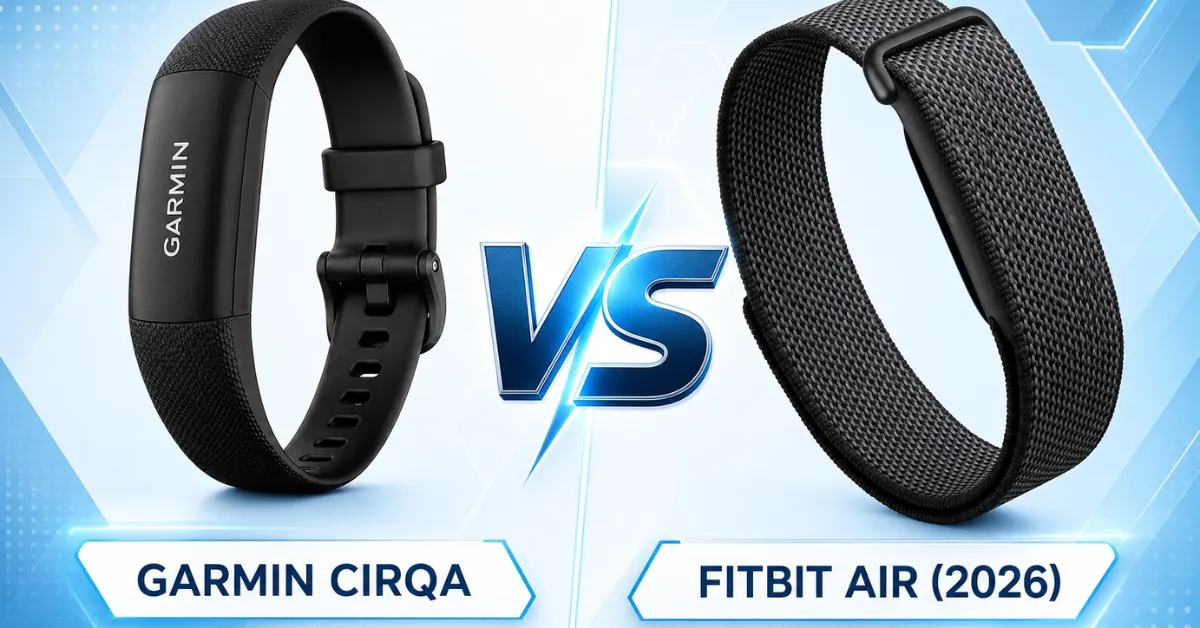
Short answer: The Fitbit Air costs $99 and is available right now. The Garmin Cirqa is rumored to cost around $507 and hasn’t launched yet. Both are screenless fitness trackers — but they’re targeting very different people. The Fitbit Air is for mainstream users who want simple, distraction-free health tracking. The Garmin Cirqa appears to be aimed at serious athletes already deep in the Garmin ecosystem. The right choice depends entirely on who you are — and we’ll tell you exactly which one fits you by the end of this article.
Honestly, I didn’t expect to be writing this comparison in 2026.
Screenless fitness trackers were supposed to be a niche product for hardcore athletes — Whoop users, Oura Ring devotees, the people who track HRV before they’ve had their morning coffee. And then Google launched the Fitbit Air at $99, screenless tracker sales jumped 88% last year, and suddenly every major fitness brand wanted a piece of the action.
Now Garmin is reportedly joining the party with the Cirqa — a screenless fabric band that leaked through a Ukrainian retailer with a jaw-dropping price tag of around $507. That’s more than five times what the Fitbit Air costs.
So is the Garmin Cirqa five times better? Or is this one of those cases where brand loyalty is being priced into the product? Let’s find out.
Important note: The Garmin Cirqa has not officially launched as of June 2026. All Cirqa specs and pricing come from a Ukrainian retailer leak. Garmin has not confirmed the $507 price. We’ll update this article the moment Garmin makes an official announcement.
Garmin Cirqa vs Fitbit Air -Quick Overview
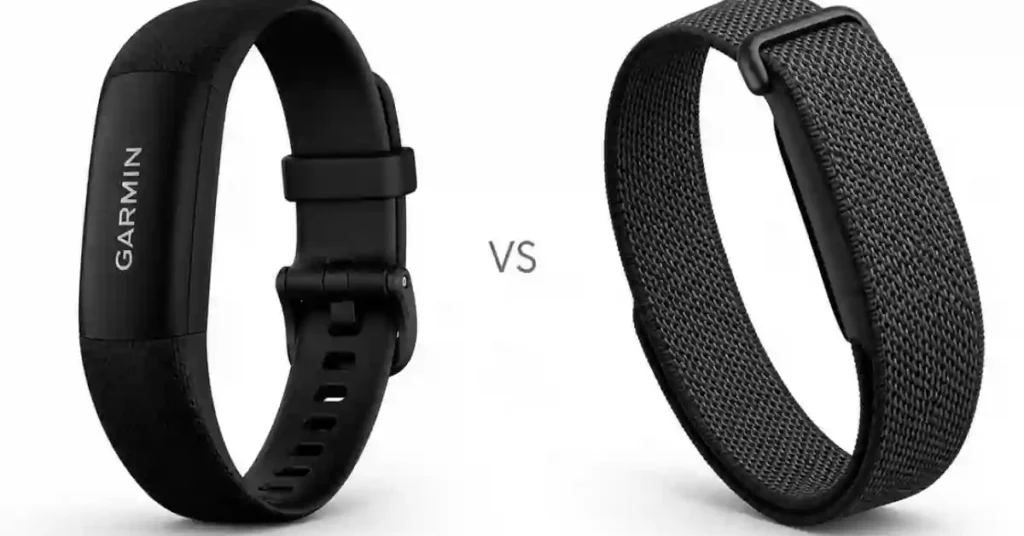
Both devices are screenless. Both track heart rate, sleep, HRV, and activity around the clock. Both pair with a smartphone app for insights. That’s where the similarities end.

If you love the Fitbit price point but prefer a traditional tracker screen or a full smartwatch interface over a screenless pebble, check out our master roundup of the best Fitbit to buy in 2026 to see how every current model stacks up.
The Price Elephant in the Room
Let’s just address it head-on, because everything else in this comparison flows from it.
The Fitbit Air costs $99. The Garmin Cirqa is rumored to cost around $507. That’s not a typo. The leaked Ukrainian retailer listing puts the Garmin Cirqa at 22,399 Ukrainian hryvnia, which converts to roughly $507 at current exchange rates.
To put that in context: at $507, the Garmin Cirqa would be more expensive than the Oura Ring 5 ($349), more expensive than the Whoop 5.0 hardware ($0 with subscription), and five times the price of the Fitbit Air.
Reality check: A leaked Ukrainian retail listing may not reflect the final US price. Garmin could launch the Cirqa at a significantly different price point. That said, Garmin’s premium positioning across its entire lineup suggests this won’t be a budget product. Don’t expect it to hit $99.
Why would Garmin charge this much? A few reasons. Garmin’s entire brand is built on premium pricing — the Fenix 9 costs $899, the Forerunner 970 costs $649. If the Cirqa is designed as a recovery companion for serious Garmin athletes, not a mass-market replacement for a Fitbit, then $300–500 actually makes sense within their lineup.
$99 vs ~$507. Unless the Cirqa delivers features that are genuinely five times better, the Fitbit Air wins on value every single time. For most people, this round alone decides the comparison.
Design & Comfort

Fitbit Air — The Comfortable Pebble
The Fitbit Air is tiny. We’re talking 5.2 grams without the band — light enough that multiple reviewers from Android Central and Engadget said it essentially disappears on the wrist during sleep.
It’s a small pebble-shaped sensor that clips into a soft fabric or silicone loop band. No buttons, no screen, no charging pins on the outside — just a smooth oval that sits quietly on your wrist all day and all night.
The double-tap gesture works for dismissing smart alarms. A small LED on the edge shows battery level. That’s genuinely all the interaction you get with the device itself — everything else lives in the Google Health app.
Garmin Cirqa — The Fabric Band
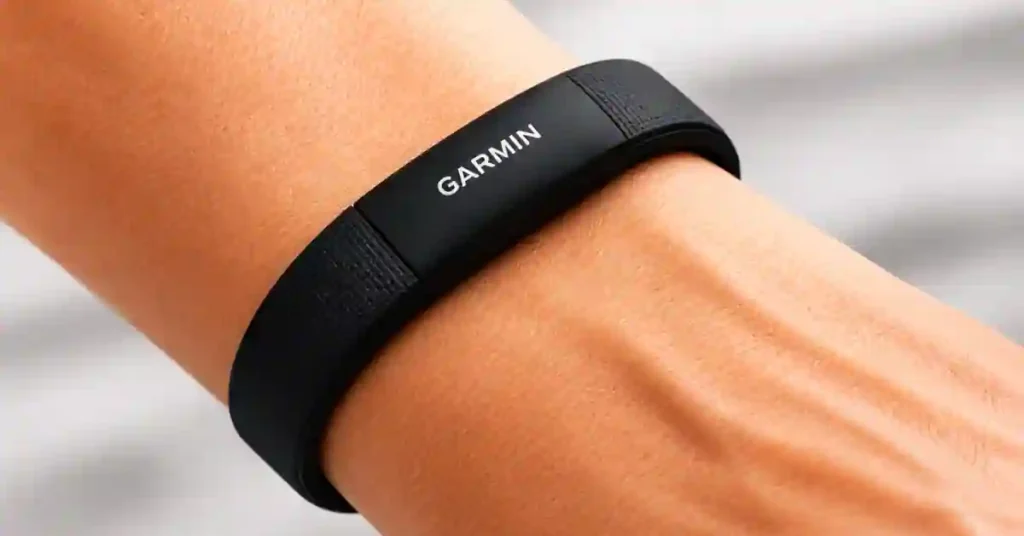
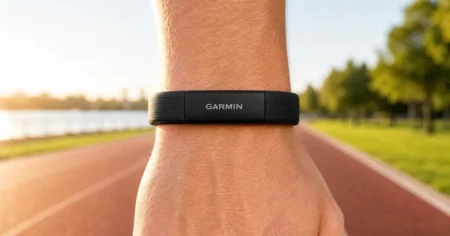
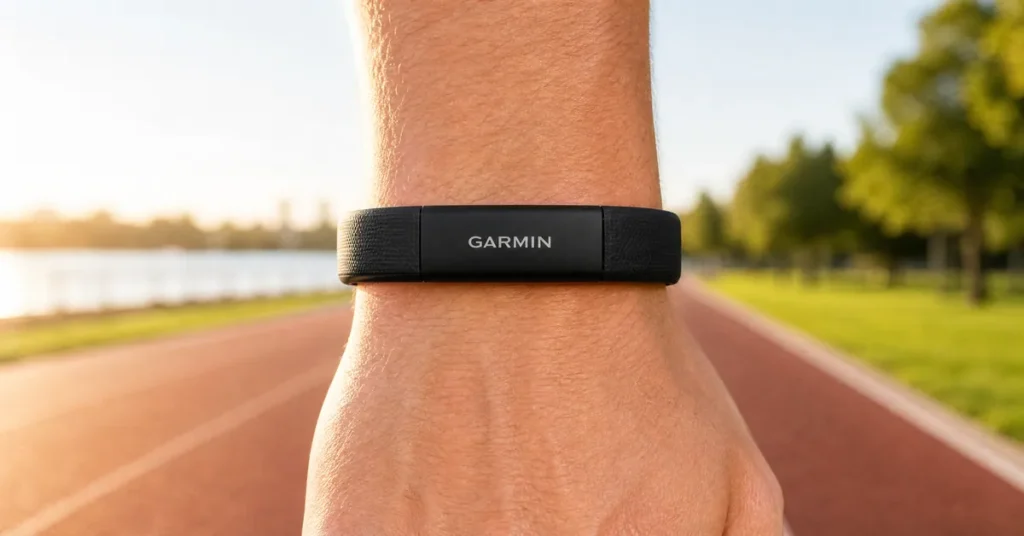
Based on the leaked listing, the Garmin Cirqa features a fabric band design — similar to Whoop’s wrist sleeve approach. It comes in two sizes (S/M and L/XL) and black and gray color options. Fabric bands tend to feel more comfortable than silicone for all-day wear, particularly for sleep tracking and intense workouts where silicone can cause irritation.
Garmin hasn’t confirmed the exact design yet, but if it follows the Whoop approach, expect a tight-fitting band designed to keep sensors firmly against your skin at all times for maximum accuracy.
Fitbit Air is a tiny pebble — minimal and almost invisible. Garmin Cirqa is expected to be a fabric sleeve — more athletic and secure. If you’re training hard, the Cirqa’s fit might be better. For everyday all-day comfort, the Air’s simplicity wins.
Health & Fitness Tracking
What Fitbit Air Tracks Right Now:
- 24/7 heart rate monitoring — continuous, passive
- SpO2 (blood oxygen) — overnight monitoring
- Sleep stages — light, deep, REM with Smart Alarm
- HRV (heart rate variability) — stress and recovery indicator
- AFib rhythm alerts — irregular heart rhythm detection
- Skin temperature — baseline and deviation tracking
- Automatic workout detection — steps, calories, active minutes
- Stress tracking — via HRV and activity patterns
For a $99 device, this sensor suite is genuinely impressive. AFib detection at this price point is something you’d normally pay $300+ for on a smartwatch.
Real reviewer verdict: 9to5Google, who gave the Fitbit Air a positive review, said Google “mostly got it right” — calling it the best first-gen product they can remember from Google. The health tracking is solid, the sensors are accurate, and the comfort factor is excellent.
What Garmin Cirqa Is Expected to Track:
- Heart rate — continuous 24/7
- Sleep quality — with Garmin’s best-in-class sleep algorithms
- Steps and calories — passive activity tracking
- Body Battery — Garmin’s proprietary energy score (0–100)
- Training Readiness — tells you if you’re ready to push hard
- HRV Status — 7-night rolling average baseline
- Stress tracking — Garmin’s continuous stress score
The key advantage the Cirqa may have is Garmin’s ecosystem. If you already use a Garmin watch for training and log runs on Garmin Connect, the Cirqa could slot in as a lightweight recovery companion — giving you accurate Body Battery and HRV data without needing to wear your heavy Fenix to bed every night.
Already have a Garmin? Read our Garmin Venu 4 review — it might actually be a better daily tracker than the Cirqa at a similar price point, with a full AMOLED display and ECG included.
Body Battery and Training Readiness are genuinely the best recovery metrics in the business. If accurate athletic recovery data is your priority and you’re already a Garmin user, the Cirqa will likely win this round. For mainstream health awareness, the Fitbit Air does everything most people need at a fifth of the price.
Garmin Cirqa vs Fitbit Air – Battery Life
The Fitbit Air is rated for 7 days of battery life — and early reviewers are confirming that number in real-world use. It also has fast charging: 5 minutes gives you a full day of use, and a complete charge takes around 90 minutes.
Garmin hasn’t confirmed battery specs for the Cirqa yet. But based on the Whoop-style design and Garmin’s typical engineering, expect somewhere in the 5–10 day range — similar to or slightly better than the Fitbit Air.
Why battery matters so much here: Screenless trackers only work if you never take them off. The moment you skip wearing it at night, your sleep data is gone. Both devices need to last long enough that charging never becomes an excuse to take them off. 7 days is the minimum you should accept — and both appear to meet that bar.
Both are targeting the 7-day range. Fitbit Air’s 5-minute fast charge is a genuine convenience advantage. We’ll update this once Garmin confirms Cirqa battery specs officially.
App Experience
Google Health App — The Real Product
Fitbit launched the Air alongside a complete rebrand of the Fitbit app into Google Health — and this is arguably the more important story. The new Google Health app puts Gemini AI at the center of your health data. The Google Health Coach creates personalized fitness plans, analyzes your sleep patterns, and gives you proactive recommendations — not just data dumps.
It works with Android 11+ and iOS 16.4+, so iPhone users are fully supported. A 3-month Google Health Premium trial is included with the Fitbit Air purchase.
Garmin Connect — Deep But Complex
Garmin Connect is one of the most data-rich fitness platforms on the market. If you love diving deep into training load, VO2 max trends, and HRV baselines, it’s unmatched. But it has a learning curve — and it’s always been better at giving you data than telling you what to do with it.
The Cirqa is expected to work with Garmin Connect+ — Garmin’s premium subscription tier at approximately $6.99/month — for full access to advanced insights.
For mainstream users, Google Health Coach is more approachable and actionable than Garmin Connect. For serious athletes who already live in Garmin Connect, the Cirqa’s deeper integration will feel more natural. It depends which world you already live in.
Real Total Cost Over 1 Year
This is where the comparison gets really interesting — and where Garmin’s value proposition either holds up or falls apart completely.
| Cost | Fitbit Air | Garmin Cirqa |
|---|---|---|
| Device cost | $99 | ~$507 |
| Subscription (monthly) | $9.99/mo (optional) | ~$6.99/mo (needed for full features) |
| Year 1 total (with sub) | $219 | ~$591 |
| Year 2 total (sub only) | $120/yr | ~$84/yr |
| 3-year total cost | ~$459 | ~$759 |
| Works without subscription? | Yes — basic features free | Limited without Connect+ |
Over three years, the Fitbit Air costs roughly $300 less than the Garmin Cirqa — even with both subscriptions factored in. That’s a significant gap.
Who Should Buy Which
- Want screenless tracking right now — it’s available today
- Have a $100–200 budget
- Are new to health tracking and want something simple
- Use iPhone or Android — works with both
- Want AFib detection without paying $300+ for a smartwatch
- Are curious about screenless trackers but not fully committed yet
- Want the Whoop experience without the Whoop price
- Already use Google services and like the ecosystem
- Already own a Garmin watch (Fenix, Forerunner, etc.)
- Live in Garmin Connect and trust its data above all else
- Need Body Battery + Training Readiness as a recovery companion
- Hate wearing your heavy Garmin to bed every night
- Are a serious endurance athlete — marathon, triathlon, ultra
- Budget is $500+ for a tracker and you’re okay with that
- Can wait until Summer 2026 for the official launch
Final Verdict — Garmin Cirqa vs Fitbit Air
For most people reading this, the answer is simple: buy the Fitbit Air today. It costs $99, it’s available right now, it tracks everything you need, reviewers love it, and you get three months of Google Health Premium free with purchase. There is no reason to wait for a $500 screenless tracker when a $99 one does 90% of the same job.
But — and this is important — the Garmin Cirqa isn’t really competing with the Fitbit Air for the same customer. If you’re a Garmin athlete who already has a Fenix 9 or Forerunner 970, the Cirqa is positioned as a recovery companion that integrates seamlessly with your existing Garmin data.
The Body Battery and Training Readiness algorithms that Garmin has spent years refining are genuinely the best in the business. If that matters to you and you’re already in the Garmin ecosystem, the premium price may actually make sense.
Bottom line: New to screenless trackers? Get the Fitbit Air today. Serious Garmin athlete? Wait for the Cirqa official launch and pricing before deciding. And whatever you do — don’t pay $500 for a screenless tracker before you’ve tried a $99 one first.
Frequently Asked Questions
What is the difference between Garmin Cirqa and Fitbit Air?
Both are screenless fitness trackers, but they target different users. The Fitbit Air costs $99 and is designed for mainstream users who want distraction-free health tracking powered by Google Health and Gemini AI. The Garmin Cirqa is rumored to cost around $507 and is aimed at serious athletes already in the Garmin ecosystem who want Body Battery and Training Readiness data without wearing a heavy watch to bed.
How much does the Garmin Cirqa cost?
A Ukrainian retailer leaked the Garmin Cirqa at approximately $507 (22,399 Ukrainian hryvnia). This has not been officially confirmed by Garmin. The actual US launch price could be different. Garmin has not announced an official price or release date as of June 2026.
When does the Garmin Cirqa release?
Garmin Cirqa is rumored for a Summer 2026 launch. No official date has been confirmed. The Fitbit Air, by comparison, launched on May 26, 2026 and is available now at $99.
Is the Fitbit Air worth buying in 2026?
Yes — for most people. At $99, the Fitbit Air offers AFib detection, 7-day battery, sleep staging, HRV tracking, and Google Health AI coaching. Early reviews from 9to5Google, Engadget, and Android Central are positive. It’s the most accessible screenless tracker on the market right now.
Does the Fitbit Air require a subscription?
No — basic health tracking features work without a subscription. Google Health Premium, which includes the AI Health Coach powered by Gemini, costs $9.99/month or $99.99/year. A 3-month trial is included with the Fitbit Air purchase.
Does Garmin Cirqa have a screen?
No. The Garmin Cirqa is a screenless fitness tracker — similar to Whoop and the Fitbit Air. Based on leaks, it features a fabric band design with no display. All data is viewed in the Garmin Connect app on your phone.
Should I wait for Garmin Cirqa or buy Fitbit Air now?
If you’re a casual user or new to screenless trackers: buy the Fitbit Air now at $99. If you’re an existing Garmin athlete who relies on Body Battery and Training Readiness: wait to see the official Cirqa price and specs before deciding. Don’t pay $500 for a screenless tracker without knowing exactly what you’re getting.
Is Garmin Cirqa better than Fitbit Air?
It depends on what “better” means to you. The Garmin Cirqa is expected to offer deeper athletic recovery insights through Body Battery and Garmin Connect. The Fitbit Air wins on price ($99 vs ~$507), availability (it’s out now), and accessibility for mainstream users. For most people, the Fitbit Air is the better value. However, if you want a screen, feel free to browse our deep-dive smartwatch reviews and ecosystem guides.
Disclaimer: Garmin Cirqa specs, pricing, and features are based on a leaked Ukrainian retailer listing and have not been officially confirmed by Garmin. Fitbit Air information is based on official Google announcements and verified reviewer testing. This article will be updated when Garmin officially announces the Cirqa. Last updated: June 2, 2026.Sunil Bhatt — Founder, SmartWatchInsight
Sunil has 4+ years covering the wearable tech industry across Garmin, Apple, Samsung, Fitbit, and Whoop. He tracks every major launch, leak, and review so you don’t have to.
Related Read:-
- Latest Apple Watch Features 2026: Series 12, Ultra 4 & watchOS 27 — Everything Confirmed
- Garmin Forerunner 975: Release Date, Expected Features & Should You Wait? (2026 Update)
- Oura Ring 5 vs Ring 4: Is It Worth Upgrading in 2026?
- Galaxy Watch 9 vs Apple Watch Series 12 (2026): Which One Should You Actually Buy?