
Whether your Garmin watch is frozen, acting glitchy, or you’re getting ready to sell it, knowing how to reset it properly can save you a lot of frustration. This guide walks you through every type of Garmin reset — soft, hard, and factory — for all popular models, step by step.
Garmin makes some of the most reliable smartwatches on the planet. But even the best tech has its off days. Maybe your Forerunner froze mid-run. Maybe your Fenix stopped syncing with your phone no matter what you try. Or perhaps the battery that used to last two weeks is now dying in two days.
Whatever the reason, a reset is often the fastest fix — and it’s something any Garmin owner can do without any technical background.
In this guide, I’ll walk you through every type of Garmin watch reset: from a quick soft reset that takes seconds, to a full factory reset that wipes everything clean. I’ll cover the most popular models — Fenix, Forerunner, Venu, Instinct, and Epix — and explain exactly what to do when your watch won’t respond at all.
Whether you’re troubleshooting a frustrating bug or prepping your watch for a new owner, you’re in the right place.
What Happens When You Reset a Garmin Watch?
Before jumping in, it’s worth understanding the difference between restarting your watch and resetting it. These aren’t the same thing, and choosing the wrong option can mean losing data you didn’t mean to delete.
Restarting (also called a soft reset) simply powers the watch off and back on again — like restarting your phone. Your data, settings, and activity history stay completely intact.
Resetting (also called a factory reset or hard reset) is a much bigger deal. It wipes the watch back to its original factory state — the way it came out of the box. That means your saved settings, custom profiles, downloaded music, installed apps, and synced data on the device itself will be erased.
Here’s the good news: if you’ve been syncing your watch with the Garmin Connect app, your activity history and health data are backed up there. After a factory reset, you can reconnect your watch and most of that information will still be accessible in the app.
Types of Garmin Watch Resets
Soft Reset (Restart)
What it does: A soft reset powers your watch off and back on without touching any of your data or settings. Think of it like a simple reboot.
When to use it:
- Your watch screen is frozen or unresponsive
- An app won’t open or is behaving strangely
- The watch feels sluggish or laggy
- You just want to refresh the system quickly
Step-by-step instructions:
For most Garmin watches, here’s how to do a soft reset:
- Press and hold the power button (usually the top-right button) for about 15 seconds.
- The watch will power off.
- Press the power button again to turn it back on.
That’s it. If the watch was just having a minor hiccup, this usually clears it right up.
Hard Reset / Factory Reset
What it does: A factory reset erases all personal data, custom settings, downloaded apps, music, and configurations from the watch. It restores the device to how it was when you first took it out of the box.
When to use it:
- Persistent bugs that a soft reset didn’t fix
- Severe sync or Bluetooth issues
- Selling or giving away your watch
- The watch is running very slowly and nothing else helps
- Major software glitches after a firmware update
What data gets deleted:
- Activity profiles and custom settings
- Downloaded Garmin Connect IQ apps and watch faces
- Saved music (Spotify, Amazon Music, etc.)
- Wi-Fi network passwords
- Paired Bluetooth devices
- Personal health baselines (like VO2 max estimates)
What’s NOT deleted:
- Activity history and health data stored in the Garmin Connect app (cloud backup)
- Firmware/software (the watch OS stays intact)
How to Factory Reset Any Garmin Watch
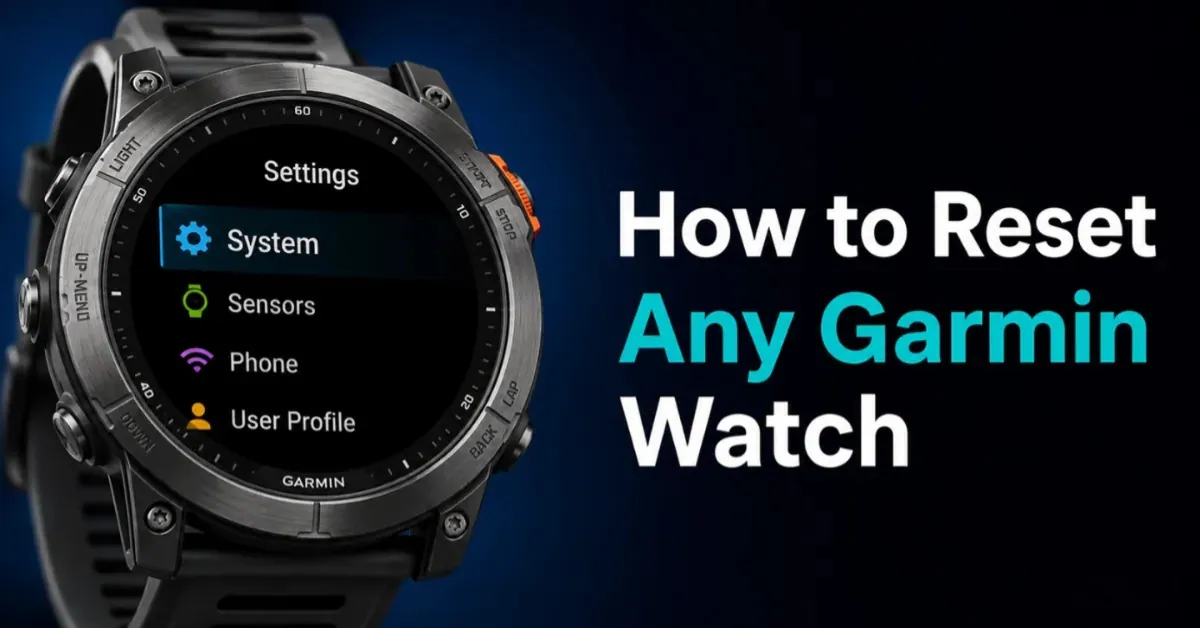
The exact menu path varies slightly between models, but the general process is nearly the same across all modern Garmin watches. Here’s the universal approach:
- From the watch face, press the menu button (usually the upper-left button on button-based models, or swipe up/press the touchscreen on touch models).
- Scroll down and select Settings.
- Scroll down and select System.
- Scroll down and select Reset.
- Choose Delete Data and Reset Settings.
- Confirm your choice when prompted.
The watch will restart and go through its initial setup screen, just like when it was brand new.
Note: Some older Garmin models may show “Restore Defaults” instead of “Delete Data and Reset Settings.” This option only resets your settings without deleting activity data — so double-check which option you’re selecting.
How to Reset Popular Garmin Watch Models
Garmin Fenix Series (Fenix 8, Fenix 7, Fenix 6, Fenix 5)
The Fenix lineup uses physical buttons for navigation. Here’s the menu path:
- From the watch face, hold the MENU button (top-left).
- Scroll to Settings → System → Reset.
- Select Delete Data and Reset Settings.
- Press START to confirm.
Good to know: Fenix watches sometimes have a slightly longer reset process due to the amount of stored data, maps, and installed apps. Give it a minute or two to complete.
Garmin Forerunner Series (Forerunner 265, 255, 245, 945, 55)
Forerunner models follow the standard Garmin layout:
- Hold the UP/MENU button (top-left button on most models).
- Go to Settings → System → Reset.
- Select Delete Data and Reset Settings.
- Confirm with the START button.
Good to know: On older Forerunner models like the 235 or 230, the menu path may be Settings → System Settings → Restore Defaults. This only resets settings, not activity data — just something to keep in mind if you’re selling the watch.
Garmin Venu Series (Venu 3, Venu 2, Venu Sq)
Venu watches have touchscreens, so navigation is a bit different:
- Swipe down from the watch face to access the Controls menu, or press the side button and tap Settings.
- Scroll down to System → Reset.
- Tap Delete Data and Reset Settings.
- Confirm when prompted.
Good to know: On the Venu Sq, you can also access settings directly by pressing the lower-right button and navigating to Settings.
Garmin Instinct Series (Instinct 2, Instinct Solar)
The Instinct series uses a rugged button-only interface:
- Hold the MENU button (middle-left button).
- Navigate to Settings → System → Reset.
- Select Delete Data and Reset Settings.
- Press GPS to confirm.
Good to know: The Instinct Solar sometimes takes a bit longer to reset due to its additional firmware layers. Let it sit for a few minutes after the reset initiates.
Garmin Epix Series (Epix Pro, Epix Gen 2)
The Epix combines a touchscreen with physical buttons:
- Press the MENU button (top-left).
- Go to Settings → System → Reset.
- Choose Delete Data and Reset Settings.
- Confirm the selection.
Good to know: The Epix has the largest onboard storage of most Garmin models, so if you have a lot of downloaded maps or music, the factory reset may take a few extra minutes.
How to Reset a Frozen Garmin Watch
This is the situation that trips up a lot of people. Your watch is completely stuck — the screen won’t respond, the buttons don’t seem to do anything, and you’re not sure what to do.
Don’t panic. Here’s what to try:
Step 1: Force restart (force soft reset)
Press and hold the power button (or the main button, typically top-right) for 15–20 seconds. Keep holding even if nothing seems to happen at first. The watch should eventually power off.
Once it’s off, press the power button again to turn it back on.
Step 2: If the watch won’t turn on after a force restart
Plug it into the charger. Sometimes a watch that appears frozen is actually just critically low on battery. Give it 10–15 minutes on the charger, then try turning it on again.
Step 3: If it’s still unresponsive
Some Garmin watches have a reset pinhole — a small hole on the back or side that you can press with a paperclip or SIM tool to force a restart. Check your specific model’s manual or Garmin’s support site to see if yours has one.
When a factory reset may be necessary:
If your watch keeps freezing repeatedly even after a soft reset, that’s a sign of a deeper software issue. A factory reset will usually clear it up. Just make sure your data is synced to Garmin Connect first (see the checklist below).
What to Do Before Resetting Your Garmin Watch
Before You Reset — Checklist
- Open the Garmin Connect app and manually sync your watch. Tap the device icon and pull down to refresh.
- Check that your recent activities uploaded. Go to the Activity feed in Garmin Connect and verify your last few workouts are there.
- Make note of your custom settings. Things like sport profiles, alert thresholds, and display preferences will need to be re-entered after a factory reset.
- Remove the watch from your phone’s Bluetooth list (you’ll re-pair after the reset).
- Charge your watch to at least 50% before resetting — you don’t want it dying mid-reset.
- Note your Wi-Fi password — you’ll need to re-enter it after setup.
- Download any music playlists again — they’ll be erased from the device.
Quick-Reference Comparison Table: Soft Reset vs. Factory Reset
| Feature | Soft Reset (Restart) | Factory Reset |
|---|---|---|
| Deletes activity data? | No | No (if synced to app) |
| Deletes settings? | No | Yes |
| Deletes apps & watch faces? | No | Yes |
| Deletes saved music? | No | Yes |
| Fixes minor freezes/bugs? | Usually | Yes |
| Time to complete | ~1 minute | 2–5 minutes |
| Recommended before selling? | No | Yes |
| Data backup needed? | No | Strongly recommended |
Common Problems Fixed by a Reset
Not sure if a reset will actually solve your problem? Here are the most common Garmin issues that a reset typically fixes:
Bluetooth connection issues — If your watch keeps dropping its connection to your phone or simply won’t pair, a soft reset often resolves it. If the problem keeps coming back, a factory reset followed by a fresh pairing usually does the trick.
Sync problems — Activities not showing up in Garmin Connect? Data stuck on the watch? A soft reset can clear a sync queue jam. For persistent sync failures, a factory reset and re-pairing is the next step.
App crashes — If a Connect IQ app or built-in feature keeps crashing, try a soft reset first. If it’s still happening, remove and reinstall the app. If the issue persists across multiple apps, consider a factory reset.
Slow performance — Over time, watches can accumulate background processes and fragmented data. A factory reset is basically a clean slate — many users report noticeably snappier performance afterward.
Battery drain — Abnormal battery drain is sometimes caused by a rogue app or a software glitch. A factory reset can help identify whether the issue is software-related. (If battery drain continues after a reset, the battery itself may need service.)
GPS issues — Slow GPS lock or inaccurate tracking can sometimes be resolved by a reset and re-downloading GPS satellite data through the Garmin Connect sync.
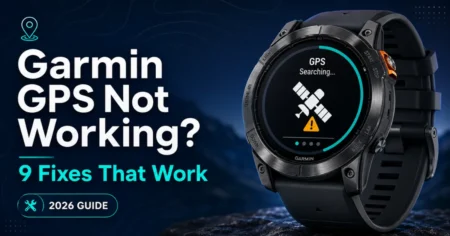
GPS stopped working after a reset? Read: Garmin Watch GPS Not Working — 9 Fixes That Actually Work.
💡 Pro Tip
After a factory reset, don’t immediately install every app and watch face you had before. Add them back one at a time over a few days. This way, if a problem comes back, you’ll know exactly which app caused it. It takes a little patience, but it’s the best way to track down a stubborn software issue.
Troubleshooting: If the Reset Doesn’t Fix the Problem
Did a factory reset still not solve your issue? Here’s what to try next.
Update the firmware
Outdated software is one of the most common sources of glitches on Garmin watches. After your reset, open Garmin Connect, go to your device settings, and check for any available software updates. Install them and see if the problem clears up.
Re-pair with Garmin Connect fresh
After a factory reset, delete the watch from Garmin Connect completely (not just unpair it from Bluetooth — remove it from the app entirely), then add it again as a new device. A completely fresh connection sometimes resolves sync issues that linger even after a reset.
Check for known issues
Visit Garmin’s official forums or subreddits like r/Garmin. If your problem is widespread, chances are other users have already found workarounds or Garmin has a fix in the works.
Contact Garmin Support
If nothing works, reach out to Garmin directly. Their support is genuinely helpful, and if your watch is under warranty, they’ll often replace it. You can contact them at support.garmin.com.
Frequently Asked Questions
Will resetting my Garmin watch delete my activities?
Not if you’ve synced with Garmin Connect first. Your activity history lives in the cloud once it’s synced. The factory reset wipes the local copy from the watch, but everything in the Garmin Connect app stays safe.
How do I reset a Garmin watch without my phone?
You don’t need your phone at all. The reset process happens entirely on the watch itself through the Settings menu. You only need your phone afterward if you want to re-pair and sync your data.
Can I reset my Garmin watch if it’s frozen?
Yes. If the watch is completely frozen and won’t respond to button presses, hold the power button for 15–20 seconds to force it to shut down. Once it restarts, you can then navigate to the Settings menu to do a factory reset if needed.
How long does a Garmin reset take?
A soft reset (restart) takes about 30–60 seconds. A factory reset typically takes 2–5 minutes, though it can take longer on watches with a lot of stored data, maps, or music files.
Does a factory reset improve battery life?
It can, yes — especially if a background app or software glitch was causing abnormal battery drain. Many users report better battery performance after a factory reset. However, if the battery is physically degraded, a reset won’t help with that.
Will I lose my fitness data (VO2 max, sleep history, etc.)?
Your long-term history is backed up in Garmin Connect. However, some estimated fitness metrics like VO2 max, training load, and body battery baselines are stored locally and will need to rebuild themselves over the first few weeks after a reset.
Can I undo a factory reset?
No — once a factory reset is complete, there’s no going back. That’s why syncing to Garmin Connect before you reset is so important. Your activity data will restore, but your settings and preferences will need to be manually reconfigured.
How often should I reset my Garmin watch?
There’s no set schedule. Most people never need a factory reset at all. Only do it when you’re experiencing a real problem that a soft reset didn’t fix, or when you’re selling or giving away the watch.
s there a difference between “Reset” and “Restore Defaults” on Garmin?
Yes, and it’s an important one. “Restore Defaults” typically resets your settings back to factory defaults but keeps your activity data on the device. “Delete Data and Reset Settings” wipes everything — settings and data both. Always read the option description carefully before confirming.
Conclusion
Resetting a Garmin watch is one of those things that sounds intimidating until you actually do it — and then you wonder why you waited so long.
The key is knowing which type of reset your situation calls for. A soft reset (just holding the power button) should always be your first move. It fixes the majority of minor glitches, freezes, and sync hiccups in about a minute with zero data risk.
A factory reset is the heavier option — use it when a soft reset doesn’t cut it, or when you’re handing the watch off to someone else. Just make sure you sync your data to Garmin Connect first so you don’t lose anything important.
Most Garmin watch issues are software-related, and a reset resolves them completely. If yours doesn’t bounce back after a factory reset, update your firmware and try a fresh pair with Garmin Connect before assuming hardware is the problem.
Good luck — and happy running (or hiking, cycling, swimming, or whatever adventure brought you to Garmin in the first place).
Related Read :-
- How to Connect Garmin Watch to iPhone : The Complete Setup Guide
- Best Garmin Watches in 2026 (Tested & Ranked)
- Garmin Watch Tips and Tricks Unleashing Advanced Features in Your Garmin Watch