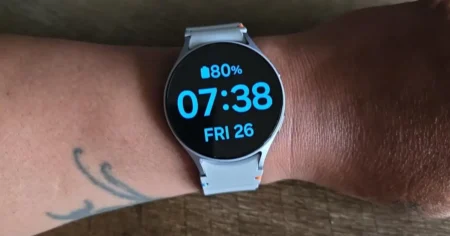

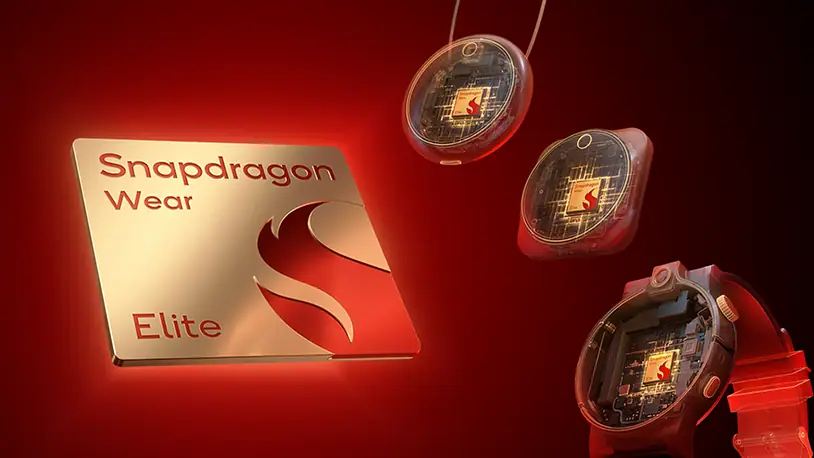
Samsung officially confirmed at MWC 2026 that the Galaxy Watch 9 will transition from Exynos to the Qualcomm Snapdragon Wear Elite. This 3nm chip introduces a massive 5x CPU performance boost, 7x faster GPU, and a dedicated Hexagon NPU for on-device AI. Key features include 30% better battery efficiency, ultra-fast charging (50% in 10 minutes), and ground-breaking NB-NTN satellite connectivity for emergency messaging.
Samsung Just Made a Big Bet on Qualcomm for Its Next Galaxy Watch
Samsung dropped a major announcement at MWC 2026 that caught the wearable tech world off guard. The next Galaxy Watch — widely expected to be the Galaxy Watch 9 — will be powered by Qualcomm’s Snapdragon Wear Elite, a cutting-edge 3nm chip designed specifically for Wear OS devices.
This is a historic first. For the first time ever, Samsung is putting Snapdragon silicon into its mainstream Galaxy Watch lineup. The shift was confirmed by InKang Song, Samsung’s Executive Vice President and Head of Technology Strategy, giving the announcement significant weight.
So what does this mean for Galaxy Watch users? Is this a genuine leap forward, or just a spec sheet upgrade? Let’s break it all down.
What Is the Snapdragon Wear Elite? (And Why It Matters)
The Qualcomm Snapdragon Wear Elite is the company’s most powerful wearable chip to date. Built on a 3-nanometer process, it sits a full generation above its predecessor, the Snapdragon W5+ Gen 2, and the performance gap on paper is nothing short of dramatic.
Here’s what Qualcomm is claiming:
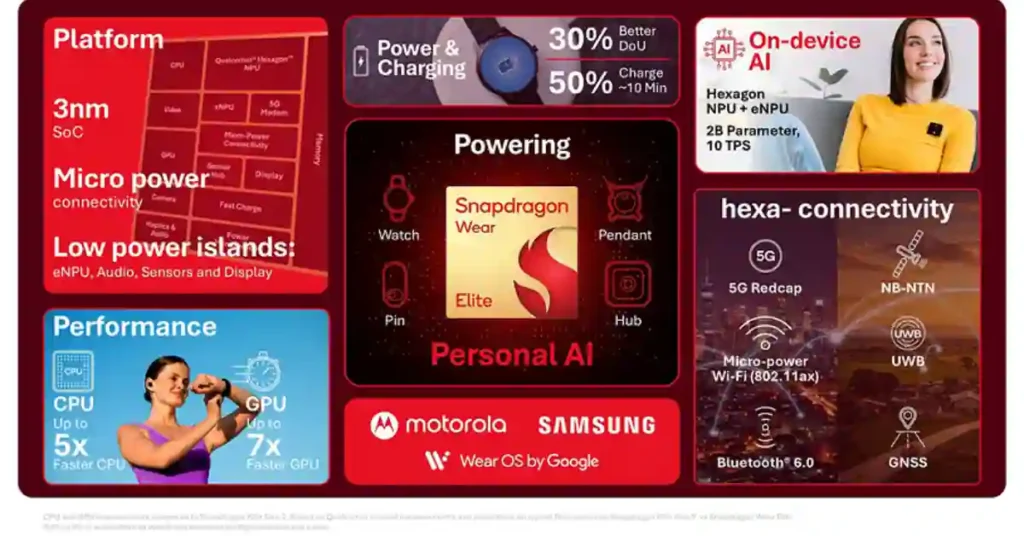
- Up to 5x faster CPU performance compared to the Snapdragon W5+ Gen 2
- Up to 7x faster GPU performance
- CPU clock speeds reaching 2.1 GHz
- A five-core layout: 1 performance core + 4 efficiency cores
- LPDDR5 memory running at up to 6,400 MHz
- Support for up to 32GB of eMMC storage
These are flagship-grade numbers for a wearable chip. The combination of a high-performance core with four efficiency cores follows the same design philosophy used in modern smartphone chips — maximizing power when you need it, conserving battery when you don’t.
For Galaxy Watch users who have complained about occasional lag in app loading or UI responsiveness, this architecture could be a meaningful real-world improvement.
On-Device AI: The Snapdragon Wear Elite’s Biggest New Feature
If there’s one area where the Snapdragon Wear Elite truly breaks new ground, it’s on-device artificial intelligence.
Qualcomm has equipped the chip with a dedicated Hexagon Neural Processing Unit (NPU) — a first for any Snapdragon wearable chip — alongside a secondary low-power eNPU for background AI processing.
Together, these two processors enable the watch to run AI models locally, without relying on cloud connectivity.
The numbers are impressive for a wrist-worn device:
- Can handle AI models with up to 2 billion parameters
- Delivers approximately 10 tokens per second of AI output
In practical terms, this hardware foundation enables features like:
- Smart reply suggestions for messages
- On-device text summarization
- AI-powered fitness coaching that adapts to your activity data
- Advanced noise cancellation for calls
- Activity and keyword recognition processed locally on the watch
The key distinction here is local processing. Because these AI tasks happen on the chip itself rather than being sent to a server, they work faster, work offline, and don’t drain battery waiting for a network round-trip.
That said, whether any of these features actually land as genuinely useful tools or remain marketing bullet points depends almost entirely on how Samsung and Google leverage the hardware in their software. The potential is real — but the execution remains to be seen.
Off-the-Grid: Emergency Satellite Messaging is Coming
One of the most overlooked but potentially life-saving features of the Snapdragon Wear Elite is the integration of NB-NTN (Narrowband Non-Terrestrial Network) support.
In plain English: The next Galaxy Watch could feature two-way satellite messaging.
Qualcomm has partnered with Skylo to enable this connectivity, allowing the watch to send and receive text messages even when you are miles away from the nearest cell tower or Wi-Fi signal.
While the Apple Watch Ultra has offered emergency satellite SOS for a couple of generations, the Snapdragon Wear Elite’s implementation is built into the core architecture of the chip, suggesting a more seamless and power-efficient experience.
Why this is a game-changer for the Galaxy Watch 9:
- True Independence: You can go for a remote hike or trail run without your phone and still have a communication lifeline.
- Two-Way Communication: Unlike basic emergency beacons, NB-NTN typically supports two-way texting, so you can actually receive a reply from emergency services or family members.
- Global Safety: This positions the “Ultra” model of the next Galaxy Watch as a direct rival to specialized outdoor watches from Garmin.
Whether Samsung will make this a standard feature or keep it exclusive to the “Ultra” model remains to be seen, but the hardware is officially ready for it.
Battery Life: Will the 30% Improvement Actually Show Up?
Battery life is the number one concern for smartwatch buyers, and Qualcomm is making a notable promise here: up to 30% improvement in days of use compared to the previous generation chip.
The architecture behind this claim is worth understanding. The Snapdragon Wear Elite uses dedicated low-power islands — separate processing blocks for audio, sensors, display management, and the eNPU.
This means common background tasks can run continuously without waking the main CPU cores. The result, in theory, is significantly lower idle power consumption throughout the day and night.
Fast charging also gets an upgrade: 50% charge in approximately 10 minutes.
Here’s the honest reality check though. The Galaxy Watch 7 and Galaxy Watch Ultra already use a 3nm chip — Samsung’s own Exynos W1000 — and while battery life on those devices is decent, it hasn’t been class-leading.
Simply having a 3nm process doesn’t automatically translate to great battery life; Samsung’s software choices and the physical battery capacity matter just as much.
The 30% figure is a chip-level claim under Qualcomm’s controlled test conditions. Whether Samsung’s implementation, software stack, and battery size choices let those efficiency gains show up in daily use is the real question that only hands-on testing after launch can answer.
Why Is Samsung Ditching Its Own Exynos Chip?
This is arguably the most strategically interesting part of the story.
Samsung designs its own Exynos chips. The Exynos W1000 powering the current Galaxy Watch 7 and Galaxy Watch Ultra is a solid performer, and Samsung has invested heavily in developing it. Choosing to switch to a competitor’s chip for the next generation is not a decision made lightly.
The most likely explanation is that the Snapdragon Wear Elite offers two specific advantages Samsung couldn’t easily match with Exynos in time:
- Dedicated AI hardware: The Hexagon NPU is purpose-built for on-device AI inference at a level the Exynos W1000 doesn’t replicate. As Samsung and Google push Wear OS deeper into AI features, having the right silicon underneath becomes critical.
- Power island architecture: The ability to keep sensors, audio, and background AI running without waking the main CPU is a specific design choice that addresses one of the biggest battery life challenges in smartwatches. The Exynos W1000 doesn’t have a direct equivalent.
It’s also worth noting that Qualcomm has positioned the Snapdragon Wear Elite for more than just watches — the platform targets pins, pendants, and smart hubs too.
Samsung may see this as an opportunity to standardize its wearable ecosystem around a single chipset platform across multiple product categories.
Galaxy Watch 9, Ultra, or Both? What Samsung Has (and Hasn’t) Confirmed
Samsung has confirmed the Snapdragon Wear Elite is coming to the next Galaxy Watch, but has deliberately not specified whether that means the Galaxy Watch 9, a new Ultra model, or both.
A staggered rollout is entirely plausible — Samsung could launch one model first and follow with another later in the year.
Qualcomm has indicated that commercial devices are expected within the next few months, which aligns with Samsung’s typical summer launch window for Galaxy Watch products.
For anyone currently weighing a Galaxy Watch 8 or Galaxy Watch Ultra purchase, this ambiguity is probably worth sitting with.
If you can wait a few months, you may end up with significantly better AI capabilities, potentially improved battery life, and a more future-proof device.
Snapdragon Wear Elite vs. Exynos W1000: Quick Comparison
| Feature | Snapdragon Wear Elite | Exynos W1000 |
|---|---|---|
| Process Node | 3nm | 3nm |
| CPU Max Clock | 2.1 GHz | ~2.0 GHz |
| Dedicated AI NPU | Yes (Hexagon NPU) | No direct equivalent |
| Low-Power eNPU | Yes | No |
| On-Device AI Model Size | Up to 2B parameters | Limited |
| Memory Type | LPDDR5 (6,400 MHz) | LPDDR5 |
| Max Storage | 32GB eMMC | 32GB |
| Battery Improvement Claim | Up to 30% vs. W5+ Gen 2 | Varies by implementation |
| Fast Charging | 50% in ~10 min | Supported |
What Galaxy Watch Users Should Actually Be Excited About
Cutting through the spec sheet, here are the changes that could genuinely matter in daily use:
Faster, smoother performance. A 5x CPU improvement over the W5+ Gen 2 is substantial. App launches, workout tracking interfaces, and navigation should feel noticeably more responsive.
AI features that actually work offline. The combination of the Hexagon NPU and eNPU means AI-powered features won’t grind to a halt when your phone is out of range or on airplane mode. For fitness tracking and health coaching use cases, this is a meaningful step forward.
Potentially better battery life. The power island design is genuinely innovative for wearables. If Samsung uses the available efficiency gains wisely rather than pushing the chip harder to justify faster benchmarks, daily users could see a real difference.
A more competitive Wear OS experience. For years, one criticism of Wear OS smartwatches was that the chip underneath couldn’t keep up with watchOS on Apple Watch. The Snapdragon Wear Elite narrows that gap significantly on the hardware side.
The Bottom Line: Should You Wait for the Next Galaxy Watch?
If you’re currently using a Galaxy Watch 6 or older, the next Galaxy Watch powered by Snapdragon Wear Elite represents a genuine generational leap.
The combination of faster performance, dedicated AI hardware, and improved efficiency architecture makes it a compelling upgrade.
If you bought a Galaxy Watch 7 or Galaxy Watch Ultra recently, the upgrade case is less urgent. The Exynos W1000 is still a capable chip, and the real-world battery and performance improvements from switching to Snapdragon Wear Elite won’t be fully quantifiable until the device ships and independent reviewers test it.
For anyone on the fence and not in urgent need of a new watch right now: waiting a few months for the next Galaxy Watch is probably worth it.
The Snapdragon Wear Elite is the most significant hardware advancement in Wear OS wearables in years, and Samsung putting it into the Galaxy Watch lineup is a strong signal that the company is serious about competing at the top of the smartwatch market.
Frequently Asked Questions
When will the Samsung Galaxy Watch with Snapdragon Wear Elite be released?
Qualcomm confirmed commercial devices are expected within the next few months from MWC 2026. Samsung typically announces Galaxy Watch devices in summer, so a mid-2026 launch is likely.
Will the Snapdragon Wear Elite be in the Galaxy Watch 9 or Galaxy Watch Ultra?
Samsung has not specified which models will get the chip. Both models may receive it, or it could be a staggered rollout.
Is the Snapdragon Wear Elite better than the Exynos W1000?
On paper, the Snapdragon Wear Elite has a significant advantage in dedicated AI hardware (Hexagon NPU) and low-power architecture. Both use 3nm process nodes.
Will battery life actually improve on the next Galaxy Watch?
Qualcomm claims up to 30% improvement, but real-world results depend on Samsung’s software and battery decisions. The power island design is architecturally promising.
Does the Snapdragon Wear Elite support on-device AI without internet?
Yes. The dedicated Hexagon NPU enables features like smart replies, text summaries, and fitness coaching to be processed locally on the device.
Stay updated on the latest Galaxy Watch news and wearable tech developments by bookmarking this page. We’ll update this article as Samsung releases official details closer to launch.