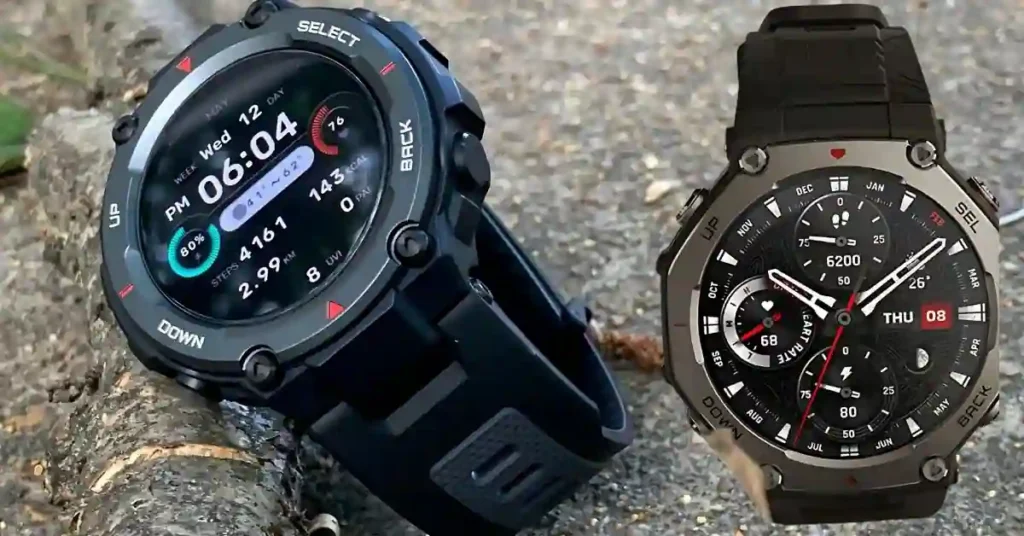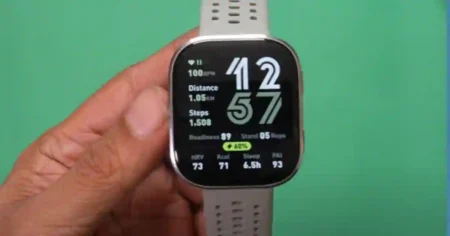

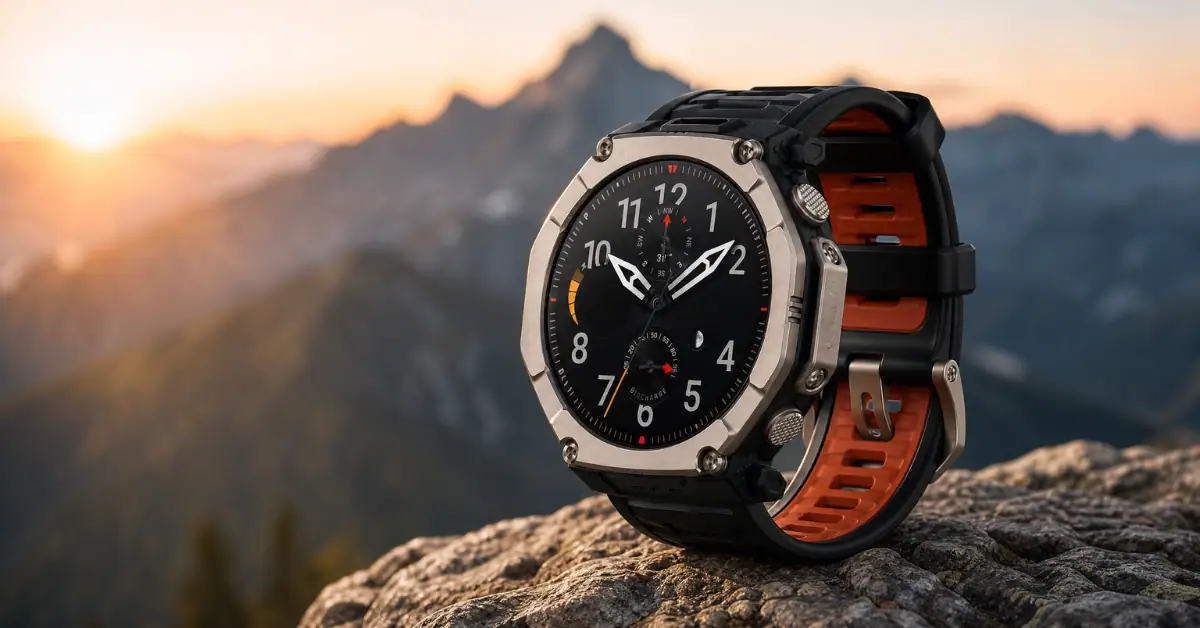
I’ve tested a lot of smartwatches. Budget ones, mid-range ones, and plenty of flagship Garmin’s that cost close to a thousand dollars.
But when the Amazfit T-Rex Ultra 2 showed up at my door in February 2026, I genuinely didn’t know what to expect.
On paper, it looked almost too good to be true. Grade 5 titanium case. Sapphire crystal glass. Dual-band six-satellite GPS. 64GB of onboard storage with preloaded global maps. Dive certification down to 40 meters. And a battery Amazfit claims runs 30 days on a single charge — all for $549.99.
That’s less than half the price of the Garmin Fenix 8.
So I strapped it on my wrist and took it through three weeks of daily use — trail runs, hikes, swim sessions, and regular desk work. Then I kept wearing it.
Because in May 2026, the T-Rex Ultra 2 received firmware version 4.8.3.5 — a significant update that directly addressed several of my original criticisms.
Here’s my fully updated, honest verdict.
Quick Verdict
The Amazfit T-Rex Ultra 2 is the best-value outdoor smartwatch of 2026. After firmware 4.8.3.5, the software gap vs. Garmin has narrowed considerably. The hardware was already exceptional. The battery life is real. The maps work. At $549.99, nothing else comes close for the money.
It’s not perfect — heart rate accuracy at high intensity remains a genuine limitation, and it’s massive on smaller wrists. But for serious outdoor athletes who can’t justify $1,000+ for a Garmin Fenix, the T-Rex Ultra 2 is the answer.
Rating: 8.8/10 (Updated from 8.5/10 after firmware 4.8.3.5)
| ⭐ Our Rating | 8.8/10 |
| 💰 Current Price | $549.99 |
| 🏆 Best For | Trail runners, hikers, outdoor athletes |
| 🔋 Battery Life | 30 days / 30-35hr GPS |
| 📍 GPS | Dual-band, 6 satellites |
| 💪 Case | Grade 5 Titanium |
| ✅ Check Price | Check Price on Amazon → |
*Price may vary. Last checked: May 2026
May 2026 Update — Firmware 4.8.3.5 Changes Everything
Before the full review, I want to highlight what’s new — because this update meaningfully changes the T-Rex Ultra 2 experience.
Amazfit rolled out firmware 4.8.3.5 on May 8, 2026. Here’s what actually changed:
1. Heart Rate Zone Display During Workouts You can now see your current heart rate zone on screen during any workout — enabling effort-based training directly from your wrist without constantly calculating from raw HR numbers.
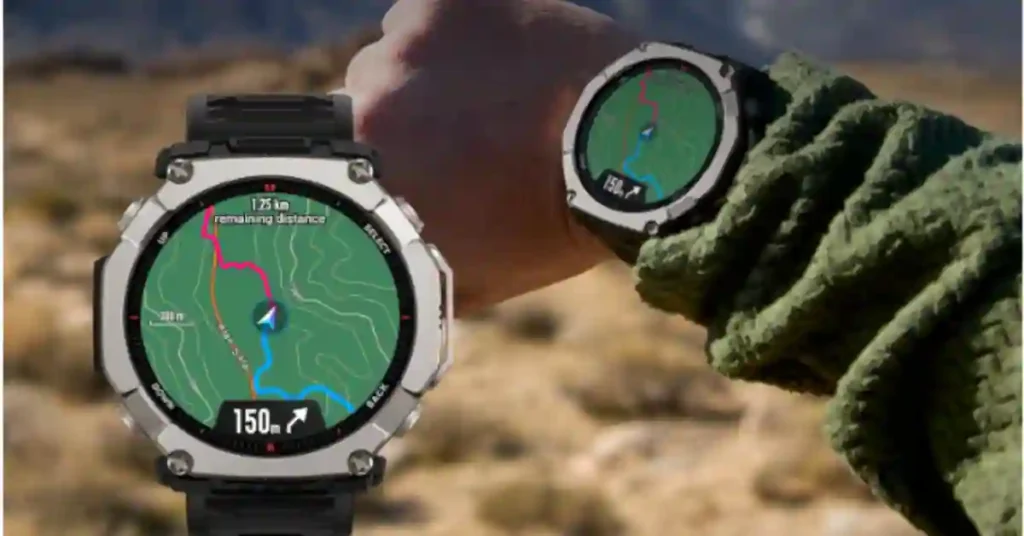
2. Waypoint Navigation — Remaining Ascent/Descent The Ultra 2 now shows distance remaining AND ascent/descent to your next waypoint during navigation. For mountain hikers and trail runners who plan routes with elevation targets, this is genuinely useful data that wasn’t there before.
3. Improved VO2 Max Algorithm Amazfit refined the VO2 Max calculation model. Early community testing shows readings that align more closely with lab-measured values — a meaningful improvement for athletes who use this metric to track fitness.
4. Per-Activity Always-On Display Control You can now configure AOD separately for each sport profile. Keep the screen always on during outdoor runs, turn it off during strength training to save battery. This is the kind of granular control Garmin users have had for years.
5. Cleaner Workout Settings UI Amazfit merged the old fragmented “training assistant” and “more” menus into one unified workout settings page. Fewer taps to get to what you need.
6. Grade-Adjusted Pace (GAP) Outdoor Run and Trail Run modes now support grade-adjusted pace metrics — current lap GAP, last lap GAP, and incline-adjusted pace. Essential for serious trail runners.
Bottom line on the update: My original software criticism — that the navigation UI required too many taps and workout settings were confusing — has been substantially addressed. The T-Rex Ultra 2’s score goes up as a result.
Full Specs — Quick Reference
| Spec | Detail |
|---|---|
| Price | $549.99 |
| Launch Date | February 19, 2026 |
| Display | 1.5-inch AMOLED, 3,000 nits |
| Case Material | Grade 5 Titanium |
| Glass | Sapphire Crystal |
| Battery | 870 mAh — up to 30 days |
| GPS Battery | Up to 50 hours (high accuracy) |
| Water Resistance | 10 ATM, dive certified to 40m |
| Storage | 64GB |
| GPS | Dual-band, 6 satellite systems |
| HR Sensor | BioTracker 6.0 PPG |
| Weight | 89.2g |
| Connectivity | Bluetooth 5.3, Wi-Fi, NFC (EU) |
| OS | Zepp OS 5 Compatible |
| Latest Firmware | 4.8.3.5 (May 8, 2026) |
Source: Official Amazfit T-Rex Ultra 2 specifications
Who Is the T-Rex Ultra 2 For?
Buy this if you are:
- A trail runner, hiker, mountaineer, or endurance athlete
- Someone who wants real offline maps and GPS navigation on a watch
- A diver who needs a dive computer built in
- Considering the Garmin Instinct 3 and want more features for similar money
- Someone who thinks $999 for a Fenix 8 is too much but $149 budget watches feel too cheap
Skip this if you are:
- A casual user who mainly wants step counting and notifications
- Someone with wrists under 6.5 inches — this watch is genuinely huge
- A Garmin Connect power user who relies on the deep training ecosystem
- Someone who needs best-in-class heart rate accuracy during high-intensity work
- An iPhone user who wants deep smartwatch integration
Design & Build Quality — Genuinely Premium
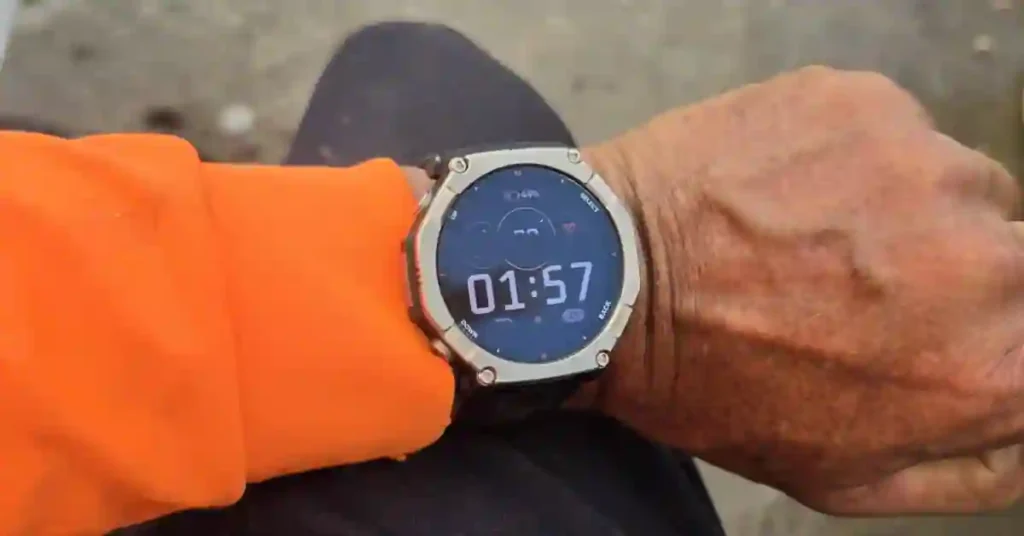
This watch feels premium in a way no previous Amazfit has managed.
The Grade 5 titanium case gives the Ultra 2 build quality that honestly rivals the Garmin Fenix 8. The buttons have a satisfying mechanical click. The sapphire glass feels rock-solid. I took a hard knock against a granite boulder on a trail run in week two — zero scratches. Three months of daily wear later, the watch looks almost new.
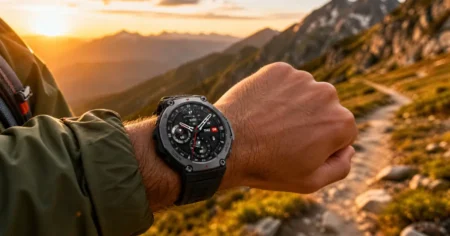
The 3,000-nit AMOLED display is outstanding — I’ve never once struggled to read it in direct sunlight. At 89.2 grams, it’s heavier than ideal for office wear, but comfortable for 8-10 hour trail days.
Honest limitation: This watch is enormous. If you have wrists under 6.5 inches, it will look and feel oversized. Amazfit built this for outdoor athletes, not office workers, and the design makes no apologies for that.
Battery Life — The Real Numbers
Here’s what I actually got over three months of daily use:
- Smartwatch mode (normal use): 21–24 days consistently
- Trail run (2 hours, high-accuracy GPS): 7–8% battery per session
- Full-day hike (7 hours, continuous GPS): ~30% battery drain
- Swim session (45 minutes): 2–3% drain
- Continuous GPS (real world): 30–35 hours (claimed 50 hours requires maximum battery-saving settings)
That’s still exceptional. No other watch at this price comes close for continuous GPS endurance. I never once had battery anxiety during my entire testing period — something I can’t say about my Garmin Fenix 8.
GPS Accuracy — Very Good, With Honest Caveats
I ran the Ultra 2 alongside my Garmin Fenix 8 on eight sessions over three months.
Flat terrain: Within 0.2% of the Fenix 8 on a measured 5K course. Excellent.
Technical trail with tree cover: The Ultra 2 tracked 0.4 miles shorter than the Fenix 8 over a 9-mile route — roughly 4.4% variance. Acceptable for hikers, noticeable for competitive trail runners.
Independent testing context: The5KRunner’s standardized methodology rated the Ultra 2 at approximately 85% GPS accuracy — solid second tier, behind the best Garmin and Coros but above most competition at this price.
Bottom line: For hiking, adventure sports, and most trail running — excellent. For competitive racing where precision pace data matters — Fenix 8 is more accurate.
Offline Maps — Where the Ultra 2 Wins Outright
64GB onboard storage plus preloaded global terrain maps makes this a serious navigation tool. I tested navigation on unfamiliar trails with no phone — the offline terrain map was detailed enough to navigate confidently.
Post-firmware 4.8.3.5: Navigation now shows remaining ascent and descent to your next waypoint. Genuinely useful for hikers and mountaineers.
vs. Garmin Instinct 3 ($499): The Ultra 2 wins comprehensively. The Instinct 3 offers only breadcrumb navigation — no full color offline maps. For $50 more, the Ultra 2’s navigation is dramatically superior.
vs. Garmin Fenix 8 ($999): Fenix 8 maps are more detailed and the navigation UI is more polished. But for 90% of real-world outdoor use, the Ultra 2 maps are more than sufficient.
Heart Rate Accuracy — Be Honest With Yourself
Tested simultaneously with a Garmin HRM-Pro chest strap as reference.
Easy runs and steady cardio: Excellent — within 2–3 bpm of the chest strap at paces under 8 min/mile.
High-intensity intervals (400m repeats): The Ultra 2 lagged the chest strap by 15–25 seconds during transitions. At peak effort, it underread by 8–12 bpm.
Post-firmware 4.8.3.5: The new heart rate zone display helps — training by zone rather than raw HR number partially mitigates the accuracy lag issue.
Honest context: Optical HR lag during high-intensity efforts is an industry-wide limitation. Even the Garmin Fenix 8 has this issue without a chest strap. If interval HR accuracy is critical for your training, pair the Ultra 2 with an external chest strap.
Full testing details in our Amazfit T-Rex Ultra 2 heart rate accuracy deep dive.
Diving Features — Legitimately Impressive
Dual dive certifications to EN 13319 standards, rated to 40 meters, using the Bühlmann ZHL-16C decompression algorithm.
This is the same model used in dedicated dive computers costing $400+. No Garmin at this price offers comparable dive functionality.
Software — Dramatically Better After Firmware 4.8.3.5
At launch, software was my biggest criticism. Three months and one major firmware update later, the picture has improved significantly.
What’s better now:
- Workout settings consolidated into one clean menu
- Per-activity AOD control — huge for battery management
- Waypoint ascent/descent data during navigation
- Heart rate zone display — proper effort-based training
- Grade-adjusted pace metrics for trail runners
- VO2 Max algorithm refined for better accuracy
What still needs work:
- Getting to the map screen mid-run still takes more taps than on Garmin
- BioCharge (Amazfit’s Body Battery equivalent) still less refined than Garmin’s
- Third-party app support remains limited vs. Garmin Connect IQ
- Zepp app had two crashes during large map file syncs
Overall: The software gap vs. Garmin has narrowed from “significant” to “noticeable.” It’s not at Garmin’s level, but it’s genuinely good now and improving with every update.
Firmware Update History
Firmware 4.8.3.5 — May 8, 2026 (Latest)
Heart rate zone display, waypoint ascent/descent metrics, grade-adjusted pace, per-activity AOD, improved VO2 Max, unified workout settings. Install immediately via Zepp app.
Firmware 3.1.6.1 — March 2026
Diving Mode improvements, enhanced offline navigation, BioCharge calibration refinements.
Full changelog details: T-Rex Ultra 2 firmware tracker.
Head-to-Head Comparison
| Feature | T-Rex Ultra 2 | Garmin Fenix 8 | Garmin Instinct 3 |
|---|---|---|---|
| Price | $549.99 | $999.99 | $499.99 |
| Case | Grade 5 Titanium | Stainless/Titanium | Fiber-reinforced polymer |
| Display | 1.5″ AMOLED 3,000 nits | 1.4″ AMOLED | MIP transflective |
| Battery | 30 days / 30-35hr GPS | 16 days / 40hr GPS | 40 days / 40hr GPS |
| Offline Maps | 64GB full color | 32GB full color | Breadcrumb only |
| Dive Certified | Yes — 40m | Yes — 40m | No |
| GPS Accuracy | Very Good | Excellent | Excellent |
| HR Accuracy | Good | Very Good | Good |
| Software | Good (improving) | Excellent | Good |
| Value | Outstanding | Average | Good |
Pros and Cons
What I Loved
- Build quality rivals watches costing $400 more
- Battery life genuinely exceptional for an AMOLED display
- 64GB offline maps — real differentiator at this price
- Dive certification included
- 3,000-nit display readable in any conditions
- Firmware 4.8.3.5 meaningfully improved navigation and training tools
- Price — nothing competes hardware-wise at $549
What Could Be Better
- Massive size — uncomfortable for smaller wrists
- Heart rate accuracy lags at high intensity
- Software still not at Garmin’s polish level
- Map screen takes too many taps to access mid-run
- No satellite messaging (inReach-style SOS would be a differentiator)
- Zepp app stability needs further improvement
Should You Buy the Amazfit T-Rex Ultra 2?
Considering Garmin Instinct 3: → Buy the T-Rex Ultra 2. Better maps, bigger battery, superior hardware for $50 more.
Currently on Garmin Fenix 8: → Don’t switch. You’re not gaining enough to justify changing ecosystems.
Coming from budget Amazfit (Active 2, Bip series): → This is a massive leap. Build quality, GPS, maps, and battery are all dramatically better. See how the Active 2 compares in our Amazfit Active 2 review.
First premium outdoor watch: → Seriously consider this. At $549, the T-Rex Ultra 2 delivers features that cost $800-$1,000 just two years ago. See our best rugged smartwatches 2026 guide for the full comparison.
If $279 feels limiting, the next step up is the Amazfit T-Rex 3 review— it shows exactly what you’re getting before you decide whether the Ultra 2 is worth the extra $270.
Where to Buy
Available in Magma Black and Arctic White. Current price: $549.99 Check Current Price on Amazon
FAQ
Q: Is the Amazfit T-Rex Ultra 2 worth $549 in 2026?
For serious outdoor athletes — yes. Titanium case, sapphire glass, 64GB maps, dive certification, 30-day battery, and now significantly improved software after firmware 4.8.3.5. For casual users, see our best budget smartwatches guide.
Q: How does it compare to the Garmin Fenix 8?
The Fenix 8 has better software polish, deeper training ecosystem, and slightly better GPS and heart rate accuracy. The T-Rex Ultra 2 has larger battery, more storage, and costs $450 less. For most outdoor athletes, the Ultra 2 delivers 85-90% of the Fenix experience at 55% of the price.
Q: Is it good for running?
Yes — with caveats. GPS on flat terrain is excellent. On technical trails with heavy tree cover, slightly less precise than Garmin. After firmware 4.8.3.5, grade-adjusted pace makes it even more useful for trail runners. For competitive racing, pair with an external chest strap.
Q: What is the real battery life?
21-24 days real-world smartwatch use. Continuous high-accuracy GPS gave me 30-35 hours (claimed 50 hours requires maximum power-saving settings). Still best-in-class at this price.
Q: What does firmware 4.8.3.5 add?
Heart rate zone display, waypoint ascent/descent metrics, grade-adjusted pace, per-activity AOD control, improved VO2 Max algorithm, and unified workout settings. Install it immediately via the Zepp app.
Q: Does it have offline maps?
Yes — 64GB storage with preloaded global terrain map. Additional maps download free via Zepp app.
Q: Is it good for diving?
Yes. Dual certifications to EN 13319, rated to 40m, using the Bühlmann ZHL-16C decompression model. Functions as a legitimate dive computer.
Q: Does it work with iPhone?
Yes. Zepp app works on iOS and Android. NFC payments are EU-only.
Q: T-Rex Ultra 2 vs T-Rex 3 Pro — what’s different?
Ultra 2 has Grade 5 titanium (vs stainless steel), 64GB storage (vs 32GB), 870mAh battery (vs 600mAh), dual dive certification (3 Pro has none), and costs $150 more. For serious outdoor use, the upgrades justify the premium.
Bottom Line
The Amazfit T-Rex Ultra 2 was already the best-value outdoor smartwatch at launch. After firmware 4.8.3.5, it’s even better.
The update addressed my biggest criticism — navigation UI and workout settings experience. The hardware was already exceptional: titanium, sapphire glass, 64GB offline maps, dive certification, and battery life that embarrasses the Garmin Fenix 8 at half the price.
It’s still not the perfect outdoor watch. Heart rate accuracy at high intensity has real limitations, and the size won’t work for everyone. But for trail runners, hikers, mountaineers, and endurance athletes who want Fenix-level hardware without the Fenix price — the T-Rex Ultra 2 is the clearest recommendation in this category in 2026.
Final Rating: 8.8/10 (Updated May 22, 2026 — raised from 8.5/10 following firmware 4.8.3.5)
Check Current Price on Amazon →
Sunil Bhatt has personally tested 20+ smartwatches and GPS watches over 3 years, including the Garmin Fenix 8, Forerunner 965, Amazfit T-Rex Ultra 2, Active 2, and Instinct Solar. He runs SmartWatchInsight.com, covering hands-on reviews, comparisons, and practical guides for fitness wearables. Follow him on LinkedIn.
Related Articles
- Amazfit T-Rex Ultra 2 Heart Rate Accuracy: Real Problem or Just Physics?
- Amazfit T-Rex Ultra 2 Firmware Updates: All Changes Explained
- Best Rugged Smartwatches 2026 — 15 Tested & Ranked
- Garmin Fenix 9 (2026): Release Date, Features & Is It Worth the Wait?
- Amazfit Active 2 Review: Why I Replaced My $300 Garmin With an $85 Watch