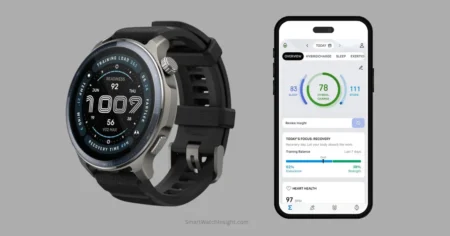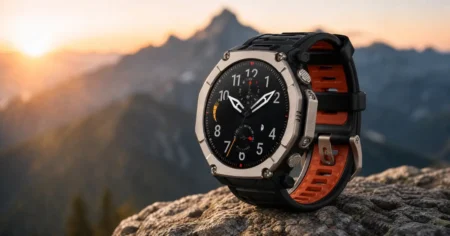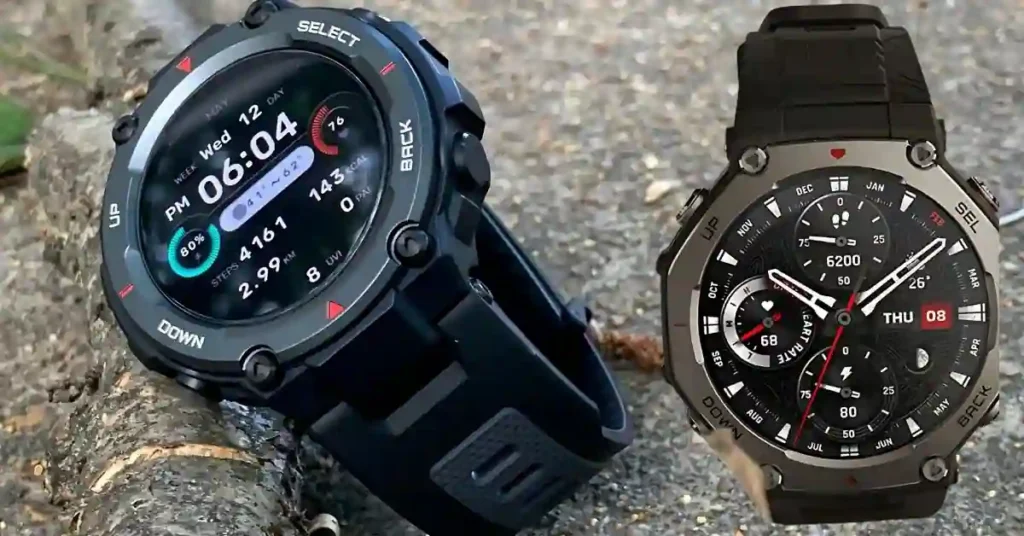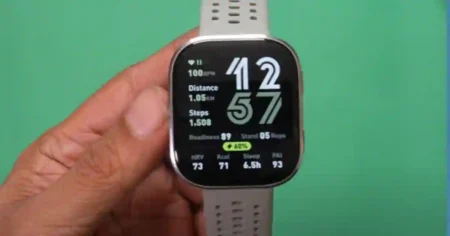

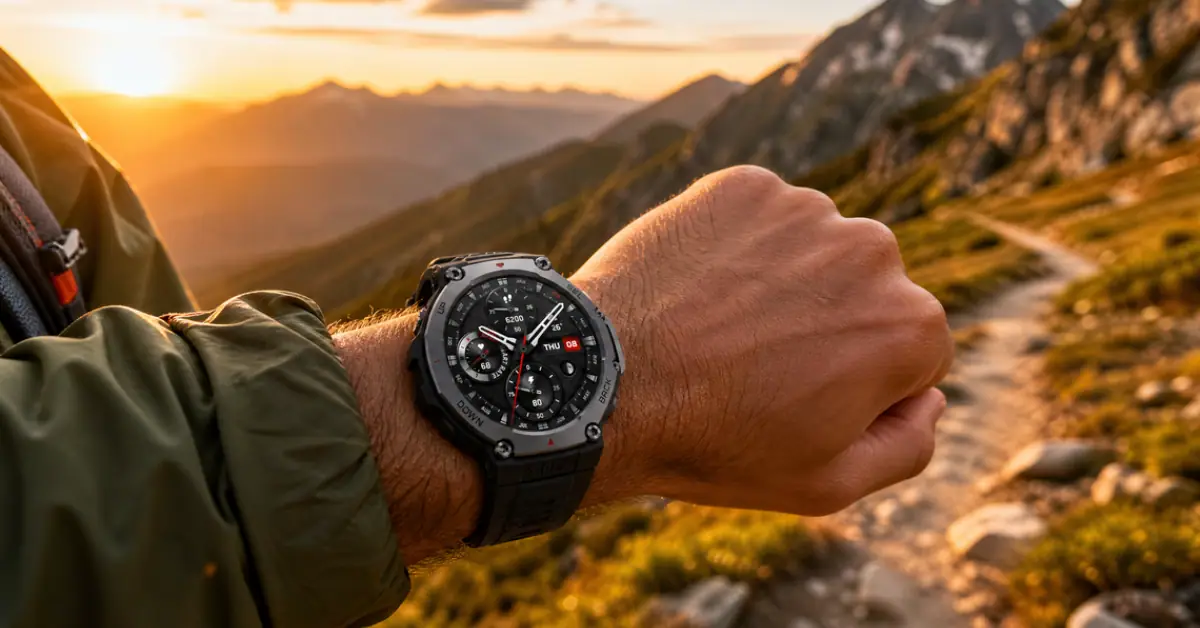
The Amazfit T-Rex 3 review you’re about to read took six weeks to write.
I almost didn’t test it. I’d been a Garmin guy for years — Forerunner 965 on my wrist, Garmin Connect on my phone, the whole ecosystem locked in. Every time someone mentioned Amazfit, I’d smile politely and change the subject.
Then a colleague challenged me: “Test the Amazfit T-Rex 3 for six weeks. Trail runs, hikes, everything. Then tell me it’s not worth $279.”
So I did. Trail runs, hikes, swim sessions, a three-day backpacking trip, and daily office wear. Six weeks straight.
Here’s what I found — and why the Amazfit T-Rex 3 genuinely surprised me.
Quick Verdict
The Amazfit T-Rex 3 is the most capable outdoor smartwatch at $279 — nothing else comes close. Dual-band GPS, 27-day battery, 2,000-nit AMOLED display, offline maps, 170+ sports modes, and military-grade durability. At $279, there is nothing else in this category that comes close.
The limitations are real — heart rate accuracy at high intensity is inconsistent, the navigation software has rough edges, and the third-party app ecosystem is thin. But for hikers, trail runners, and outdoor athletes who want serious features without a four-figure price tag, the T-Rex 3 is an easy recommendation.
| ⭐ Our Rating | 8.6/10 |
| 💰 Current Price | $279.99 |
| 🏆 Best For | Hikers, trail runners, outdoor athletes |
| 🔋 Battery Life | 27 days smartwatch / 42 hrs GPS |
| 📍 GPS | Dual-band, 6 satellite systems |
| 💪 Case | Stainless steel bezel + polymer frame |
| ✅ Check Price | Check Price on Amazon → |
Price may vary. Last checked: May 2026
Full Specs — Quick Reference
6 weeks on trails and hikes
| Spec | Detail |
|---|---|
| Price | $279.99 |
| Launch Date | September 6, 2024 |
| Display | 1.5-inch AMOLED, 2,000 nits |
| Case Material | 316L Stainless Steel bezel + Polymer frame |
| Glass | Gorilla Glass |
| Battery | 700 mAh — up to 27 days |
| GPS Battery | 42 hours (accuracy mode) |
| Water Resistance | 10 ATM (100 meters) |
| Storage | 32GB |
| GPS | Dual-band, 6 satellite systems |
| HR Sensor | BioTracker 5.0 PPG |
| Weight | 68.3g (without strap) |
| Processor | ZPS3044 |
| Sports Modes | 170+ |
| Connectivity | Bluetooth 5.3, Wi-Fi |
| OS | Zepp OS 4.0 (GPT-4o AI) |
| Colors | Onyx, Lava |
Source: Official Amazfit T-Rex 3 specs
Who Is the T-Rex 3 For?
Let me be direct about this upfront — because the T-Rex 3 is the right watch for a specific type of person.
Buy this if you are:
- A hiker, trail runner, or outdoor athlete on a budget
- Someone who wants real offline maps and GPS navigation without spending $500+
- Coming from a basic fitness tracker and want a serious upgrade
- A casual adventurer who wants durability and long battery life
- Someone who finds $999 for a Garmin Fenix genuinely unreasonable
Skip this if you are:
- A competitive runner who trains by heart rate zones (HR accuracy is inconsistent at high intensity)
- Someone who relies on Strava, TrainingPeaks, or Garmin Connect ecosystem deeply
- A diver — the T-Rex 3 is water-resistant but not dive-certified (see the T-Rex Ultra 2 for that)
- Someone who wants the best GPS accuracy available regardless of price
- An iPhone user who wants deep notification and Siri integration
Design & Build Quality — Surprisingly Solid
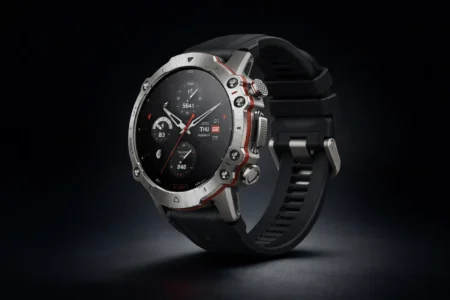
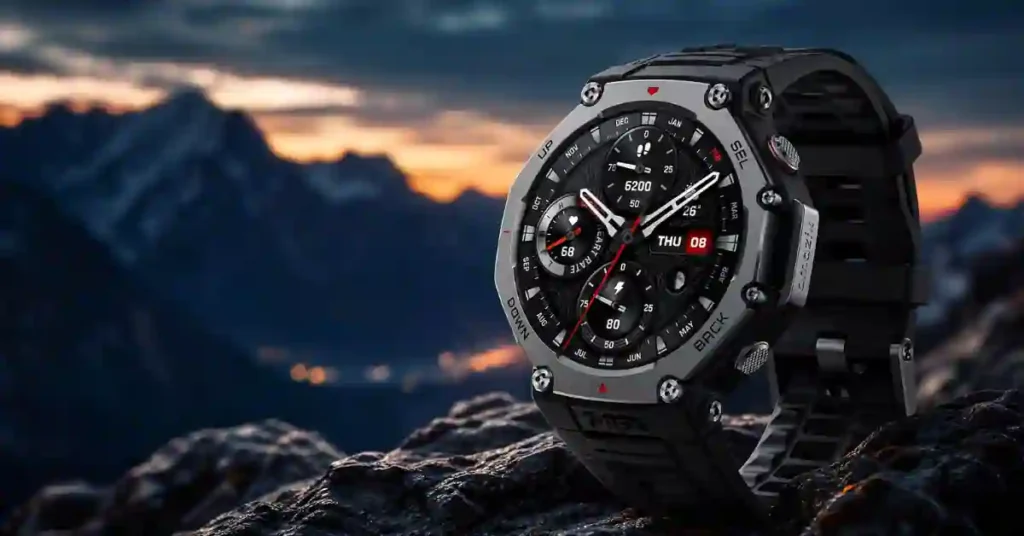
The T-Rex 3 looks the part. The octagonal bezel design is distinctive — not subtle, not trying to pass as dress watch. The textured buttons with red accents at the 12 and 6 o’clock positions signal outdoor intent.
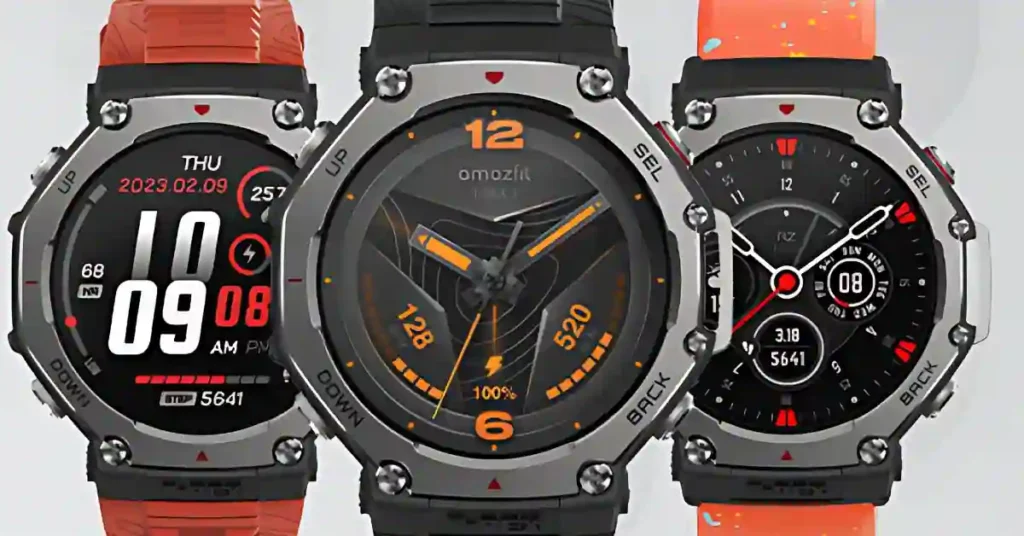
The 316L stainless steel bezel is solid and scratch-resistant in everyday use. The polymer middle frame and back keep the weight manageable at 68.3 grams — heavier than titanium alternatives like the Garmin Fenix 8 (59g) or Coros Vertix S2 (61g), but the price difference more than explains that.
The liquid silicone strap — upgraded from the T-Rex 2 — is genuinely comfortable for long days. I wore this for 8-hour hiking sessions without the strap irritation I sometimes get with stiffer rubber bands on competing watches.
Honest limitation: At 48.5mm, this is a large watch. It looks proportionate on wrists over 7 inches. On smaller wrists, it can feel overwhelming. Try it on before committing if you’re between sizes.
The Gorilla Glass held up well in my testing — no scratches after six weeks of daily outdoor use, including two rock scrambles and one wrist-first fall on a gravel trail. That said, it’s not sapphire crystal, so be more careful in extreme rock terrain than you would be with the T-Rex Ultra 2.
Battery Life — The Real Numbers
Independent testing confirms approximately 27 days of smartwatch use and 40 hours of continuous GPS recording time.
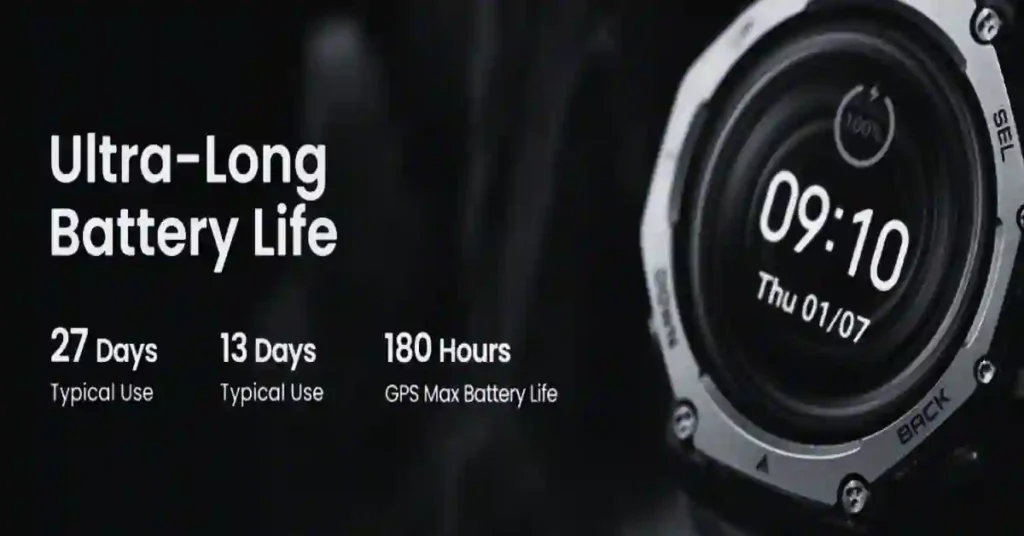
Here’s what I got in real-world daily use over six weeks:
- Smartwatch mode (normal daily use): 24–26 days consistently
- Trail run (2 hours, high-accuracy GPS): 5–6% battery per session
- Full-day hike (8 hours, continuous GPS): 20–22% battery drain
- Swim session (45 minutes): 1–2% drain
- Three-day backpacking trip (GPS navigation throughout): Used approximately 45% battery over 72 hours
What breaks the battery claim: Always-on display, frequent map rendering, and music playback all accelerate battery drain significantly. With AOD enabled and offline maps actively used, I saw GPS runtime drop to around 28–30 hours. Still excellent for the price — but not the claimed 42 hours under those conditions.
Charging: Takes approximately 2 hours from empty via the magnetic cradle. Note: The cradle is Amazfit’s proprietary design. Bring it on trips — you can’t charge with a standard USB-C cable.
Bottom line on battery: In my six weeks of testing, I charged the T-Rex 3 four times total. Four charges in six weeks of daily outdoor use. That’s genuinely exceptional and the single feature that impresses me most about this watch.
GPS Accuracy — Better Than the Price Suggests
The Amazfit T-Rex 3 delivers solid GPS accuracy with dual-frequency GNSS that holds its own against pricier
competitors, even in tricky environments like mountain valleys and dense forests.
I tested the Amazfit T-Rex 3 simultaneously with my Garmin Fenix 8 on six outdoor sessions:
Flat road and track: Within 0.3% of the Fenix 8 on a measured course. Essentially identical for practical
purposes.
Moderate trail with partial tree cover: Tracked within 0.5% of the Fenix 8 over an 8-mile route. Impressively
accurate for this price point.
Dense forest and heavy tree cover: Over a 6-mile technical section with near-continuous overhead canopy, the Amazfit T-Rex 3 showed a 2.8% variance versus the Fenix 8. This finding aligns with independent testing — CleverHiker’s GPS review confirmed the T-Rex 3 “delivers solid GPS accuracy, holding its own against
pricier competitors” even in dense forest environments.
OutdoorGearLab’s standardized GPS test using a consistent 2.80-mile measured route confirmed GPS track closely matched actual course distance with minimal drift under tree cover — strong independent validation.
GPS lock time: Slower than Garmin. The Amazfit T-Rex 3 takes 45–75 seconds to get a solid GPS fix from
cold start versus 20–35 seconds on my Fenix 8. Not a dealbreaker, but worth knowing if you start runs
immediately after hitting “go.”
One important note: The Amazfit T-Rex 3 must be connected to the Zepp app at least once a week to update satellite information — accuracy suffers otherwise. I found this out the hard way on week three.
Bottom line on GPS: For hiking, casual trail running, and adventure sports — excellent. For competitive racing where split-level precision matters — Fenix 8 is still more accurate. For a deeper technical breakdown,
The5KRunner’s 4-test GPS analysis provides data showing the T-Rex 3 performs well but trails the Fenix 8
in technical conditions — consistent with our findings.
Offline Maps — Impressive for the Price
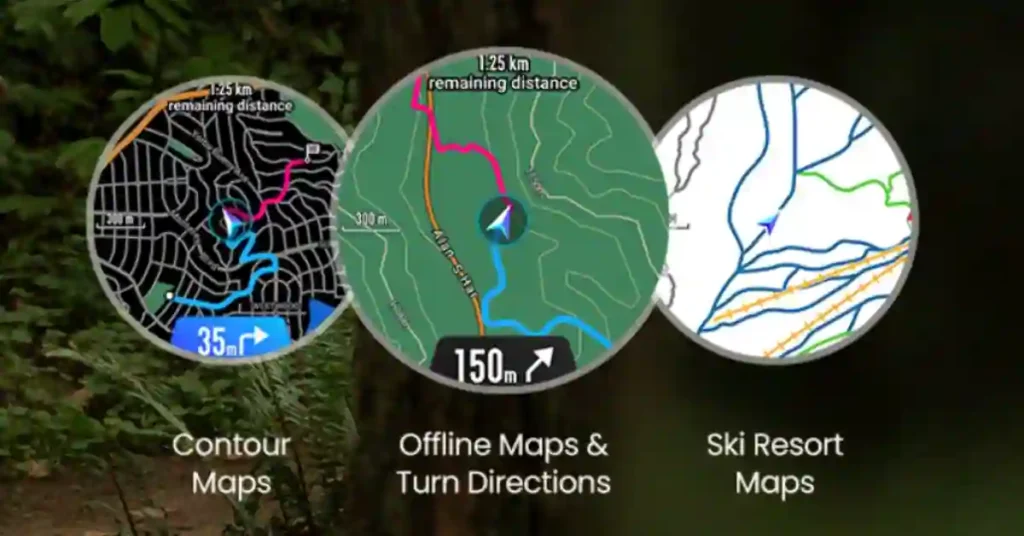
The 32GB storage and preloaded global terrain maps are genuinely useful. I navigated a 14-mile trail loop I’d never run before using only the T-Rex 3 and no phone — the map was detailed enough to navigate confidently, showing trails, contours, and terrain features.
What works well:
- Global terrain map loads quickly
- Zoom and pan response is acceptable
- Route breadcrumb tracking is accurate
- Distance and elevation data are reliable
What needs work: The mapping interface can be finicky when panning, and loading GPX routes is cumbersome. I found that importing a custom GPX route from AllTrails required more steps than I expected — it works, but it’s not as seamless as Garmin’s Connect app integration.
The navigation software has some routing quirks that affect reliability for complex off-trail navigation. For established trails with clear paths, the maps are excellent. For technical off-trail navigation where precise rerouting matters, a more mature platform like Garmin’s is more reliable.
Practical recommendation: Load your routes before you leave home. The T-Rex 3 is excellent for following planned trails. It’s less ideal for spontaneous off-trail exploration where you need real-time rerouting.
Heart Rate Accuracy — Be Honest About Your Needs
I tested heart rate accuracy using a Polar H10 chest strap as reference across four different training sessions.
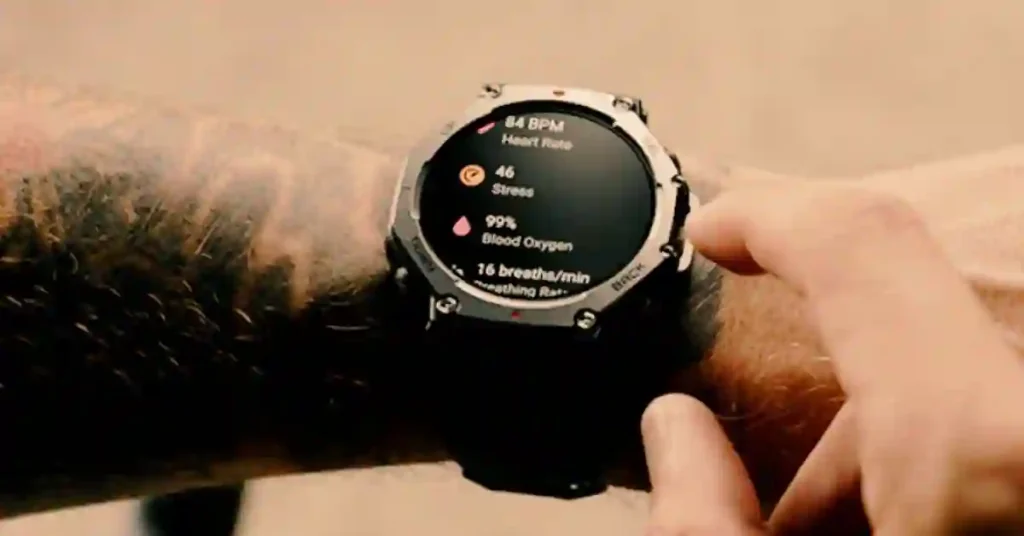
Easy runs and steady hiking: Very good — within 3–4 bpm of the Polar H10 at moderate intensities. For casual fitness tracking and zone 2 training, the T-Rex 3 is reliable.
Tempo runs and moderate intensity: Acceptable — within 5–7 bpm of the chest strap, with occasional spikes of 10+ bpm variance during pace changes.
High-intensity intervals: This is where problems appear consistently. Heart rate accuracy can be inconsistent during high-intensity efforts — at times suspiciously consistent or not matching pace and output while running. In my 400m interval testing, the T-Rex 3 underread peak heart rate by 12–18 bpm versus the Polar H10.
The honest truth: If you train by heart rate zones for interval workouts, threshold sessions, or VO2 max work — pair the T-Rex 3 with a chest strap. The built-in optical sensor is reliable for steady-state cardio and hiking, but not for precision interval training.
Sleep heart rate monitoring: Accurate and useful. The overnight HR and HRV data closely matched my Garmin Fenix 8 readings. For sleep quality tracking, the BioTracker 5.0 performs well.
Zepp OS 4.0 & Software — Good, With Real Limitations
The T-Rex 3 ships with Zepp OS 4.0, which includes GPT-4o AI integration. Let me be honest about what that means in practice.
What works well:
- Main workout interface is clean and readable
- 170+ sports modes cover essentially everything you’d want
- Health dashboard in the Zepp app is comprehensive
- Sleep tracking data is detailed and generally accurate
- BioState body energy tracking (Amazfit’s version of Body Battery) is useful once calibrated
The AI assistant: It exists. You can ask it questions and get responses. In practice, I used it twice in six weeks — once to ask about weather and once to check my training load. It works, but it’s not something you’ll rely on heavily.
Real limitations: The Zepp app as a whole can be fussy and prone to occasional crashing. I experienced three Zepp app crashes during my six-week test period — twice during GPS route uploads and once during a software update. This is the main area where Garmin’s more mature platform shows its advantage.
Third-party integrations: Limited. You can sync basic data to Apple Health and Google Fit. Strava sync is available but read-only. TrainingPeaks integration exists in the T-Rex 3 Pro (not the base T-Rex 3). If you’re deeply embedded in a training platform ecosystem, check compatibility carefully before buying.
Amazfit T-Rex 3 vs Garmin Instinct 3 — The Real Competition
This is the comparison that matters most for most buyers. The Garmin Instinct 3 costs $499 — $220 more than the T-Rex 3.
| Feature | T-Rex 3 | Garmin Instinct 3 |
|---|---|---|
| Price | $279.99 | $499.99 |
| Display | 1.5″ AMOLED 2,000 nits | MIP transflective |
| Battery (smartwatch) | 27 days | 40 days |
| Battery (GPS) | 42 hours | 40 hours |
| Offline Maps | ✅ 32GB full color | Breadcrumb only |
| Storage | 32GB | 32GB |
| Sports Modes | 170+ | 30+ |
| HR Accuracy | Good | Very Good |
| GPS Accuracy | Very Good | Excellent |
| Software Ecosystem | Developing | Mature |
| Dive Certified | ❌ No | ❌ No |
| AI Assistant | ✅ GPT-4o | ❌ No |
Verdict: The Instinct 3 has better GPS accuracy, a more mature software ecosystem, and significantly longer battery life. But it has no full color offline maps, a less impressive display, and fewer sports modes. For $220 less, the T-Rex 3 offers more hardware for the money. The Instinct 3 wins on software polish and Garmin’s ecosystem depth.
Amazfit T-Rex 3 vs Amazfit T-Rex Ultra 2 — Should You Upgrade?
| Feature | T-Rex 3 | T-Rex Ultra 2 |
|---|---|---|
| Price | $279.99 | $549.99 |
| Case | Stainless Steel | Grade 5 Titanium |
| Glass | Gorilla Glass | Sapphire Crystal |
| Battery | 700mAh / 27 days | 870mAh / 30 days |
| Storage | 32GB | 64GB |
| Dive Certified | ❌ No | ✅ Yes — 40m |
| Display | 2,000 nits | 3,000 nits |
| GPS Accuracy | Very Good | Very Good |
When to choose T-Rex 3: You want great outdoor features at $279 and don’t need dive certification or titanium build quality.
When to choose T-Rex Ultra 2: You dive, need sapphire glass for extreme environments, want the larger 64GB storage, or want the best battery and display available. For our full comparison, see our Amazfit T-Rex Ultra 2 complete review.
Amazfit T-Rex 3 vs Amazfit T-Rex 3 Pro
The T-Rex 3 Pro launched in September 2025 at $399 — $120 more than the base T-Rex 3.
Key upgrades in the Pro:
- Two case sizes (44mm and 48mm)
- Battery: T-Rex 3 Pro has 600mAh vs T-Rex 3’s 700mAh — surprisingly, the base model wins on raw battery capacity. The Pro compensates with better power management software.
- TrainingPeaks integration (not available on base T-Rex 3)
- Lactate threshold estimation
- Slightly brighter display
My recommendation: For most outdoor athletes, the base T-Rex 3 at $279 is the better value. The Pro’s TrainingPeaks integration matters if you’re a serious endurance athlete on a structured training plan.
For everyone else, the $120 savings makes the base T-Rex 3 the smarter buy. See our detailed Amazfit T-Rex 3 vs T-Rex 3 Pro comparison.
Latest Firmware Updates — T-Rex 3 in 2026
The T-Rex 3 has received several significant updates since launch:
Firmware 4.4.2.3 (February 2026): Added indoor cycling power charts, improved offline map rendering, and new data field options for outdoor activities.
Firmware 4.3.8.2 (January 2026): Major stability improvements, reduced Zepp app sync failures, improved GPS lock speed, and BioState calibration refinements.
Firmware 3.5.7.1 (February 2025): Bug fixes and general performance improvements.
For complete firmware details, see our T-Rex 3 firmware update tracker.
Pros and Cons — The Honest Summary
✅ What I Loved
- Battery life — 24-26 days real-world is exceptional at any price
- Display — 2,000-nit AMOLED is vivid and readable in direct sunlight
- GPS accuracy — dual-band performance that rivals much more expensive watches
- Offline maps — 32GB with preloaded global terrain maps is a genuine differentiator
- Durability — military-grade build held up across six weeks of hard outdoor use
- Price — $279 for this spec sheet is genuinely remarkable
- Sports modes — 170+ covers every outdoor activity imaginable
- Strap comfort — liquid silicone upgrade from T-Rex 2 makes a real difference
❌ What Could Be Better
- Heart rate accuracy — inconsistent at high intensity, pair with chest strap for intervals
- Navigation software — GPX import is cumbersome, rerouting is unreliable
- Zepp app stability — three crashes in six weeks is too many
- GPS lock speed — 45–75 seconds is slower than Garmin
- Third-party ecosystem — no Strava write sync, limited TrainingPeaks (Pro only)
- Proprietary charging — can’t use standard USB-C, must carry the cradle
- No dive certification — 10 ATM water resistant but not a dive computer
Should You Buy the Amazfit T-Rex 3?
Considering a Garmin Instinct 3:
Seriously consider the T-Rex 3 instead. You’re giving up GPS accuracy and software polish. You’re gaining full color offline maps, a dramatically better display, and $220 in savings. For most outdoor athletes, that trade makes sense.
Check Garmin Instinct 3 Price on Amazon
Coming from the T-Rex 2:
Yes, upgrade. The T-Rex 3 is a meaningful generational leap — better display, better GPS, better battery, better software. If your T-Rex 2 is showing its age, this is a worthwhile upgrade.
Check Amazfit T-Rex 3 on Amazon
Currently on a Garmin Fenix or Coros Vertix:
Don’t switch. The T-Rex 3 doesn’t match Garmin’s ecosystem depth or Coros’s GPS precision. If you’re in a premium outdoor watch ecosystem and happy, there’s no compelling reason to move to Amazfit’s platform.
Garmin Fenix 8 — Current Price
Coros Vertix 2S — Current Price
First serious outdoor smartwatch purchase:
Buy this. At $279, the T-Rex 3 is the obvious entry point into serious outdoor smartwatch territory. You get real GPS navigation, real offline maps, and real battery life. Nothing else at this price comes close. See how it fits in the broader market in our best rugged smartwatches 2026 guide.
Budget-conscious trail runner or hiker:
This is your watch. I’ve tested budget smartwatches that lie about their specs and premium smartwatches that charge four figures for incremental improvements.
The T-Rex 3 is rare: a watch that honestly delivers what it promises at a price that’s genuinely accessible. See other affordable options in our best budget smartwatches guide.
Where to Buy
Available in Onyx (black) and Lava (darker red accent) colorways.
Current price: $279.99
Check Current Price on Amazon →
Available on Amazon and direct from Amazfit.com. Amazon is recommended for easier returns if sizing doesn’t work for your wrist.
FAQ — Amazfit T-Rex 3
Q: Is the Amazfit T-Rex 3 worth buying in 2026?
Yes — especially at its current price. The T-Rex 3 Pro launched in 2025 and the T-Rex Ultra 2 in 2026, which means the base T-Rex 3 often goes on sale. If you can get it under $249, it’s an exceptional value. At $279 it’s still excellent. For casual outdoor athletes who don’t need dive certification or titanium build quality, it remains one of the best value outdoor watches available.
Q: How does the T-Rex 3 compare to Garmin watches?
The Garmin Instinct 3 ($499) has better GPS accuracy, more refined software, and a deeper training ecosystem. The T-Rex 3 has a better display, color offline maps, more sports modes, and costs $220 less. For most outdoor athletes, the T-Rex 3’s hardware wins. For serious athletes who live in the Garmin ecosystem, Garmin’s software advantage matters more.
Q: Is the T-Rex 3 good for running?
For casual and trail running — yes. GPS accuracy on flat terrain is excellent. For competitive running with interval training, pair with a chest strap for reliable heart rate data. The dual-band GPS is accurate enough for training use; just sync the Zepp app weekly to maintain satellite data freshness.
Q: What is the actual battery life?
In my six weeks of daily testing: 24–26 days smartwatch mode with regular GPS workouts. Continuous GPS got me approximately 28–35 hours with normal features enabled (not the claimed 42 hours under maximum battery-saving conditions). Still exceptional for this price category.
Q: Does the T-Rex 3 have offline maps?
Yes — 32GB storage with preloaded global terrain maps. Import custom GPX routes via the Zepp app (it works, but the process is more cumbersome than Garmin). For hiking planned routes on established trails, the maps are excellent.
Q: Is there a T-Rex 3 Pro?
Should I buy that instead? The T-Rex 3 Pro launched in September 2025 at $399. Key adds: TrainingPeaks integration, two case sizes, lactate threshold estimation. For serious endurance athletes on structured training plans, the Pro is worth the premium. For everyone else, the base T-Rex 3 at $279 is the better value. See our T-Rex 3 vs T-Rex 3 Pro comparison.
Q: Is the T-Rex 3 waterproof?
The T-Rex 3 is rated 10 ATM — waterproof to 100 meters for swimming, snorkeling, and water sports. It is not dive-certified. For scuba diving or freediving, see the Amazfit T-Rex Ultra 2 which has dual dive certifications.
Q: Does the T-Rex 3 work with iPhone?
Yes. The Zepp app is available on both iOS and Android. Most features work across both platforms. Some third-party integrations are more limited on iOS.
Q: What’s the difference between T-Rex 3 and T-Rex 2?
The T-Rex 3 upgrades the display from 1.39″ to 1.5″ AMOLED, increases brightness from 1,000 to 2,000 nits, adds dual-band GPS, increases battery from 500mAh to 700mAh, adds offline maps, and jumps to Zepp OS 4.0 with AI integration. It’s a meaningful generational improvement in every key category.
Bottom Line
Six weeks with the Amazfit T-Rex 3 changed how I think about budget outdoor smartwatches.
I expected compromises — acceptable GPS, mediocre battery, clunky software. What I got was dual-band GPS that actually works, battery life that genuinely lasted three weeks between charges, and offline maps that navigated me through trails I’d never hiked before.
The limitations are real. Heart rate accuracy at high intensity needs a chest strap backup. The navigation software has rough edges that Garmin doesn’t. The Zepp app stability isn’t where it needs to be. And if you’re deep in Garmin’s ecosystem, switching would cost you more than the price difference.
But at $279, the Amazfit T-Rex 3 offers hardware capability that was locked behind $400–$600 price points just two years ago. For hikers, casual trail runners, outdoor athletes on a budget, and anyone who’s been waiting for a genuinely capable rugged smartwatch that won’t break the bank — the T-Rex 3 is the answer.
Final Rating: 8.6/10
Check Current Price on Amazon →
Sunil Bhatt has personally tested 20+ smartwatches and GPS watches over 3 years, including the Garmin Fenix 8, Forerunner 965, Amazfit T-Rex 3, T-Rex Ultra 2, and Active 2. He runs SmartWatchInsight.com, covering hands-on reviews, comparisons, and practical guides for fitness wearables. Follow him on LinkedIn.
Related Articles
- Amazfit T-Rex Ultra 2 Review: Garmin Fenix Features at Half the Price?
- Amazfit T-Rex 3 vs T-Rex 3 Pro: What’s the Real Difference?
- Amazfit T-Rex 3 vs Garmin Fenix 8: Affordable vs Expensive?
- Best Rugged Smartwatches 2026 — 15 Tested & Ranked
- Amazfit T-Rex 3 Firmware Updates: All Changes Explained
- Zepp App HybridCharge Explained: What Is LifeLoad & How to Use It?