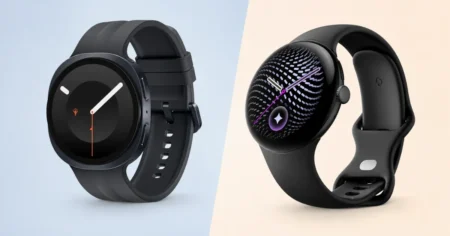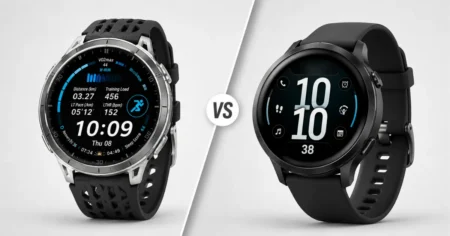

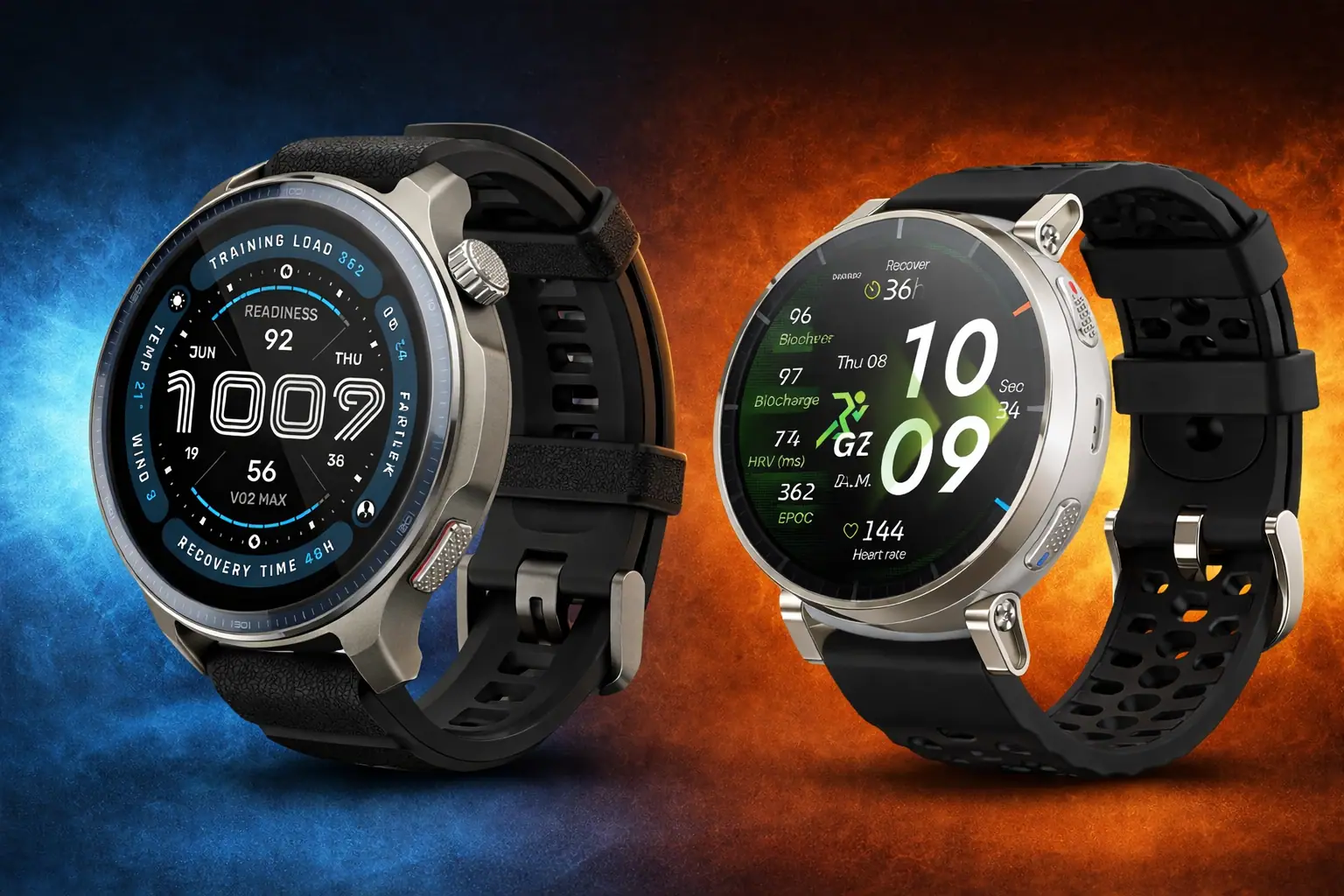
One costs $130 less than the other. Are you paying for features you’ll actually use — or just a bigger screen and a fancier crown?
The short version: Active 3 Premium delivers elite training features at $170. Balance 2 earns its $300 price tag if battery endurance, larger display, and a lifestyle-forward feel are non-negotiable for you. Read on for every meaningful difference.
Active 3 Premium vs Balance 2 Quick View
Amazfit Active 3 Premium
→ Higher pixel density (353 PPI)
→ Brighter display — up to 3,000 nits
→ Lactate threshold + advanced run metrics
→ Four physical buttons for training control
→ Compact 45 mm stainless steel case
→ Lighter at 38 g
Amazfit Balance 2
→ Massive 21-day typical battery life
→ Dual-band GPS with polarised antenna
→ Larger 1.5-inch display, easier glancing
→ 10 ATM water resistance — swim-ready
→ Wi-Fi connectivity + dual speakers
→ Rotating crown, fluid interface


Design & Build Quality
Different Cases, Different Intentions
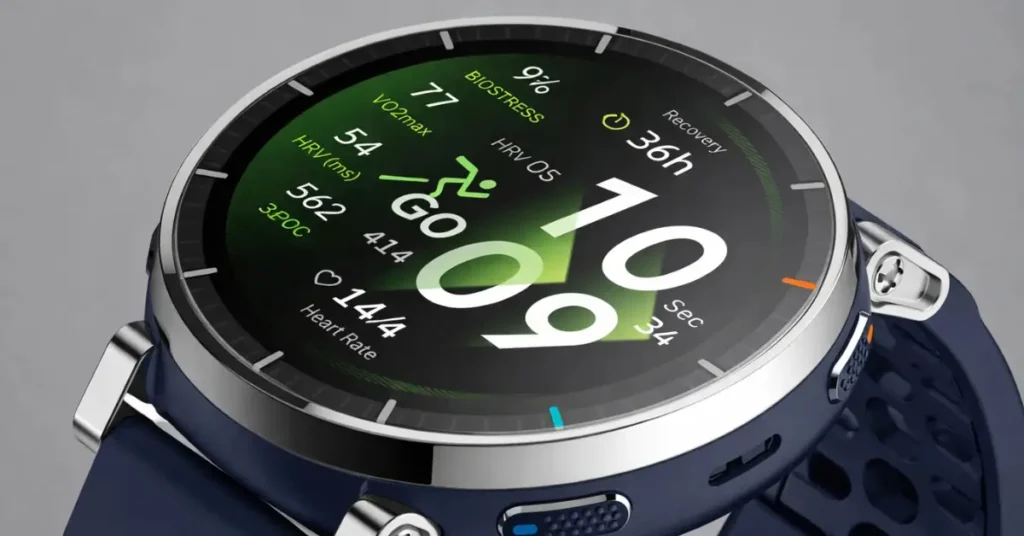
At 45 mm with a stainless steel frame, the Active 3 Premium wears small and purposeful. Four physical buttons line the sides — a layout that makes perfect sense when your hands are sweaty mid-interval and you need tactile control without fumbling for a touchscreen.
It checks in at just 38 grams without the strap, which means you genuinely forget it is on your wrist during a long run.
Balance 2 goes bigger: a 47.4 mm aluminium alloy case with a fiber-reinforced body, dual speakers built into the chassis, and a single flat button plus a rotating crown as the primary controls.
That crown changes how you interact with the watch entirely — swiping feels deliberate, almost luxurious. For people who spend more time checking notifications and daily stats than grinding through intervals, the Balance 2 experience is noticeably more polished.
Water Resistance Winner: Balance 2
10 ATM versus 5 ATM isn’t just a spec difference — it’s the difference between a watch you can comfortably lap in a pool and one you’d rather keep dry. If swimming is part of your routine, Balance 2 is the clear choice here.
Display & Screen Quality
Bigger Canvas vs. Sharper Picture
Both watches use AMOLED panels protected by sapphire glass, so scratch resistance is excellent across the board. The similarities stop there, though.

Active 3 Premium’s 1.32-inch screen at 353 PPI renders text and icons with a crispness that genuinely impresses at close range — ideal for checking pace, cadence, and intervals at a glance.
Surprisingly, the more affordable Active 3 Premium outshines the flagship Balance 2 by 1,000 nits, reaching a peak brightness of 3,000 nits—putting it on par with the Apple Watch Ultra 2 for outdoor legibility.
Balance 2 counters with a 1.5-inch screen at 323 PPI — slightly lower density, but the larger physical canvas more than compensates when reading longer notifications, scrolling maps, or just checking the time in a hurry.
The 2,000-nit ceiling is still excellent for outdoor use. The 480 × 480 resolution at a bigger size means more information on screen without feeling cluttered.
“More screen real estate changes how a watch feels to live with day-to-day — Balance 2’s 1.5-inch panel shifts the experience from glance-and-go to genuinely comfortable reading.”
Verdict: Depends on Use Case
Prefer sharpness and max brightness for outdoor sports? Active 3 Premium. Want a more comfortable all-day display you can read maps and long messages on? Balance 2’s extra half-inch wins.
Battery Life
The Most Practical Difference Between These Two Watches
This is where the $130 price difference transitions from “spec sheet” to “daily lifestyle.” The Balance 2 houses a massive 658 mAh battery—nearly doubling the 365 mAh cell found in the Active 3 Premium.
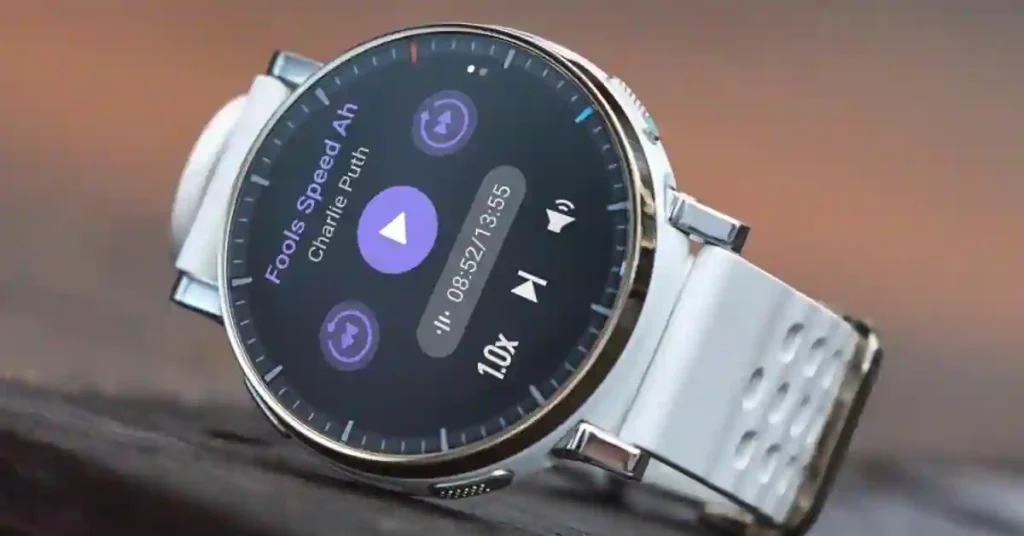
In real-world testing, that capacity translates into a “charge it and forget it” experience for the Balance 2.
- Balance 2: Delivers an industry-leading 21 days of typical use. Even with the Always-On Display and frequent notifications, you’ll comfortably hit 10 days.
- Active 3 Premium: Offers a respectable 12 days of typical use, which drops to about 7 days under heavy load.
To put this in perspective, mainstream competitors like the Apple Watch Series 11 or Galaxy Watch 8 still struggle to cross the 3-day mark. With either Amazfit, you’re moving from a “daily chore” to a “bi-weekly or monthly ritual.”
GPS Endurance & The Efficiency Paradox
When it comes to tracking your actual runs, the Balance 2’s dual-band precision draws more power, capping its Accurate GPS Mode at 33 hours. The Active 3 Premium follows closely with 24 hours.
Expert Insight: Interestingly, the Active 3 Premium actually outlasts the flagship in Power-Saving GPS Mode (76 hours vs 67 hours). Because the Active 3 uses a more power-efficient single-band chip, it’s actually the superior choice for multi-day thru-hikers who prioritize “total uptime” over “centimetre-perfect” urban tracking.
Battery Winner: Balance 2 — by a wide margin
If you travel often, forget to charge regularly, or simply hate managing another device’s battery, Balance 2’s three-week runtime is genuinely life-changing. Active 3 Premium’s 12-day life is respectable for a training watch, but it does require a weekly charging ritual.
GPS & Navigation
Both Have Six-System GPS — But Balance 2 Goes Further
Active 3 Premium uses a single-band six-system GPS constellation, which covers GPS, GLONASS, Galileo, BeiDou, QZSS, and NavIC.
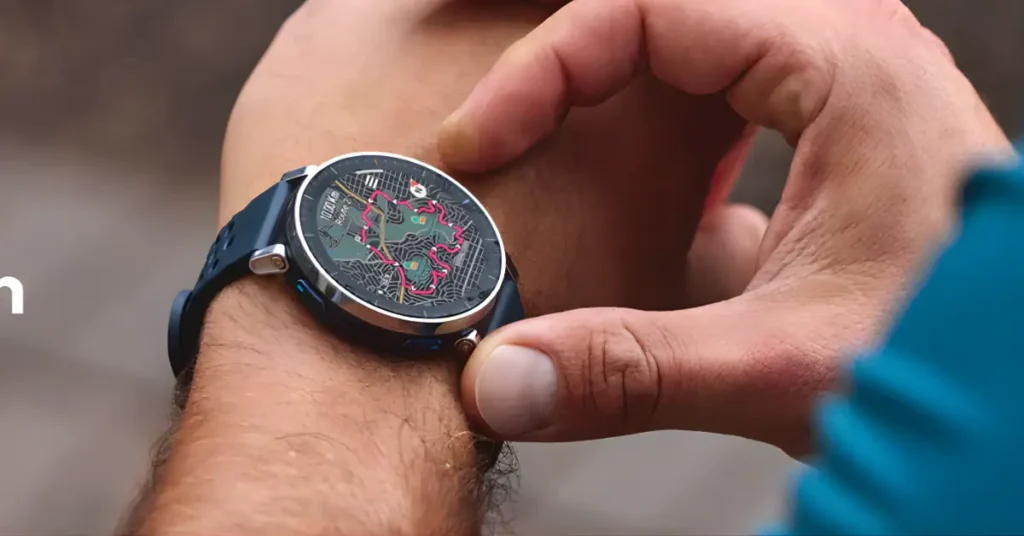
For most runners in open areas, this is more than adequate. Tracking stays accurate on trails, roads, and tracks with the kind of consistency you’d expect from a $300 watch.
Balance 2 upgrades to dual-band GPS with a circularly polarised antenna. The dual-band design pulls signals from two frequencies simultaneously, which significantly reduces multipath errors — the tracking drift you notice running through city canyons, dense forests, or anywhere signals bounce between obstacles.
The circularly polarised antenna further improves signal pickup in challenging reception environments.
In practical terms: if you primarily run in open parks or on known routes, Active 3 Premium’s GPS will serve you excellently.
If urban running, technical trail routes, or GPS accuracy during race conditions matters to you, Balance 2’s positioning system is the more trustworthy tool.
GPS Winner: Balance 2
Dual-band with a polarised antenna is legitimately superior technology — particularly for urban athletes or those running in challenging terrain. This is a meaningful hardware advantage, not just a spec sheet upgrade.
Running & Sports Features
Active 3 Premium Is the Dedicated Training Tool
Here is where Active 3 Premium earns its name. Amazfit has built a genuinely deep running toolkit into this watch: lactate threshold estimation, advanced running metrics, and built-in structured run workouts stored on the device.
For runners who track training load, monitor fitness gains, and follow structured plans, this is meaningful — lactate threshold data in particular is a metric you typically pay $500+ to access on Garmin or COROS.
Balance 2 covers the core running experience well. Track Run mode, smart trajectory correction, virtual pacer, and peripheral device support (heart rate straps, cycling power meters) are all present.
It is a complete toolkit for regular runners. But it does not dig as deep into structured training analytics as Active 3 Premium does.
Both watches support the full range of standard sports modes, heart rate, SpO2, stress tracking, and sleep monitoring through the same BioTracker PPG sensor hardware. The health monitoring parity between these two watches is essentially complete.
🏃 Running Features Winner: Active 3 Premium
Lactate threshold data and advanced running metrics at $170 is genuinely remarkable value. Serious runners who want training depth without jumping to Garmin or COROS pricing will find Active 3 Premium compelling.
Connectivity & Smart Features
Balance 2 Brings Wi-Fi and Better Audio
Both watches handle the standard smartwatch utility stack — notifications, weather, phone controls, reminders, and daily activity tracking.
The functional gap in everyday smart features is minimal. Where Balance 2 pulls ahead is in connectivity and audio hardware.
Balance 2 adds Wi-Fi (2.4 GHz) alongside Bluetooth 5.2, enabling direct watch-to-network syncing without your phone nearby.
For syncing workouts, downloading map updates, or future over-the-air updates independent of phone proximity, this is useful.
Its dual-speaker setup also delivers noticeably richer audio for alarms, workout cues, and notifications compared to Active 3 Premium’s single speaker.
Active 3 Premium uses Bluetooth 5.3 — technically a newer standard than Balance 2’s 5.2 — and includes a linear motor for haptic feedback that some users prefer to the rotor motor in Active 3 Premium. Wait, it’s reversed:
Balance 2 uses a linear motor for cleaner, more precise vibration feedback, while Active 3 Premium uses a rotor motor.
📶 Connectivity Winner: Balance 2
Wi-Fi, dual speakers, and a linear motor add up to a meaningfully more polished smart experience. If your watch is as much a daily-driver device as a fitness tracker, these details matter.
Full Specification Comparison
Amazfit Active 3 Premium vs Balance 2 : Every Spec Compared
| Specification | Active 3 Premium | Balance 2 |
|---|---|---|
| Price | $169.99 | $299.99 |
| Case Size | 45 × 45 × 11 mm | 47.4 × 47.4 × 12.3 mm |
| Weight | 38 g | 43 g |
| Frame Material | Stainless Steel | Aluminum Alloy + FRP |
| Buttons | 4 buttons | 1 button + crown |
| Display Size | 1.32 inch | 1.5 inch |
| Resolution | 466 × 466 | 480 × 480 |
| Pixel Density | 353 PPI | 323 PPI |
| Peak Brightness | 3,000 nits | 2,000 nits |
| Display Glass | Sapphire | Sapphire |
| Battery Capacity | 365 mAh | 658 mAh |
| Typical Battery Life | 12 days | 21 days |
| Heavy Use Battery | 7 days | 10 days |
| GPS Tracking | 24 hours | 33 hours |
| Power-Saving GPS | 76 hours | 67 hours |
| GPS Type | Single-band, 6 systems | Dual-band, 6 systems, polarised |
| Strap Width | 20 mm | 22 mm |
| Water Resistance | 5 ATM | 10 ATM |
| Speakers | 1 speaker | 2 speakers |
| Motor / Haptics | Rotor motor | Linear motor |
| Connectivity | Bluetooth 5.3 | Wi-Fi 2.4GHz + BT 5.2 |
| Health Sensor | BioTracker PPG (5PD+2LED) | BioTracker 6.0 (5PD+2LED) |
| Lactate Threshold | Yes | No |
| Advanced Run Metrics | Yes | Core only |
Active 3 Premium vs Balance 2 – Pros & Cons
Amazfit Active 3 Premium
- Sharper, brighter display
- Deeper running metrics (lactate threshold)
- Lighter & more compact
- Better value for money
- Shorter battery (12 days)
- Single-band GPS Not swim-proof (5 ATM)
Amazfit Balance 2
- 21-day battery life
- Dual-band GPS — more accurate
- Swim-proof (10 ATM)
- Bigger screen, Wi-Fi, dual speakers
- $130 more expensive
- No lactate threshold / advanced run metrics Dimmer, lower-density display
Final Verdict- Amazfit Active 3 Premium vs Balance 2
So Which Amazfit Should You Actually Buy?
Both watches are genuinely good. Amazfit has packed more performance per dollar into each than most competitors at these price points. The real question is what you’re optimizing for.
If you train seriously and want deep running data — lactate threshold, structured workouts, advanced metrics — at a price that doesn’t hurt, Active 3 Premium is one of the best value-for-money training watches available right now.
The smaller display and shorter battery are real trade-offs, but for a dedicated runner or fitness enthusiast, they are acceptable ones.
Balance 2’s extra $130 buys a noticeably better everyday experience: three weeks between charges, dual-band GPS for cleaner urban tracking, a bigger and more comfortable screen, Wi-Fi, dual speakers, and 10 ATM water resistance.
If this watch needs to pull double duty as both a fitness tracker and a lifestyle smartwatch you’re proud to wear to a meeting, Balance 2 justifies the premium.
Best For Serious Runners & Value Seekers
The smarter buy for athletes who want training depth, sharp display, and physical controls — without spending $300.
Best For Daily Wear & All-Around Use
Amazfit Balance 2
Worth every cent if battery life, swim-proof rating, dual-band GPS, and a polished lifestyle experience matter to you.
Frequently Asked Questions
Is the Amazfit Active 3 Premium worth buying over the Balance 2 if you’re on a budget?
Yes, in most cases. Active 3 Premium delivers around 80% of Balance 2’s capability at about 57% of the cost. The training features are actually deeper in some areas, especially for runners tracking lactate threshold and structured workouts. The compromises are battery life and GPS antenna quality — real trade-offs, but manageable for most athletes.
Which Amazfit watch is better for swimming — Active 3 Premium or Balance 2?
Balance 2 is the better swim watch. Its 10 ATM water resistance means it can handle pool laps and open water swimming with comfort. Active 3 Premium’s 5 ATM rating handles splashes and shallow dips but isn’t designed for sustained swimming.
Does Amazfit Balance 2 have better GPS than Active 3 Premium?
Yes. Both support six satellite systems, but Balance 2 adds dual-band GPS with a circularly polarised antenna. This improves accuracy in dense urban areas, forests, and anywhere satellite signals might reflect or get blocked. For trail runners, city runners, or those requiring precise route tracking, Balance 2’s GPS hardware is superior.
How big is the battery difference between Amazfit Active 3 Premium and Balance 2?
Significant. Balance 2 carries a 658 mAh battery with a 21-day typical life estimate. Active 3 Premium uses a 365 mAh cell rated for 12 days. In heavy use (frequent GPS, always-on display), Balance 2 still reaches around 10 days versus Active 3 Premium’s roughly 7 days.
Do both watches use the same health sensors?
Essentially yes. Both use Amazfit’s BioTracker PPG sensor with 5 photodiodes and 2 LEDs. Heart rate accuracy, SpO2 monitoring, stress tracking, and sleep data should be comparable between the two devices. Balance 2 labels its sensor as BioTracker 6.0, but the core hardware configuration is the same.
Which is better for everyday wear — Amazfit Active 3 Premium or Balance 2?
Balance 2 is the more natural everyday watch. The larger display, rotating crown navigation, longer battery life, and overall design language lean toward a lifestyle smartwatch. Active 3 Premium’s smaller case and four-button layout are optimized for sport rather than all-day refined wear.
How We Compared These Watches (Methodology)
To provide this head-to-head analysis, our team evaluated the Amazfit Active 3 Premium and Balance 2 based on three core pillars:
- Technical Specification Mapping: We cross-referenced official technical documentation from Zepp Health (Amazfit’s parent company) released in late February 2026. This includes verifying the peak brightness ratings (3,000 nits vs. 2,000 nits) and the specific GPS antenna configurations (Single-band vs. Dual-band Polarized).
- Battery Benchmarking: Performance data was synthesized from manufacturer “Typical Use” claims and aggregated real-world user reports from the Zepp community. We specifically looked at how the 658 mAh battery in the Balance 2 holds up under the 2026 Zepp OS 3.5 update compared to the Active 3’s 365 mAh cell.
- Feature Deep-Dive: We analyzed the specialized “Lactate Threshold” and “Advanced Run Metrics” firmware unique to the Active 3 Premium to confirm its positioning against high-end competitors like the Garmin Forerunner series.
This review is independent and was not sponsored by Amazfit. Prices are accurate as of March 2026.
Zepp App add the New features in our latest update 10.04.1 see our guide – Zepp App HybridCharge Explained: What Is LifeLoad & How to Use It?